One Year Later, Mich. Police Officers Recall Race to Stop Church Gunman During Mass Shooting
What to Know
- Grand Blanc Township police officers recalled the split-second decisions, active shooter training and teamwork that helped stop a gunman during a 2025 attack on a Michigan church.
- Officers rescued trapped worshippers from the burning building, breaking windows and pulling children and adults to safety as smoke filled the church.
- A year later, responders say training, experience, heroic actions by civilians and a measure of luck helped prevent an even greater loss of life.
GRAND BLANC TWP., MI—Jason Carpentier stood watching flames consume the Church of Jesus Christ of Latter-day Saints when he borrowed a fellow officer’s phone and called his wife.
Moments earlier, the Grand Blanc Township police officer played a crucial role in stopping the gunman who crashed through the church, opened fire on worshippers and set the building ablaze.
As smoke billowed into the sky and devastation surrounded him, Carpentier broke down and delivered the following message over the phone: “The worst nightmare came true today.”
She immediately understood what he meant, and he wanted her to hear it from him before seeing it on the news.
It was at that moment when reality truly hit him.
Nearly a year after a gunman attacked the church on McCandlish Road on Sept. 28, 2025, the officers who rushed toward the danger still remember the small moments as clearly as the gunfire.
They remember a child’s hand pressed against a smoke-filled window and parents screaming for children.
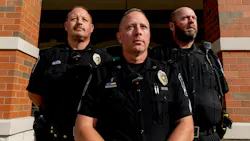
For Sgt. Tim Bueche, Carpentier and Officer Tom Whitt, each remembers more about the lives saved by instincts, training, quick decisions and ordinary people who became heroes.
Each of them thought the dispatch might be a misunderstanding when they first heard that shots were fired at a church.
Maybe someone was hunting nearby, Bueche thought.
But after the second call went out, it suddenly became real.
The dispatch
Carpentier was sitting in front of picketers near Henry Ford Genesys Hospital on Holly Road, facing north, about a mile and a half from the church.
He pulled over quickly before arriving to retrieve a rifle from the trunk of his patrol vehicle. He remembered feeling fear.
He ran through active shooter scenarios in his mind repeatedly during the minute drive to the church.
Carpentier could hear gunfire outside of the building, which provided him with a slight sense of relief, he remembered.
He felt better about an outdoor firefight than an indoor one and knew he wouldn’t have to clear the church alone.
As Carpentier rounded the west side of the building, he unexpectedly encountered a DNR conservation officer, Luke Robare, who was already moving toward the threat and issuing commands with his rifle drawn at the ready.
Seeing another armed officer also reduced the stress of the situation, knowing he was no longer facing the threat alone.
He saw the gunman, Thomas Jacob Sanford, about 50 feet away, holding his rifle with one hand near his head at an angle.
Sanford was moving toward Carpentier and Robare. He wasn’t complying with commands.
Carpentier, a husband and father of two teenage daughters, simply resorted back to his training.
“I was ready. I said, ‘You are going to have to make a decision, like right now? He’s not dropping the gun and he’s going to clear those cars.”
Within moments, the threat was stopped.
His first impression of the suspect wasn’t rage or panic, but his attention was consumed by the tactical reality unfolding in front of him.
Carpentier was dialed in to Sanford’s weapon, distance, cover and the fact that he continued advancing.
When Robare and Carpentier arrived, the gunman was outside because he had moved from the church building to the rear of the property where church members were gathering and fleeing.
“He was out back shooting at the people as they ran to their reunification point,” Bueche said.
The first concern upon arrival, Bueche said, was learning whether there was one shooter or multiple shooters.
He remembered hearing reports of a man carrying a gas can and thinking it made no sense, until he arrived and saw smoke.
“As soon as I pulled in, it clicked. Oh, like this is exactly why he has a can of gas.”
Rescue mission
Bueche realized this was more than just an active shooter scene.
It had the potential to be a mass-casualty event.
Police thought anywhere from 150-200 people could have been inside the building during the church morning service.
After checking on Carpentier, or as he called him “Carp,” Bueche went into problem solving mode — “See problem, fix problem.”
People were running in every direction, victims were lying on the lawn, wounded victims were being loaded into vehicles, and the church filled with smoke.
Bueche then phoned Chief William Renye, who was driving back from a vacation cottage in Michigan’s Thumb, delivering what he described as the worst news the chief had received in his career.
He remembered standing directly in the center of McCandlish Road when he made the call Renye will never forget.
Whitt remembered that Sunday as a beautiful, clear day before everything instantly changed.
He heard the call go out over the radio and suddenly thought back to active shooter training he previously taught in Grand Blanc schools.
By the time Whitt arrived, the gunman had been shot and first responders shifted to rescue efforts.
Whitt, with tears in his eyes, recalled seeing a child’s hand pressed against a window through thick smoke near the southwest corner of the building.
“I look up and I see a hand on a window. And it’s a little hand,” Whitt said.
He helped break the window open and began pulling children and adults from the burning church.
As they searched for survivors, officers encountered an unexpected obstacle: the very active shooter training that may have saved lives.
Churchgoers had barricaded doors throughout the church, preventing the gunman from accessing rooms.
One room was barricaded with a piano.
With smoke filling the building, those items slowed rescuers trying to reach people trapped inside.
“Officers were smashing windows out and stuff. And you’re kind of taught, like, hey, don’t open up fire scenes. It just feeds oxygen into it. But the dichotomy of that is there’s people and kids in there,” Bueche said.
He described the moment he saw Whitt and another officer rescuing people through a window as “energizing.”
Officers spread around the church and began “raking windows with rifles” searching for people who were trapped, Bueche said.
The sergeant estimated every window on the outside of the church was broken.
Tragedy hits home
It wasn’t until reviewing body camera footage in the days after that Whitt realized those people he pulled out of the window of the burning church had ties to his family.
Among them was the mother of his oldest daughter’s best friend from high school.
Whitt spent years as a school resource officer at Grand Blanc schools.
He knew many local families, students, and their parents, all affected by the attack.
“That’s where it hits home,” Whitt said.
Whitt’s first deep breath came moments after all police officers were pulled from the building due to increasing risk of smoke inhalation after rescue efforts stalled.
He broke down while standing alone in the parking lot, cried for no more than one minute, then returned to work.
In the hours after the gunfire stopped, Whitt’s role shifted from rescue to reassurance.
When church members arrived to retrieve vehicles and reunite with loved ones, he ferried families around the property and tried to provide comfort wherever he could.
Many people recognized him from his days in the district.
On what he called “their worst day,” Whitt said he hoped a familiar face, a smile or a few reassuring words could offer some relief.
A teacher later told him that the active shooter training he formerly preached had saved lives.
Each of the officers repeatedly mentioned memories of parents screaming that their children were still inside the burning church.
Bueche remembered a mother, standing nearby the hill where victims were being collected, yelling out, “My kids are in there.”
Officers said being unable to promise those children were safe was among the hardest parts of the incident.
They also recalled the heroic actions of Bridger Frampton, a parishioner who repeatedly entered the smoke-filled building helping others escape.
Frampton suffered severe smoke inhalation and was later later intubated at a hospital following his efforts, but officers credited him directly with saving lives.
Whitt and Bueche said Frampton became separated from his family when the shooting started but repeatedly entered to help others escape.
Frampton was there at the window with Whitt.
Whitt remembered staring at him and noticing something odd.
“I just remember looking at his teeth and thinking, what is wrong with his teeth?” he recalled.
Whitt thought it looked almost like he had been eating Oreo cookies.
Instead, soot from smoke inhalation had coated Frampton’s mouth.
Bueche returned the next two days, as leader of the incident command center while the situation continued to unfold.
He said he needed to be there and “see it through.”
On Sunday night, Bueche remembers passing the Grand Blanc Schools sign reading “GB Strong” on his drive home.
It was one of the first moments he allowed himself to process that day.
When he went home that night, investigators still didn’t know how many people might be inside the church.
He remembered going to bed fearing the death toll could be much higher.
He spent the following days helping coordinate logistics with ATF, FBI, MSP, and other agencies.
In the days following the incident, Bueche relied on his friend, Michigan State Police trooper Dennis McGuckin, to talk through the events in Bueche’s garage.
“If you bog yourself down on the why, I don’t know how you get out of a career doing this,” Bueche said, explaining why he avoids dwelling on the gunman’s actions.
Renye tasked Lt. Jon Swartz with overseeing the well-being of township employees in the aftermath of the attack, ensuring first responders and other staff received the support that they needed.
Swartz called Annette Hill, a therapist who worked with Oakland County Sheriff’s Office after the deadly 2021 Oxford High School shooting, for mandatory meetings and debriefs with family.
She arrived within 48 hours, ready to assist.
Her work culminated when officers walked through the scene days after it was cleared by investigators.
The counseling was critical in helping officers process the trauma, Renye said.
Looking back a year later, what sticks with the officers is how much worse the attack could have been.
At various points during the response, officers feared there could be dozens of people trapped inside the burning church.
They were hearing reports of children hiding in rooms, possible victims in a basement and people unaccounted for in the smoke.
Officers had briefly discussed the possibility of finding up to 16 victims once the fire was extinguished.
They each acknowledged the lives lost that day — Thelma Rina Armstrong, William Patrick “Pat” Howard, John Thomas Bond, Jr., and Craig Douglas Hayden.
The fact that additional fatalities were avoided, and everyone did what they were supposed to do was encouraging, Bueche said.
He was careful not to say the response was solely the result of great police work.
It was a combination of experience, training, and some luck, Bueche said.
Everyone on his shift had more than a decade of experience, with some officers with more than 20 years on the job.
Because of that, Bueche was confident that whoever arrived at the scene first would do what needed to be done.
Running into a DNR conservation officer at the scene was seen as a stroke of luck.
DNR officers rarely spend time in Grand Blanc Township, but Robare was driving home for lunch when he heard the dispatch.
The attack validated years of active shooter training, Renye, Bueche and the officers agreed.
In most dangerous situations, officers wait for backup before making contact. Active shooter incidents are one of the few exceptions.
Officers are trained to immediately move toward gunfire because every second increases the risk of losing innocent people.
When the shooting began at the church, Bueche said, officers fell back on that training without hesitation – a response they believe help saved lives.
“The good guys won that day,” Carpentier said.
____________
©2026 Advance Local Media LLC.
Visit mlive.com.
Distributed by Tribune Content Agency, LLC.