Why Realistic Police Training Can Still Produce Predictable Decisions
What to Know
- Training scenarios might unintentionally teach officers to expect a weapon or shooting outcome, causing them to recognize a familiar script rather than evaluate what is actually unfolding.
- Realistic training should test officers' ability to update decisions with new information, distinguish real threats from expected threats and adapt when dispatch information proves inaccurate.
- Research suggests decision-making and perceptual skills can be improved through varied, uncertainty-based training, but scenario realism, stress and qualification scores alone do not necessarily measure sound judgment in the field.
Editor's note: This is the second installment of a two-part series. Check out Part 1.
In Part One, The Threat Before the Threat: How Dispatch Primes the Officer's Brain, I examined how information received before an encounter can influence what officers anticipate, which cues attract their attention and how they interpret an ambiguous movement. Paul Taylor's simulator experiment demonstrated just how consequential that prearrival information can become: Officers incorrectly warned that a subject might have a gun fired at his cellphone presentation far more often than officers who received accurate information (Taylor, 2020). But the conclusion raised a question that deserves considerably more attention than it received in that first installment. If a radio transmission can establish an expectation before the officer arrives, what role do years of firearms and scenario-based training play in shaping the patterns through which that expectation is interpreted?
Consider an officer completing a dozen force-on-force exercises during an agency training cycle. Each scenario begins differently, with a disturbance at a residence, a suspicious person near a vehicle or a report of an armed subject in a public place. The settings change, as do the role-players and the reasons for police involvement, but the underlying sequence is remarkably consistent. A warning suggests that someone may be armed, the officer makes contact, the subject becomes increasingly confrontational and, at a predictable point, a weapon appears. The officer responds with a well-rehearsed defensive action, achieves the required hits and receives an approving critique. By the end of the day, the instructor has documented a succession of successful performances, and the student understandably leaves believing the training was productive.
It may have been productive. The officer might have improved communication, positioning, control of the muzzle and the ability to perform under pressure, all of which are legitimate instructional objectives. But the same exercises may also have communicated an unintended lesson: When dispatch warns of a weapon, the subject will eventually present one, and the officer's principal responsibility is to recognize the familiar moment when the shooting starts. What appears to be a series of varied scenarios may actually be repetition of a single decision with different scenery. If the outcome is already embedded in the script, the learner may become proficient at anticipating the exercise rather than discovering what the unfolding encounter requires.
The Lesson We Never Wrote Into the Curriculum
Every training scenario teaches more than the instructor's stated objective. The role-player's tone, the dispatch narrative, the time available before escalation, the objects placed in the environment and the consequences of the student's decisions all contribute to the experience from which the learner extracts patterns. An instructor may intend to teach effective movement toward cover or proper trigger management, while the student also learns that a particular warning predicts a particular outcome. None of this requires a poorly designed curriculum or an incompetent instructor. It reflects a basic property of learning: People do not absorb only the facts we announce or the movements we demonstrate. They also learn relationships among the events they repeatedly experience.
Gary Klein's recognition-primed decision-making model provides a useful framework for understanding why such relationships can become influential. Experienced decision-makers recognize patterns that resemble previous situations, anticipate developments and identify workable courses of action without comparing every possible alternative (Klein, 1993). That capacity is invaluable in police work because deliberate analysis is not always possible when conditions change quickly. Yet recognition works best when the learned pattern fits the present circumstances, and a superficial resemblance can create confidence in an interpretation that overlooks a critical difference. The issue is not whether recognition-based judgment is desirable, but whether training has provided officers with sufficiently varied experiences to distinguish meaningful threat indicators from incidental features that happened to accompany threats during earlier exercises.
This is where the findings discussed in Part One become especially uncomfortable. Taylor (2020) experimentally demonstrated that inaccurate prearrival information influenced shooting decisions in one simulator setting, but his study did not establish that predictable training caused the errors. The proposed connection between repetitive scenario design and dispatch-driven expectations is therefore a hypothesis grounded in established principles of learning and perception, not an already proven causal explanation for real-world shootings. That limitation should be stated plainly, because a scientifically defensible argument does not become stronger by claiming more than the evidence can support. It becomes stronger when we identify a plausible vulnerability, explain the mechanism, and design assessments capable of determining whether the vulnerability actually exists.
When Realism Becomes a Rehearsed Answer
Police trainers have made enormous progress in moving beyond static qualification courses. Protective equipment, marking cartridges, dynamic role-players, realistic environments and increasingly sophisticated simulation technologies can expose officers to demands that a paper target cannot reproduce. Those developments are valuable, but it is possible to confuse physical resemblance with cognitive realism. A darkened hallway, a loud confrontation and a role-player wearing ordinary street clothes may look convincingly operational while still presenting a completely predictable decision. If every training problem eventually produces an attacker, the student may be learning when to expect the attack rather than how to determine whether one is occurring.
The problem becomes even more apparent when the instructor unintentionally reveals the answer before the exercise begins. Announcing that the next evolution is a deadly-force scenario, distributing only marking-cartridge pistols, or placing students in a queue where everyone can hear the previous confrontation can supply cues that would not exist during an ordinary police response. The student knows a gunfight is coming because the class has been organized around producing one. Even a well-intentioned instructor may reward that expectation by praising rapid engagement while overlooking whether the student continued evaluating the evidence as the situation developed. Successful performance under those conditions may demonstrate competence at a rehearsed task without establishing the same level of competence when the threat is uncertain.
One possible consequence is negative transfer, in which something learned in one setting interferes with performance when the situation changes. The term does not mean that familiar habits are inherently harmful, because repeated practice is essential to developing reliable skills. It describes the risk that a previously useful relationship between a cue and a response will be applied where the relationship no longer holds. In firearms training, the concern is not that an officer learned to respond to a weapon presentation, but that the officer may also have learned to treat the mere expectation of a weapon as though the presentation has already occurred. Research on practice and transfer establishes the broader vulnerability, while its specific role in dispatch-related shooting errors remains a question for direct testing (Barnett & Ceci, 2002; Schmidt & Bjork, 1992).
An ethnographic study by Jessica Katzenstein (2025), published in Cultural Anthropology, examined police scenario training and the way officers were taught to anticipate future danger. Her analysis described how some exercises encouraged what she called "thinking threat first," emphasizing possible violent outcomes as officers interpreted current circumstances. This was interpretive field research, not an experiment establishing that scenario training caused unjustified force, and its observations should not be generalized to every police academy. Nevertheless, the study raises a legitimate instructional concern: When a scenario continually directs attention toward the worst event that might happen next, how well does it cultivate the equally important skill of assessing what is happening now?
There is a necessary distinction between preparing for danger and presuming it. Officers must recognize an immediate deadly threat and respond decisively when the law and circumstances justify it, and a training program that concentrates exclusively on peaceful outcomes would be just as unrepresentative as one that guarantees a gunfight. An accurate weapons report may provide essential preparation, while an apparently routine call may become dangerous without warning. The objective is therefore neither to make officers suspicious of every dispatch nor to teach them that weapon reports are usually wrong. It is to preserve their capacity to update an assessment as new evidence arrives, even when that evidence conflicts with the original narrative or with a pattern learned during previous training.
A Good Score Is Not Necessarily Durable Learning
Much of conventional firearms training is organized around outcomes that are easy to document. We can count hits, measure elapsed time, record a qualification score and determine whether the student executed a required sequence. Those measures are useful, but they reveal only a portion of the performance required during an actual encounter. A student may shoot accurately after a familiar threat cue without having been required to discriminate between a weapon and a harmless object, reconsider an inaccurate dispatch or decide that no force is justified. The performance is observable and perhaps impressive, while the crucial decision-making capability remains largely untested.
Soderstrom and Bjork (2015) drew an important distinction between performance during practice and learning that remains available later. Improvements visible within a training session do not necessarily demonstrate durable retention or transfer to altered conditions, and instructional methods that make performance look smooth can sometimes produce weaker long-term learning. Schmidt and Bjork (1992) similarly argued that practice arrangements that maximize immediate success can be less effective for later performance than conditions requiring more effort and variability. That is not an argument for making training arbitrarily difficult. It is a warning that the ease with which a student completes a familiar exercise is an unreliable measure of readiness for an unfamiliar problem.
Barnett and Ceci (2002) further demonstrated why claims about training transfer require precision. Transfer depends upon the content being learned and the context in which it must later be used, including the environment, timing, people and demands of the task. An officer who can shoot accurately in a controlled scenario may possess a valuable skill, but we cannot assume that the same exercise established the ability to distinguish legitimate threats under different lighting, social conditions, dispatch information or uncertainty. The central issue is whether an instructor's evaluation measures the capability the agency actually needs or merely the student's proficiency in the specific task that the instructor repeatedly presented.
In Unlocking the Brain Code, I put the concern this way: "If the training environment does not demand perceptual discrimination and rapid decision-making, those capacities cannot develop fully" (Hanson, 2026, p. 151). That statement does not diminish the importance of foundational mechanical training. Grip, muzzle management, safe manipulation, recoil control and accurate fire remain indispensable, and early learners often benefit from relatively stable conditions while acquiring those skills. The limitation appears when instructors mistake mechanical improvement for evidence that the student has also developed the perception, judgment and adaptability required to select the appropriate response. The target can tell us where a round went, but it cannot tell us whether the round should have been fired.
What the Police Training Research Actually Demonstrates
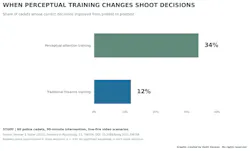
Research has begun to investigate whether perceptual and cognitive instruction can improve firearms decision-making, although the findings are more specific than the promises sometimes made on behalf of realistic training. Heusler and Sutter (2022) evaluated 60 German police cadets who completed pretests, 90 minutes of training and posttests using live-fire, video-based shoot and don't-shoot scenarios. One group received instruction emphasizing tactical gaze control, situational awareness and visual attention, while the comparison group practiced more conventional marksmanship skills. The intervention group showed greater improvement in correct decisions during shoot scenarios, with 34% improving from pretest to posttest compared with 12% in the control group. However, the researchers did not find a statistically significant between-group advantage in improvement on don't-shoot decisions.
That qualification is critical. Improving an officer's ability to recognize a genuine threat does not automatically demonstrate an equal improvement in withholding fire when the object is harmless, and the two capabilities should not be casually combined into a single claim about decision-making. The study also revealed an intriguing difference in what the groups learned: The traditional group improved a conventional marksmanship measure, while the perceptual-training group demonstrated a relative advantage in the targeted shoot-decision outcome. Both results may be useful, but they represent different instructional achievements, and neither should be used to claim that a brief intervention has been proven to prevent mistaken shootings in the field (Heusler & Sutter, 2022).
Perhaps the most revealing detail for our discussion is buried in the researchers' methods rather than their headline result. To prevent participants from recognizing predictable patterns, Heusler and Sutter constructed 16 counterbalanced orders of shoot and don't-shoot scenarios, randomly assigned participants among those orders and inserted additional dummy scenarios that were excluded from the analysis. In other words, the researchers deliberately attempted to stop the experimental task from revealing its own answer (Heusler & Sutter, 2022). That design choice is extraordinarily relevant to police instruction because it recognizes that the order and predictability of exercises can themselves become sources of information. If researchers must account for that possibility when evaluating decision-making, instructors should be asking whether their own training environments inadvertently reward the very pattern recognition that the assessment is supposed to test.
Olma, Sutter and Sülzenbrück (2024b) extended this line of research in a preregistered experiment involving 45 experienced police officers. Their blended training approach combined instructional video with practical work emphasizing visual attention, situational awareness and gaze control. Participants already performed well on many decision measures, limiting the researchers' opportunity to show improvements in shoot/don't-shoot accuracy, but the intervention group showed advantages in response times and time to the first hit in shoot scenarios. A subsequent systematic replication involving 52 police cadets likewise found improvements in response measures without demonstrating a meaningful advantage in decision accuracy, partly because false-positive errors were absent in the tested scenarios (Olma et al., 2024a). These findings support the potential value of teaching perceptual strategies while reminding us that a ceiling effect can make an assessment incapable of distinguishing competent performance from genuinely improved judgment.
Recent research also suggests that the value of cognitive training may become more apparent when the problem is genuinely ambiguous. Espevik and colleagues (2026) evaluated a decision-making program involving 166 regular patrol and SWAT-type officers, using scenario exercises and structured debriefing to examine situational awareness and team behavior. The study found improvements in situational-awareness ratings, while the benefits for expert-rated team behavior among regular patrol officers appeared in ambiguous scenarios rather than nonambiguous ones. The investigators were not testing dispatch priming or a specific firearms qualification, so the results should not be treated as proof that a particular scenario formula reduces shooting errors. They do, however, illustrate why an assessment of judgment must contain actual uncertainty if it is intended to reveal how well officers manage uncertainty.
We should also resist the belief that a well-designed single day can accomplish everything a developmental training program requires. Di Nota and colleagues (2021) tested an abbreviated one-day intervention intended to develop physiological regulation and decision-making under stress, comparing 82 participating officers with 105 controls. Unlike more extensive versions of the approach, the shortened program produced no statistically significant improvements in lethal-force decision errors or the measured physiological outcomes immediately afterward or at follow-up. The study involved a particular intervention rather than a universal test of all short courses, and the 12-month follow-up had substantial attrition. Its lesson is nevertheless difficult to ignore: Scientific language and an appealing training design are not substitutes for evidence that the dosage, practice opportunities and assessment methods are sufficient to produce durable changes.
Stress Can Hide a Predictable Decision
This is also why the profession should be cautious about describing a training scenario as realistic merely because it produces elevated heart rates, fear or a vigorous physical response. In Part One, I discussed the differences between physiological arousal and the more complicated appraisal of danger, building on my earlier article, A Sprint Isn't a Gunfight. A role-player firing marking cartridges, an instructor shouting commands or a demanding physical evolution may create legitimate pressure, but none of those conditions guarantees that the student has been required to interpret an uncertain threat. If the learner already knows that the exercise ends with a shooting, additional intensity may simply make the rehearsed response more difficult to execute without making the underlying decision any less predictable.
Di Nota and Huhta (2019), examining complex motor learning in police training, argued for integrating realistic perceptual and decision-making demands with the development of skilled motor behavior. Guadagnoli and Lee's (2004) challenge-point framework likewise suggests that useful practice depends upon the relationship between task difficulty and the learner's current capabilities, not upon maximizing difficulty for its own sake. An overwhelmed novice may learn little from an impossibly complicated exercise, while an experienced officer may learn equally little from a high-intensity scenario whose answer is obvious from the outset. Effective progression requires instructors to manipulate the informational and physical demands of a task so that students must continually adapt while remaining able to learn from the experience.
The danger, then, is not stress itself but the combination of stress with predictable meaning. A student who has rehearsed a response many times may execute it very quickly under pressure, yet speed alone cannot establish that the student interpreted the situation correctly. What requires deliberate instruction is the ability to distinguish an action that signals a developing threat from one that merely resembles a familiar training cue. The goal is neither hesitation nor automatic engagement. It is timely, evidence-based action that remains responsive to the situation as it changes.
Teaching Officers to Update, Not Merely Anticipate
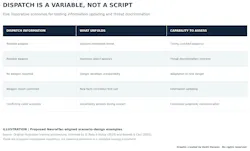
A useful starting point for redesigning scenario-based instruction is to treat the dispatch message as a variable rather than as an announcement of the exercise's predetermined outcome. Consider a series of encounters involving essentially the same setting and initial subject behavior. In one, the caller's report of a firearm is accurate and the person subsequently presents an immediate threat. In another, the warning is mistaken and the individual produces a harmless object. A third begins with a routine call that contains no weapons information but develops into a genuinely dangerous confrontation. A fourth includes a later dispatch correction that contradicts the original warning, while a fifth presents incomplete or conflicting accounts that must be evaluated as the officer approaches and makes contact. The objective across these variations is not to reward shooting or nonshooting as the preferred outcome, but to require officers to connect their decisions to the evidence available at each stage.
Those variations create different learning demands even when the officer's equipment and the physical environment remain unchanged. The accurate warning requires timely recognition and an appropriate response to a genuine threat, whereas the inaccurate warning tests discrimination and the ability to withhold an unjustified response. The unexpectedly developing threat challenges the assumption that an apparently routine dispatch guarantees safety. The corrected report tests whether incoming information can modify an existing expectation, while conflicting accounts require the officer to manage uncertainty without prematurely treating either interpretation as established fact. None of these scenarios should be constructed as a trick in which the instructor possesses secret information the officer could never reasonably obtain. The purpose is to evaluate whether the student uses the information that would actually be available to a similarly situated officer.
Crucially, there should be no easily discoverable sequence that makes the result predictable. A curriculum in which every other scenario is a don't-shoot exercise simply creates a new pattern to memorize, just as a class in which every dispatch mentioning a gun proves inaccurate teaches the wrong lesson in the opposite direction. The appropriate distribution of outcomes should be chosen with reference to the training objectives and, where reliable data exist, relevant operational conditions, rather than an arbitrary requirement that half the exercises end in deadly force. Instructors can introduce variations in the timing of updated information, the subject's ability to comply, the presence of bystanders and the officer's available options while retaining enough control to keep the exercises safe and assessable.
Interleaving these different information problems, returning to them through spaced practice and asking officers to explain which cues changed their conclusions can make retrieval more effortful than completing the same drill repeatedly. That extra effort should not be confused with pointless difficulty, because the instructional value comes from requiring the learner to select and adapt a response rather than merely repeat it. The relevant test is whether officers can use the learned distinctions later, after the immediate coaching and familiar scenario cues have been removed, an objective consistent with the learning-versus-performance distinction described by Soderstrom and Bjork (2015).
The role-player's behavior should also respond meaningfully to the officer's actions within defined training boundaries. A person who begins upset but unarmed may calm down when given time and clear instructions, while another may reveal information that changes the officer's understanding of the event. A genuine threat may still develop suddenly despite reasonable attempts at communication. An officer who creates distance or uses cover should encounter consequences appropriate to those decisions rather than watching the role-player ignore every action until the script reaches its predetermined shooting cue. Realistic branching requires disciplined preparation, carefully trained role-players and a reliable safety structure, but the additional complexity serves a clear educational purpose: The student's actions become part of the problem to be assessed rather than incidental movements performed before an inevitable gunfight.
The NeuralTac Question: What, Exactly, Are We Measuring?
This is where the NeuralTac™ approach to instructor development becomes particularly relevant. Rather than defining competence exclusively through a final shooting outcome, the framework emphasizes retention, transfer, contextual relevance, adaptability and the perceptual-cognitive processes supporting skilled performance. Applied to dispatch priming, those principles suggest that an assessment should examine how an officer uses information as an encounter unfolds. Did the student distinguish an unverified caller allegation from a personally observed fact? Did contradictory information change the threat assessment when it reasonably should have? Was a genuine threat recognized and addressed without unnecessary delay, or was force initiated because the officer anticipated an attack that the available evidence did not support?
These questions cannot be answered simply by counting hits or recording how quickly an officer fired. A more defensible evaluation would document the dispatch information available to the participant, the subject's observable behavior, the opportunities to receive or detect new cues and the actions selected at consequential decision points. Evaluators could then assess the appropriateness of the decision, perceptual discrimination, information updating, restraint when force was unjustified, timely response when danger was immediate, and subsequent adaptation. Such measures should be tied to clearly described behaviors and agency policy rather than an instructor's intuition about what the student must have been thinking. Any proposed NeuralTac assessment instrument would still require reliability testing and validation before its scores could be represented as established predictors of field performance.
An additional concern is whether the officer has actually learned anything that survives beyond the exercise. A student who receives immediate coaching and then successfully repeats the same scenario may demonstrate improvement, but that result does not establish durable retention or transfer. A stronger program would return to the relevant decision-making demands after a delay, vary the setting and role-players, and introduce new dispatch narratives that do not announce which response will be required. It would also use evaluators who have not been told which techniques the student recently practiced, where practical, and examine agreement among trained raters. These safeguards are not administrative decoration; they help distinguish an observed performance from a defensible conclusion about the capability the instruction was intended to develop (Barnett & Ceci, 2002; Soderstrom & Bjork, 2015).
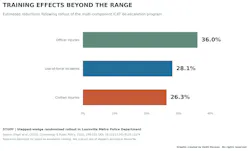
A broader field evaluation illustrates why outcomes beyond the training room deserve attention. Engel and colleagues (2022) studied the Louisville Metro Police Department's implementation of Integrating Communications, Assessment, and Tactics (ICAT), a de-escalation program evaluated through a stepped-wedge randomized rollout. Following training, the researchers estimated reductions of 28.1% in use-of-force incidents, 26.3% in civilian injuries and 36.0% in officer injuries relative to the study's comparison conditions. ICAT includes communication and tactical components beyond firearms decision-making, and these field results do not establish that manipulating dispatch information within scenarios reduces shootings. They do, however, demonstrate the value of asking whether a carefully evaluated training intervention is associated with consequential operational outcomes rather than assuming that attendance, completion or a passing score establishes effectiveness.
When the Scorecard Becomes the Curriculum
There is an institutional reason these distinctions are frequently overlooked. It is relatively easy to produce a record showing how many rounds an officer fired, whether a qualification standard was met and how many hours of scenario training were completed. It is harder to demonstrate that the officer can recognize a real threat under unfamiliar conditions, adapt when a caller's report proves inaccurate and withhold deadly force when an anticipated threat does not materialize. Training programs often gravitate toward the outcomes that can be documented most efficiently, particularly when budgets, schedules, regulatory requirements and administrative expectations reward consistency. Over time, the scorecard can become the curriculum, and the abilities that are most difficult to measure can receive the least attention.
I addressed that institutional tendency in Unlocking the Brain Code: "Over time, what can be measured becomes what is valued, and what is valued becomes what is pursued" (Hanson, 2026, p. 27). That observation is particularly troubling when the measure is a passing firearms score rather than evidence of sound threat assessment. A qualification may establish that an officer can handle and fire a weapon to a specified standard, which remains indispensable, but it cannot independently show whether the officer will recognize when firing is or is not justified. Nor can a successful scenario evaluation establish transferable judgment if the officer knew the expected outcome before the exercise began. These are different educational demands, and an agency cannot assume that success in one proves competence in the others.
None of this is an argument for discarding conventional firearms instruction or replacing tactical proficiency with lengthy philosophical discussions. Officers still need to shoot accurately, maintain safe control of their weapons, operate effectively under physical and emotional pressure, and act decisively when circumstances demand it. The profession also needs consistent standards, reliable documentation and training environments that protect participants from preventable injury. The point is that those requirements form a foundation rather than a complete account of readiness, and they become more defensible when accompanied by instruction that deliberately develops threat discrimination, response selection, adaptability and the capacity to revise an assessment when evidence changes.
If Part One demonstrated that the words transmitted over a police radio can shape an officer's expectations, Part Two asks what those words encounter when they reach an already trained mind. Previous learning can help an officer recognize a genuine threat that someone else overlooks, but it can also supply a familiar interpretation that must be challenged when the circumstances do not fit. Our responsibility as instructors is not to eliminate the instinct to anticipate danger, and certainly not to punish officers for recognizing it quickly. It is to ensure that anticipation remains subordinate to the evidence, that the training environment does not disclose the answer in advance, and that success means more than executing a well-rehearsed response to a predictable problem.
The ultimate question is not simply whether the officer can make the shot. It is whether the officer has correctly determined that the shot needs to be made, and whether the training we provided developed that judgment rather than merely rehearsing its anticipated result. A radio transmission may influence the threat an officer expects to encounter, but the training experiences we design help determine how that expectation is interpreted. If we want officers to recognize the difference between a reported danger and the situation actually unfolding before them, then we must teach them to read the evidence, not merely to recognize the script.
References
Barnett, S. M., & Ceci, S. J. (2002). When and where do we apply what we learn? A taxonomy for far transfer. Psychological Bulletin, 128(4), 612-637. https://doi.org/10.1037/0033-2909.128.4.612
Di Nota, P. M., Arpaia, J., Boychuk, E. C., Collins, P. I., & Andersen, J. P. (2021). Testing the efficacy of a 1-day police decision-making and autonomic modulation intervention: A quasi-random pragmatic controlled trial. Frontiers in Psychology, 12, Article 719046. https://doi.org/10.3389/fpsyg.2021.719046
Di Nota, P. M., & Huhta, J.-M. (2019). Complex motor learning and police training: Applied, cognitive, and clinical perspectives. Frontiers in Psychology, 10, Article 1797. https://doi.org/10.3389/fpsyg.2019.01797
Engel, R. S., Corsaro, N., Isaza, G. T., & McManus, H. D. (2022). Assessing the impact of de-escalation training on police behavior: Reducing police use of force in the Louisville, KY Metro Police Department. Criminology & Public Policy, 21(2), 199-233. https://doi.org/10.1111/1745-9133.12574
Espevik, R., Rose-Saus, E., Johnsen, B. H., Sanden, S., & Olsen, O. K. (2026). Decision-making training for frontline police officers: Effects on situational awareness and team behavior. Scandinavian Journal of Psychology, 67(2), 596-604. https://doi.org/10.1111/sjop.70050
Guadagnoli, M. A., & Lee, T. D. (2004). Challenge point: A framework for conceptualizing the effects of various practice conditions in motor learning. Journal of Motor Behavior, 36(2), 212-224. https://doi.org/10.3200/JMBR.36.2.212-224
Hanson, K. (2026, November 4). A sprint isn't a gunfight: Rethinking stress in police firearms training. Officer.com. https://www.officer.com/training-careers/article/55416701/police-firearms-training-why-elevated-heart-rate-does-not-equal-realistic-stress
Hanson, K. A. (2026). Unlocking the brain code: Exposing the limits of traditional firearms instruction and high-liability training through neuroscience, psychology, and human performance research. Applied Threat Science Publications.
Heusler, B., & Sutter, C. (2022). Shoot or don't shoot? Tactical gaze control and visual attention training improves police cadets' decision-making performance in live-fire scenarios. Frontiers in Psychology, 13, Article 798766. https://doi.org/10.3389/fpsyg.2022.798766
Katzenstein, J. (2025). Officer safety time: Police scenario training and thinking threat first. Cultural Anthropology, 40(3), 493-518. https://doi.org/10.14506/ca40.3.05
Klein, G. A. (1993). A recognition-primed decision (RPD) model of rapid decision making. In G. A. Klein, J. Orasanu, R. Calderwood, & C. E. Zsambok (Eds.), Decision making in action: Models and methods (pp. 138-147). Ablex Publishing.
Olma, J., Sutter, C., & Sülzenbrück, S. (2024a). Blended police firearms training improves performance in shoot/don't shoot scenarios: A systematic replication with police cadets. Frontiers in Psychology, 15, Article 1495812. https://doi.org/10.3389/fpsyg.2024.1495812
Olma, J., Sutter, C., & Sülzenbrück, S. (2024b). When failure is not an option: A police firearms training concept for improving decision-making in shoot/don't shoot scenarios. Frontiers in Psychology, 15, Article 1335892. https://doi.org/10.3389/fpsyg.2024.1335892
Schmidt, R. A., & Bjork, R. A. (1992). New conceptualizations of practice: Common principles in three paradigms suggest new concepts for training. Psychological Science, 3(4), 207-217. https://doi.org/10.1111/j.1467-9280.1992.tb00029.x
Soderstrom, N. C., & Bjork, R. A. (2015). Learning versus performance: An integrative review. Perspectives on Psychological Science, 10(2), 176-199. https://doi.org/10.1177/1745691615569000
Taylor, P. L. (2020). Dispatch priming and the police decision to use deadly force. Police Quarterly, 23(3), 311-332. https://doi.org/10.1177/1098611119896653
About the Author
 Keith Hanson
Contributing Editor Keith Hanson is a career law enforcement professional with extensive experience across operational and instructional domains, specializing in firearms instruction, tactical operations training, and counterterrorism tactics. With a strong background in neuroscience and psychology, Keith is a co-creator and senior program architect of NeuralTac™, which combines neuroscience, combat psychology, neuropsychology, kinesiology, and educational sciences, drawing from the latest research in human performance, to produce advanced high-liability instructional frameworks for law enforcement agencies, contract security firms, and other armed professionals. It also aims to develop and foster advanced-level master trainers within those organizations. Additionally, as a certified Force Science analyst and certified cognitive/forensic interviewer, Keith serves as a court-recognized expert witness on use-of-force matters and provides consultation on legal strategies. He is the author of "Unlocking the Brain Code: Exposing the Limits of Traditional Firearms Instruction and High-Liability Training Through Neuroscience, Psychology, and Human Performance Research."
You can email Keith: [email protected]
And visit his LinkedIn page: https://www.linkedin.com/in/keithhanson1973/
Related
 How police training shapes split-second decisions