The Threat Before the Threat: How Dispatch Primes the Officer's Brain
What to Know
- Research suggests dispatch information can shape an officer's expectations before arriving at a call, influencing how threats are perceived and decisions are made under uncertainty.
- A simulator study found officers were significantly more likely to shoot at a subject holding a cellphone when dispatch information incorrectly suggested the person was armed.
- The findings highlight the importance of separating reported information, direct observations and conclusions when evaluating potential threats and making force decisions.

Previously, in A Sprint Isn't a Gunfight: Rethinking Stress in Police Firearms Training, I wrote that something mentioned almost in passing in one article can unexpectedly become the foundation for an entirely new discussion. A sentence intended to support a broader argument can raise additional questions, and before long, a relatively minor observation becomes a subject deserving an article of its own. And, it would appear, I've managed to do it again.
This time, the observation appeared in my article examining John Boyd's Observe, Orient, Decide and Act (OODA) loop, Getting Inside the OODA Loop Means Challenging Officers' Expectations. While discussing how previous experiences influence an officer's orientation, perception and subsequent decision-making, I wrote, "If an officer is already expecting a particular threat, incoming information may be interpreted in ways that reinforce that expectation, making the quality of previous training experiences particularly significant." At the time, it was simply a supporting statement about the relationship between expectation and perception, but the more I considered its implications, the more significant that single sentence became. Could information received over a police radio influence what an officer subsequently believes he sees? Could a dispatcher's description of a potential threat influence how an otherwise ambiguous movement is interpreted? And could the officer's previous training experiences reinforce those expectations, potentially influencing decisions about the use of deadly force?
As it turns out, that single statement contains enough scientific, instructional and operational significance to warrant not merely another article, but an entire two-part series. And so, that's exactly what I've written. In this first installment, we will examine a phenomenon known as dispatch priming, exploring how information communicated to officers before they arrive at an incident can shape their expectations, influence their perception and affect subsequent decision-making. More importantly, we will examine research demonstrating that these influences are not merely theoretical. In one randomized simulator experiment, changing what officers were told before an encounter produced striking differences in their decisions about whether to fire at a subject holding a cellphone (Taylor, 2020). The implications extend beyond the individual officer to emergency communications, supervisory practices and the cognitive processes underlying threat recognition.
The second installment, scheduled for next week, will turn our attention toward an arguably more uncomfortable question: whether traditional firearms and scenario-based training practices may inadvertently reinforce the very expectations that influence an officer's interpretation of an encounter. Before examining what instructors may be teaching officers to expect, however, we need to understand how those expectations are established in the first place, how they interact with incoming sensory information and why they can become so influential when decisions must be made quickly and under conditions of uncertainty. A simple hypothetical illustrates just how consequential the information received before an encounter can become.
Imagine a patrol officer dispatched to investigate a man looking into the windows of a residence. The caller reports that the homeowner is away, that the man appears nervous and that he has repeatedly placed a hand inside his jacket. As the officer approaches, dispatch provides an update indicating that the caller believes the man has a handgun. The officer begins evaluating the approach, considering available cover, assessing potential escape routes and preparing for the possibility of an armed confrontation. Minutes later, the officer encounters the man, whose hand suddenly moves into his pocket before an object becomes visible. In that brief interval, the officer must interpret the movement and determine whether some form of protective action, potentially including deadly force, is necessary.
Now consider a second officer responding to precisely the same circumstances, with one seemingly minor difference. Instead of being told that the man may have a handgun, this officer receives an update indicating that the subject appears to be talking on a cellphone. The individual, movement, lighting, location and object are otherwise identical, yet the information each officer carries into the encounter is substantially different. Would those officers necessarily interpret the same movement in the same way, and if they reached different conclusions, could the difference be attributed entirely to judgment, experience or firearms proficiency? The unsettling possibility is that their perceptual assessments began taking shape before either officer had directly observed the individual, with the radio transmission influencing what each expected to encounter.
This is the fundamental concern underlying dispatch priming, a manifestation of the broader cognitive processes through which information received before an event influences how subsequent information is noticed, organized and interpreted. Expectations are not inherently defective; they allow people to anticipate hazards, recognize familiar patterns and respond efficiently without having to consciously reconsider every possibility. For police officers, however, those same cognitive efficiencies carry extraordinary consequences when the anticipated event involves a deadly threat and the available evidence is incomplete or ambiguous. An inaccurate expectation may increase the apparent significance of an otherwise harmless movement, while reliable advance information can improve threat recognition and prevent a costly mistake. The challenge, therefore, is not to eliminate anticipation, which would be neither possible nor desirable, but to prevent anticipation from becoming a substitute for observation and continuing assessment.
When the Same Movement Produces Different Decisions
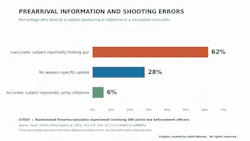
In a randomized controlled experiment, University of Colorado Denver researcher Paul L. Taylor examined whether information provided before an encounter influenced officers' decisions in a firearms simulator. The study involved 306 active law enforcement officers who listened to recorded dispatch information concerning a possible trespasser before responding to a simulated encounter. Of particular interest was a situation in which the subject rapidly produced a cellphone from his pocket, requiring officers to determine whether the movement justified firing. Participants were assigned to conditions in which dispatch provided no weapon-specific update, inaccurately suggested that the subject had a gun, or accurately indicated that he appeared to be using a cellphone (Taylor, 2020). By manipulating the information officers received before the encounter, the experiment allowed Taylor to examine the influence of an expectation that existed before the subject's critical movement occurred.
The differences were striking. Among officers who received no weapon-specific update, 28% fired at the subject holding a cellphone, but that error rate increased to 62% when officers had been told that the subject appeared to have a gun. Conversely, when the information suggested that the subject was using a cellphone, only 6% fired at the cellphone presentation. These percentages describe decisions made during a controlled simulation and should not be confused with the frequency of mistaken shootings in operational policing. Nevertheless, because the experimental conditions differed in the prearrival information provided, the results offered unusually direct evidence that dispatch communications can influence decisions when officers subsequently encounter an ambiguous movement (Taylor, 2020). In this experiment, the information officers received before seeing the subject was associated with a difference of 56 percentage points between the inaccurate gun-warning condition and the accurate cellphone-warning condition.
Another finding complicates any attempt to characterize dispatch priming as an influence that necessarily interferes with appropriate defensive action. According to Force Science's account of the experiment, officers also encountered a condition in which the subject actually presented a firearm, and participants fired in response regardless of the dispatch information they had received. Taylor also noted potential differences in response timing, although those observations should not be overstated beyond what the research established. The principal concern was not that advance information inevitably undermined an officer's response to a genuine weapon, but that inaccurate advance information substantially increased erroneous shooting decisions when the subject produced a harmless object (Force Science, 2019; Taylor, 2020).
Indeed, one of the most important implications of Taylor's findings is that dispatch priming should not be reduced to a simplistic argument against providing officers with potentially threatening information. Accurate prearrival intelligence was associated with better discrimination in the cellphone encounter, reinforcing the legitimate operational value of information that allows officers to anticipate hazards, coordinate resources and prepare for a potentially dangerous confrontation. The problem emerges when information that should establish a possibility is unconsciously elevated into a conclusion that has not been independently verified. Knowing that a firearm may be present is fundamentally different from knowing that one is present, just as knowing that a person is armed is different from establishing that the person poses an immediate threat justifying deadly force.
The law enforcement profession has encountered this research before. Force Science discussed Taylor's findings in a 2019 article published by Police1, emphasizing the potentially disastrous consequences of inaccurate prearrival information, while Dr. Matthew Loeslie examined the same experiment in a 2024 American Police Beat article addressing confirmation bias in policing (Force Science, 2019; Loeslie, 2024). Those earlier discussions are important because they demonstrate that the underlying phenomenon is neither newly discovered nor limited to academic speculation. What deserves further attention is the way information can change as it travels from caller to dispatcher to responding officer, how that information interacts with established cognitive processes, and why the officer's previous training experiences may influence the interpretation of what ultimately happens at the scene.
The Brain Is Not a Video Recorder
Most people experience vision as though the eyes capture an event and the brain simply displays a faithful recording of what occurred. The actual process is considerably more complicated because human perception depends upon the interaction of incoming sensory information, selective attention, existing knowledge and expectations about what is likely to happen. Visual input is incomplete, attentional resources are limited, and the nervous system must continuously determine which features of an environment deserve priority. Summerfield and Egner (2009), reviewing the relationship between expectation and attention in visual cognition, described how prior information can influence what people attend to and how incoming information is processed. This capacity is enormously useful because it allows the brain to allocate limited resources efficiently, but it also creates circumstances in which expected information may be recognized or interpreted more readily than competing explanations.
Confirmation bias introduces another potentially consequential influence. Psychologist Raymond Nickerson (1998) described the tendency to seek, recognize or interpret information in ways that favor an existing belief or hypothesis, a process that can operate without a deliberate intention to disregard contradictory evidence. When an officer approaches an encounter already expecting a firearm, an ambiguous movement toward the waistband may appear consistent with that expectation, making confirming details especially prominent while information suggesting another explanation receives less attention. This does not establish that the officer consciously ignores contrary evidence, nor does it prove that every mistaken shooting can be attributed to confirmation bias. It does, however, describe a plausible cognitive pathway through which an unverified warning might influence the interpretation of the subject’s later behavior.
An important qualification is necessary here because discussions of perceptual error can easily drift into claims that the evidence does not support. Taylor's experiment measured shooting decisions rather than the participants' subjective visual experiences, meaning the results cannot establish that officers literally saw firearms that were not present. Some participants may have misidentified the object, while others may have recognized ambiguity but assigned greater significance to the possibility of a weapon, responded before contradictory information could influence their decision, or failed to prioritize visual details that distinguished the cellphone from a handgun. Those explanations are not equivalent, and the experiment was not designed to determine the precise mental sequence experienced by every participant. The defensible conclusion is that prior information affected decisions under the tested conditions, while the exact perceptual and cognitive mechanisms responsible for each individual response remain less certain (Summerfield & Egner, 2009; Taylor, 2020).
This complexity also explains why the problem cannot be resolved through the familiar admonition to ignore dispatch information and simply trust what the officer sees. Visual perception does not operate independently of attention, memory or expectation, and discarding potentially lifesaving information would create obvious operational hazards. A more defensible approach is to preserve the distinction between information that has been reported, circumstances the officer has personally observed and conclusions that can reasonably be drawn from the available evidence. A caller's statement that an individual is armed represents reported information, whereas the officer's observation of an object that resembles a firearm constitutes direct sensory evidence requiring interpretation. Whether the individual presents an immediate threat depends on the surrounding circumstances and behavior, not merely the existence of the report or the presence of an object. Maintaining those distinctions allows officers to use advance information without automatically treating it as confirmation of a threat that has yet to be established.
OODA Begins Before the Officer Arrives
This relationship between expectation and perception connects directly with John Boyd's Observe, Orient, Decide and Act model, commonly referred to as the OODA loop. In law enforcement training, OODA is frequently presented as a straightforward sequence of four steps that must be completed more rapidly than an opponent can respond. Boyd's own conceptualization, however, was considerably more sophisticated, particularly in the central role he assigned to orientation. In The Essence of Winning and Losing, Boyd identified previous experiences, cultural traditions, new information, analysis and synthesis as influences upon orientation, while depicting orientation as shaping observation as well as decisions and actions. The model also included continuing feedback from an unfolding environment, making it an adaptive process rather than a rigid series of isolated decisions (Boyd, 1995/2010).
Dispatch information enters that process as outside information, but it does not remain a neutral collection of facts awaiting consideration after the officer arrives. A report of a potentially armed suspect can begin influencing orientation while the patrol vehicle is still traveling toward the location, shaping which possibilities the officer anticipates, which environmental cues subsequently attract attention and which responses appear plausible. Taylor's findings illustrate the potential significance of that interaction, because officers responding to substantially similar visual information made markedly different decisions depending upon the dispatch information they had previously received. The experiment does not validate Boyd's model as a scientific explanation of dispatch priming, but the results are consistent with the broader understanding that prior expectations can influence how people organize and interpret unfolding events.
This also exposes a weakness in the commonly repeated instruction that officers must learn to get inside a suspect's OODA loop. Speed certainly has operational value when an officer has accurately recognized a genuine threat and must respond before circumstances deteriorate, but accelerating a decision based on an inaccurate interpretation is hardly an indication of superior judgment. An officer who rapidly executes a technically proficient response to a situation that did not justify it has not demonstrated better decision-making merely because the response occurred quickly. The effectiveness of an adaptive OODA process depends upon its continuing responsiveness to incoming information, particularly when that information challenges the original interpretation. Orientation should guide observation without becoming so rigid that contradictory evidence can no longer modify the officer's assessment.
Gary Klein's recognition-primed decision-making model provides a complementary explanation for why such expectations can become influential. Klein (1993) examined how experienced decision-makers recognize familiar patterns and identify workable responses without consciously comparing an exhaustive list of alternatives. This recognition-based approach allows people operating under time pressure to draw upon previous experiences, anticipated developments and familiar courses of action, often with considerable efficiency. Its effectiveness, however, depends upon the quality of the relationship between the present circumstances and the patterns the decision-maker has previously learned. When a situation resembles a familiar threat but differs in a critical detail, the apparent familiarity can create confidence in a response that is poorly matched to the actual circumstances.
In Unlocking the Brain Code, I argue that mechanical proficiency and perceptual judgment cannot be treated as equivalent achievements, particularly when the consequences of an incorrect decision extend well beyond whether a bullet strikes its intended target. As I wrote, "Instead of evaluating perceptual discrimination, instructors evaluate shot placement" (Hanson, 2026, p. 29). That distinction is especially relevant to dispatch priming because the decision whether to fire necessarily precedes the demonstration of marksmanship. An officer may execute a mechanically flawless shot while relying upon an inaccurate interpretation of the threat, and technical excellence in firearms handling does not independently establish the ability to distinguish a genuine deadly threat from an ambiguous but harmless action. These capabilities interact in operational performance, but they are not interchangeable, and the distinction becomes increasingly important when an officer approaches an encounter already expecting a particular outcome.
The Dispatcher Is Part of the Information System
Dispatch priming also challenges the traditional conception of emergency communications as a relatively neutral process in which a dispatcher receives facts from a caller and passes those facts to responding officers. In practice, call-takers must extract useful information from people who are often frightened, confused, angry, distracted or mistaken about what they are witnessing. They must then organize that information, determine its apparent urgency, assign an appropriate classification and communicate the details most relevant to the responding units. Every stage involves interpretation, and each creates an opportunity for uncertainty to be preserved, clarified or unintentionally transformed into a more definitive description than the available evidence supports. None of this requires carelessness or improper intent; it reflects the unavoidable reality that emergency communications personnel are human decision-makers working under significant informational and operational constraints.
Jessica Gillooly examined these dynamics in a 2020 analysis of the emergency call and radio communications associated with the arrest of Harvard professor Henry Louis Gates Jr. Her research considered how information provided by a caller was interpreted and transmitted, and how the resulting communication could influence the expectations of officers responding to the incident. The concern was not that dispatchers should suppress potentially important safety information, but that the information-gathering and transmission process can alter the degree of uncertainty ultimately communicated to the officer. When a caller expresses suspicion rather than certainty, or reports an interpretation rather than a directly observed fact, the distinction can become consequential if that uncertainty is lost before the responding officer receives the information (Gillooly, 2020).
Gillooly subsequently expanded her examination of dispatch decision-making in a 2022 study involving 20,764 calls concerning mental health crises and public assaults handled by a dispatch center in southeastern Michigan. Taking advantage of the quasi-random assignment of calls to different call-takers, she investigated variation in how ostensibly similar incidents were classified and prioritized. Some call-takers were more likely than others to classify calls as high priority, and that variation was associated with consequential differences in how officers subsequently characterized incidents at the scene. Calls whose assigned call-taker induced a high-priority classification were approximately three times as likely to receive a high-priority classification from responding officers relative to the study's comparison mean, with particularly pronounced effects in calls involving mental health crises (Gillooly, 2022). Although the study did not examine firearms decisions or establish that dispatch classifications caused officers to use force, it demonstrated how judgments made during the earliest stages of an emergency response can influence subsequent interpretations of the same incident.
The potential operational significance of imperfect prearrival information becomes clearer in a 2020 National Policing Institute review of more than 1,000 fatal and nonfatal officer-involved shootings involving large police agencies in the United States and Canada. In the relevant subset of shootings initiated by a community member's 911 call, 69% of callers reported that the individual was or might be armed with a firearm. Among the cases containing such a report, investigators subsequently found no firearm present or recovered in 35%, while some incidents without an initial firearm report nevertheless involved individuals who were later found to be armed. These are descriptive findings from encounters that ultimately resulted in officer-involved shootings, not a representative sample of all emergency calls, and they cannot establish that dispatch priming caused any particular shooting. Their significance lies in demonstrating that advance information concerning the presence or absence of firearms can be incomplete or inaccurate in encounters with potentially lethal consequences (National Policing Institute, 2020).
Consider the difference between two otherwise similar radio transmissions. In the first, dispatch advises that the subject "has a gun," whereas in the second, dispatch explains that the caller believes the subject may possess a firearm but has not actually confirmed its presence. Both dispatch transmissions identify a potentially serious safety concern, but they convey substantially different degrees of certainty, and that distinction may influence how the officer interprets subsequent behavior. The first presents the presence of a weapon as an established condition, while the second preserves the fact that the information remains an allegation or inference. There will certainly be emergencies in which dispatch has reliable evidence that a firearm is present, and officers should receive that information plainly and without unnecessary hesitation. Where uncertainty exists, however, accurately communicating its nature is part of providing reliable intelligence, not an invitation for officers to disregard a potentially dangerous situation.
A Recent Case Illustrates the Stakes
An October 2026 report from Austin's NPR station, KUT, offers a current example of the questions raised when dispatch information and an officer's interpretation of unfolding circumstances intersect. Reporter Andrew Weber examined the July fatal police shooting of 17-year-old Anthoneil Williams II, reporting that Austin police said the original 911 call, believed to have been placed by Williams himself, described a person with a gun in a park. Responding officers approached without knowing that the individual was unarmed, and when Williams reached toward his waistband, officers fired. The object described in subsequent reporting was a water bottle rather than a firearm. The shooting became the subject of investigation and public controversy, but the available reporting did not establish that dispatch priming caused the officers' decisions or that any particular aspect of the encounter could be explained by a single cognitive mechanism (Weber, 2026).
One of the more revealing details in the reporting concerned the language used during the emergency call itself. Former police officer and University of South Carolina criminologist Seth Stoughton questioned the dispatcher's use of the term "brandishing," observing that a civilian caller may not interpret police terminology in the same way a trained law enforcement professional would. That concern points toward an additional vulnerability in the communications process, because the wording of a question can influence how a caller frames an event, just as the language of a subsequent radio transmission may influence what a responding officer anticipates. Stoughton did not claim to have established the cause of the shooting, nor did he declare the officers' actions unlawful. His observations instead underscore the importance of examining how information was elicited, interpreted and communicated before it reached those who would ultimately make decisions at the scene (Weber, 2026).
It would be scientifically irresponsible to treat the Austin incident as a real-world replication of Taylor's experimental findings. The operational circumstances were complex, portions of the sequence were contested, and the publicly available information did not permit investigators or outside observers to isolate dispatch priming from the many other variables potentially influencing the officers' decisions. Nevertheless, the incident illustrates why the relationship between caller language, dispatcher questioning, radio communications and direct observation deserves careful examination. When reconstructing an encounter, the important inquiry is not simply what the officer was told or what a later video appears to show, but how the information available at each stage may have contributed to the officer's evolving assessment and whether contradictory evidence was available before the decision was made.
Anticipation Also Has a Physiological Dimension
Expectations do not influence perception independently of the body's response to anticipated danger. An officer dispatched to a potentially violent incident may experience heightened physiological arousal while driving toward the location, well before encountering the individual involved. The possibility of an armed confrontation can influence perceived urgency, attentional priorities and preparation, even when the officer has not yet encountered anything personally threatening. Such a response is not inherently evidence of panic or diminished professionalism, but rather a reflection of the physiological adjustments that can accompany anticipation of a high-consequence event. The more important question is how those adjustments interact with information processing and judgment, particularly when the information that prompted the response later proves inaccurate.
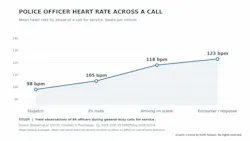
Baldwin and colleagues (2019) examined this issue by monitoring 64 officers during general-duty calls for service, combining cardiovascular measures with GPS data and operational records. Their analysis distinguished phases of an incident and attempted to account for the respective contributions of physical activity and psychological stress. Mean heart rates were approximately 98 beats per minute at dispatch, 105 while officers were en route, 118 upon arrival and 123 during the encounter, use-of-force or arrest phase. Higher-priority calls and incidents involving reported or accessible weapons were associated with increased physiological responses, suggesting that significant arousal may begin developing during the response itself rather than emerging only after an officer encounters an immediate threat. The findings reinforce the importance of viewing prearrival information as part of an evolving operational experience, not merely a collection of facts received before the encounter begins.
A separate experimental investigation provides additional insight into how heightened threat-related anxiety can influence police shooting decisions, although it did not directly examine dispatch priming. Nieuwenhuys, Savelsbergh and Oudejans (2012) studied 36 police officers performing shooting tasks under conditions of relatively low and high anxiety. When anxiety increased, participants became more inclined to shoot, including making erroneous shooting responses when subjects surrendered. The researchers interpreted those findings as evidence that heightened anxiety can increase reliance on threat-related expectations at the expense of relevant visual information. The distinction between this study and Taylor's experiment is important because Nieuwenhuys and colleagues manipulated anxiety rather than radio communications, meaning the results cannot be presented as an independent replication of dispatch priming. They do, however, provide evidence that threat-related expectations and physiological or emotional conditions can interact in ways that influence decisions about whether to fire.
These findings also require careful interpretation, particularly because physiological arousal is so frequently misunderstood in firearms training. As I explained in my earlier article, A Sprint Isn't a Gunfight: Rethinking Stress in Police Firearms Training, an elevated heart rate resulting from physical exertion is not physiologically or psychologically equivalent to the complex stress response associated with a perceived threat to life. Similarly, heart rate alone is neither a reliable measure of fear nor definitive evidence of perceptual narrowing, cognitive impairment or deteriorating decision-making. A particular heart-rate value cannot tell us what an officer was thinking, what information attracted the officer's attention or how an ambiguous movement was interpreted. Baldwin and colleagues (2019) did not demonstrate that dispatch information caused officers to misidentify objects, just as Nieuwenhuys and colleagues (2012) did not establish that inaccurate 911 information produced the shooting errors observed in their experiment. What these studies collectively suggest, however, is that officers may arrive at a critical encounter with their physiological responses, attentional priorities and expectations already influenced by their anticipation of what they are about to confront. This distinction is especially significant when examining dispatch priming because, as the research increasingly suggests, the encounter does not begin cognitively or physiologically at the moment the officer first sees the subject. In some respects, it may have begun several minutes earlier, with a few seemingly routine words transmitted over a police radio.
The Evidence Is Serious, but Not Unanimous
A responsible examination of dispatch priming must acknowledge that not every experimental investigation has reproduced Taylor's results, and that distinction is especially important when considering how broadly the findings should be applied. In a 2007 study, Lucy Mitchell and Rhona Flin exposed British authorized firearms officers to either a threat-oriented or neutral briefing before simulated encounters in which the subject ultimately fired at the officers or surrendered. Although the nature of the briefing influenced how surprised participants felt, it did not produce a statistically significant difference in the time required to draw and aim their firearms. Moreover, none of the participants fired during the scenario in which the subject surrendered, regardless of the briefing received (Mitchell & Flin, 2007). The results demonstrate that prior threat-oriented information does not necessarily lead to shooting errors in every experimental setting.
Potts and colleagues (2022) conducted another investigation involving 77 volunteers, including law enforcement personnel and participants from other occupational backgrounds, using a virtual-reality environment to examine decisions involving armed and unarmed subjects. The researchers manipulated whether participants received priming information and whether the subject presented a gun or a cellphone, but they did not find a statistically significant effect of dispatch priming on participants' responses. They did observe that law enforcement participants made more accurate decisions than participants without law enforcement backgrounds, suggesting that experience or training may influence performance independently of the dispatch manipulation. The experiment differed from Taylor's in sample composition, simulation technology and other methodological characteristics, making direct comparisons difficult. Its results do not invalidate Taylor's findings, but they caution against treating dispatch priming as an inevitable influence that operates with equal strength across all participants and circumstances.
The International Association of Chiefs of Police' Police Chief magazine revisited this contrasting evidence in August 2026 while discussing the growing use of virtual reality in police training, including the absence of a significant dispatch-priming effect in the Potts experiment (Loudy et al., 2026). Taken together, these investigations suggest a more complicated relationship between prior information and shooting decisions than a single experiment can fully explain. Differences in how subjects behave, the clarity of the threat, the realism and timing of the simulation, participants' previous experiences and the information available during the encounter may all influence whether expectations affect the outcome. Those possibilities deserve further investigation rather than an assumption that the absence of an effect in one setting disproves its presence in another.
There is also a broader methodological concern that should not be overlooked. A statistically significant result in a controlled firearms simulation demonstrates that a relationship was observed under the conditions tested, but it does not automatically establish the frequency or magnitude of that relationship during actual police encounters. Conversely, the absence of a statistically significant result does not prove that no influence exists under different conditions. The scientifically defensible position is that dispatch priming represents a demonstrated influence in some experimental circumstances, with important uncertainty concerning the conditions under which it becomes most consequential. That uncertainty does not weaken the justification for examining the issue; it identifies where further research and more sophisticated training evaluation are needed.
What Should Officers and Agencies Take From This?
The practical lesson is not that officers should simply slow down, disregard information about possible weapons or hesitate whenever a potentially dangerous movement occurs. There are encounters in which officers have sufficient time, distance, cover or other resources to gather additional information, just as there are circumstances in which an immediate threat makes delay dangerous. Effective decision-making requires the ability to distinguish between those situations rather than applying the same response to every encounter. Dispatch information should contribute to preparation and threat assessment, but the decision to use force must remain grounded in the circumstances the officer actually confronts, including the individual's behavior and the evidence available when the decision becomes necessary.
For the responding officer, the essential distinction is between preparation and conclusion. A report concerning a possible firearm may reasonably justify heightened awareness, protective positioning, coordination with other responding units and efforts to obtain additional information, but it cannot eliminate the need to evaluate what the individual is actually doing. When direct observation contradicts the original dispatch information, the officer's assessment must remain capable of changing, even when the original report appeared credible. The reverse is equally important because an apparently benign dispatch does not guarantee that an unexpected deadly threat cannot develop. Professional judgment requires maintaining a working interpretation that remains responsive to new evidence rather than becoming anchored to the first explanation that appeared plausible.
For emergency communications personnel, the most significant opportunity for improvement concerns the accuracy with which information is gathered, classified and transmitted. A caller who directly observes a firearm possesses different information from someone who infers the presence of a weapon from a gesture, while a person describing firsthand observations is not necessarily as reliable as a caller repeating another individual's assumptions. Those distinctions may be critical when officers begin organizing their approach around a reported threat. Agencies should therefore examine whether their protocols preserve the source and degree of certainty associated with important information, and whether subsequent corrections or contradictory observations are communicated promptly enough to influence the responding officer's assessment. The objective is not to delay essential safety warnings or impose unnecessary verbal complexity during emergencies, but to avoid converting uncertainty into unwarranted certainty as information moves through the communications system.
These considerations also have implications for the language used during emergency calls. Call-takers must obtain accurate and operationally useful information under conditions that frequently demand rapid questioning, but the terminology used to elicit that information may influence how callers characterize what they have witnessed. Questions about whether a person possesses, displays, threatens with or uses a firearm are not interchangeable, and neither are statements that a caller saw an object resembling a gun or merely believes one may be present. Developing more precise communication practices requires careful study of actual call recordings, dispatcher decision-making and subsequent officer responses. Such work should be framed as a means of improving information reliability rather than assigning blame to personnel operating within an inherently imperfect system.
Supervisors and investigators face a related challenge when attempting to reconstruct the decisions made during a critical encounter. Video recordings may reveal important details about the individual's actions, available cover, distances and the timing of events, but they cannot independently establish what information the officer possessed, which expectations had already developed or which competing demands influenced attention. Conversely, an officer's statement that dispatch reported a weapon does not automatically establish that the officer reasonably interpreted everything that followed, particularly if contradictory information became available before force was used. A more thorough assessment requires reconstructing the communications timeline alongside the officer's observations and actions, including what was reported, what was verified, what changed and when the officer had an opportunity to respond to those changes. That approach reduces the risks associated with both hindsight-driven criticism and uncritical acceptance of an early report as an explanation for a later decision.
For firearms instructors and those responsible for high-liability training, the implications extend beyond communication procedures into the architecture of learning itself. In Unlocking the Brain Code, I argue that students who have never been required to distinguish among changing behavioral cues cannot be presumed to possess that capability simply because they perform well in controlled training exercises. As the book explains, "Learning is specific to the conditions under which it occurs" (Hanson, 2026, p. 151). When police training repeatedly presents unmistakable threats, familiar scenario structures and predictable relationships between early warnings and eventual confrontations, students may become highly proficient under those particular conditions while leaving important questions about transfer unanswered. The concern is not that every predictable exercise produces a harmful cognitive expectation, but that the instructional environment may shape what officers learn to anticipate without instructors ever examining whether those expectations remain appropriate when the circumstances change.
That distinction is especially important because the available research has not established a direct causal relationship between particular firearms-training methods and dispatch-related shooting errors in the field. It would be inaccurate to claim that conventional qualification courses or scripted scenarios have been experimentally proven to produce the kind of mistakes observed in Taylor's simulator study. The more defensible argument is that previous learning experiences are a scientifically plausible influence upon how officers recognize patterns, allocate attention and interpret incomplete information. Di Nota and Huhta (2019) similarly emphasize the importance of integrating perceptual, cognitive and decision-making demands into the development of complex police motor skills, recognizing that technical execution and operational judgment must function together. An officer's ability to execute a response accurately and efficiently is indispensable, but so is the ability to determine whether that response is appropriate under the conditions actually encountered.
The implications for training design therefore involve more than adding a dispatch recording to the beginning of a shooting scenario. If the dispatch message always predicts the eventual confrontation, students may learn to associate the warning with a predetermined outcome rather than evaluate how subsequent evidence supports or contradicts it. Conversely, if every reported weapon turns out to be harmless, a different and equally unrealistic expectation may develop. What training must ultimately cultivate is the ability to assess and update information as events unfold, respond appropriately when a genuine threat emerges and withhold force when the available circumstances do not justify it. Those objectives require careful control of scenario design, thoughtful evaluation and evidence that performance transfers beyond the particular exercises students have already practiced.
The Threat We Were Taught to Expect
The deeper question emerging from this research concerns the relationship between an officer's immediate expectations and the experiences through which those expectations were developed. Dispatch may provide the initial suggestion that a subject is armed, but previous experience helps determine what that suggestion means, which behaviors appear significant and which responses come most readily to mind. An officer who has repeatedly encountered a familiar relationship between a weapons warning, an ambiguous movement and a firearm presentation during training may approach a similar real-world situation with expectations that deserve careful examination. That possibility does not establish that training caused an error, but it raises a legitimate question about whether some instructional practices produce proficiency in recognizing a rehearsed pattern rather than adaptability in interpreting unfamiliar circumstances.
This brings us directly to the second installment of the series. If information received over the radio can influence an officer's perception, and if previous experiences help shape the patterns through which incoming information is interpreted, then the quality, variability and contextual relevance of those experiences become central considerations in professional training. In Part Two, The Threat We Taught Them to See, we will examine how predictable firearms and scenario-based training may inadvertently reinforce the expectations officers bring into an encounter, and how research on learning, decision-making and transfer offers a more defensible approach to developing adaptable performance.
The underlying distinction is straightforward, even if applying it under the pressures of an actual encounter is anything but simple. A radio transmission communicates what someone has reported, perceived or believes may be happening; it is not the encounter itself, and its accuracy must remain open to revision as new information becomes available. Officers must prepare for the danger that has been reported while remaining capable of recognizing a different reality when the evidence demands it. The more uncomfortable question is whether our training environments consistently develop that capability or simply teach officers to become exceptionally proficient at responding to the threats we have already told them to expect.
References
Baldwin, S., Bennell, C., Andersen, J. P., Semple, T., & Jenkins, B. (2019). Stress-activity mapping: Physiological responses during general duty police encounters. Frontiers in Psychology, 10, Article 2216. https://doi.org/10.3389/fpsyg.2019.02216
Boyd, J. R. (2010). The essence of winning and losing (C. Richards & C. Spinney, Eds.; originally presented 1995). https://www.coljohnboyd.com/static/documents/1995-06-28__Boyd_John_R__The_Essence_of_Winning_and_Losing__PPT-PDF.pdf
Di Nota, P. M., & Huhta, J.-M. (2019). Complex motor learning and police training: Applied, cognitive, and clinical perspectives. Frontiers in Psychology, 10, Article 1797. https://doi.org/10.3389/fpsyg.2019.01797
Force Science. (2019, February 25). How dispatch priming can drive some disastrous shooting decisions. Police1. https://www.police1.com/officer-shootings/articles/how-dispatch-priming-can-drive-some-disastrous-shooting-decisions-LJCtW18sMGVhmFcb/
Gillooly, J. W. (2020). How 911 callers and call-takers impact police encounters with the public: The case of the Henry Louis Gates Jr. arrest. Criminology & Public Policy, 19(3), 787-804. https://doi.org/10.1111/1745-9133.12508
Gillooly, J. W. (2022). "Lights and sirens": Variation in 911 call-taker risk appraisal and its effects on police officer perceptions at the scene. Journal of Policy Analysis and Management, 41(3), 762-786. https://doi.org/10.1002/pam.22369
Hanson, K. (2026, November 4). A sprint isn't a gunfight: Rethinking stress in police firearms training. Officer.com. https://www.officer.com/training-careers/article/55416701/police-firearms-training-why-elevated-heart-rate-does-not-equal-realistic-stress
Hanson, K. (2026, November 13). Getting inside the OODA loop means challenging officers' expectations. Officer.com. https://www.officer.com/training-careers/article/55418900/how-police-training-can-improve-ooda-loop-decision-making-and-adaptability
Hanson, K. A. (2026). Unlocking the brain code: Exposing the limits of traditional firearms instruction and high-liability training through neuroscience, psychology, and human performance research. Applied Threat Science Publications.
Klein, G. A. (1993). A recognition-primed decision (RPD) model of rapid decision making. In G. A. Klein, J. Orasanu, R. Calderwood, & C. E. Zsambok (Eds.), Decision making in action: Models and methods (pp. 138-147). Ablex Publishing.
Loeslie, M. (2024, May 26). Exploring confirmation bias in policing. American Police Beat. https://apbweb.com/2024/05/exploring-confirmation-bias-in-policing/
Loudy, J., Rzemyk, T., & Smith, B. (2026, August 5). Readying officers for reality: Virtual reality offers safe, effective tactical training. Police Chief Online. https://www.policechiefmagazine.org/readying-officers-reality-vr/
Mitchell, L., & Flin, R. (2007). Shooting decisions by police firearms officers. Journal of Cognitive Engineering and Decision Making, 1(4), 375-390. https://doi.org/10.1518/155534307X264861
National Policing Institute. (2020, November 25). Origins of officer-involved shootings: Analysis of data reported to police via 911 calls reveal opportunities to reduce violent outcomes. https://www.policinginstitute.org/onpolicing/origins-of-officer-involved-shootings-analysis-of-data-reported-to-police-via-911-calls-reveal-opportunities-to-reduce-violent-outcomes/
Nickerson, R. S. (1998). Confirmation bias: A ubiquitous phenomenon in many guises. Review of General Psychology, 2(2), 175-220. https://doi.org/10.1037/1089-2680.2.2.175
Nieuwenhuys, A., Savelsbergh, G. J. P., & Oudejans, R. R. D. (2012). Shoot or don't shoot? Why police officers are more inclined to shoot when they are anxious. Emotion, 12(4), 827-833. https://doi.org/10.1037/a0025699
Potts, J., Hawken, A., Hillhouse, M., & Farabee, D. (2022). Virtual reality for law enforcement training: A demonstration and implication for dispatch priming. Police Practice and Research, 23(5), 623-632. https://doi.org/10.1080/15614263.2022.2065991
Summerfield, C., & Egner, T. (2009). Expectation (and attention) in visual cognition. Trends in Cognitive Sciences, 13(9), 403-409. https://doi.org/10.1016/j.tics.2009.06.003
Taylor, P. L. (2020). Dispatch priming and the police decision to use deadly force. Police Quarterly, 23(3), 311-332. https://doi.org/10.1177/1098611119896653
Weber, A. (2026, October 14). Unarmed teen's shooting highlights need for more training, communication by APD and 911 call takers. KUT. https://www.kut.org/text/crime-justice/2026-10-14/anthoneil-williams-shooting-apd-911-austin-tx-police
About the Author
 Keith Hanson
Contributing Editor Keith Hanson is a career law enforcement professional with extensive experience across operational and instructional domains, specializing in firearms instruction, tactical operations training, and counterterrorism tactics. With a strong background in neuroscience and psychology, Keith is a co-creator and senior program architect of NeuralTac™, which combines neuroscience, combat psychology, neuropsychology, kinesiology, and educational sciences, drawing from the latest research in human performance, to produce advanced high-liability instructional frameworks for law enforcement agencies, contract security firms, and other armed professionals. It also aims to develop and foster advanced-level master trainers within those organizations. Additionally, as a certified Force Science analyst and certified cognitive/forensic interviewer, Keith serves as a court-recognized expert witness on use-of-force matters and provides consultation on legal strategies. He is the author of "Unlocking the Brain Code: Exposing the Limits of Traditional Firearms Instruction and High-Liability Training Through Neuroscience, Psychology, and Human Performance Research."
You can email Keith: [email protected]
And visit his LinkedIn page: https://www.linkedin.com/in/keithhanson1973/
Related
 A close-up of a 911 dispatcher's face in profile with her headset on
 dreamstime_xxl_27967070_1