Key Highlights
- InVeris' fats LIVE hybrid system combines live fire with projection technology, offering realistic, space-efficient training with impact-resistant self-healing rubber screens.
- The company's VR systems, including the upgraded fats VR, utilize AI-driven scenarios and customizable curricula to simulate de-escalation and use-of-force situations for comprehensive officer training.
- Fats AR blends real environments with CGI virtual characters, allowing officers to rehearse complex scenarios like school shootings in actual or virtual settings without extensive setup.
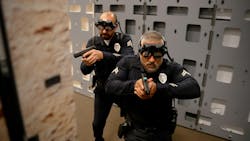
More on OFFICER.com
Download the November/December issue of OFFICER Magazine.
Click Here to subscribe to OFFICER Magazine.
Law enforcement officers are only as good as the training they are offered. It can be difficult for agencies to find the right training, though, in frequency, variety and quality. Training simulators, such as projection systems, have many benefits but can be costly and take up a lot of space. The first Virtual Reality simulators offered a space-saving alternative, but the technology had a long way to go in order to meet the needs of officers. Companies have been busy working on solutions, and InVeris now offers a diverse suite that includes advanced AI-enabled VR, a live fire hybrid training system and augmented reality.
During the International Association of Chiefs of Police (IACP) Annual Conference and Exposition in Denver in October, Chris Barrette, who specializes in Live Fire Sales, and Juan Barrillas, who specializes in Virtual Sales, both spoke to OFFICER Magazine about the advances InVeris has made in these areas and about how law enforcement officers can benefit from additional training opportunities.
The evolution of InVeris
The three legacy companies that make up Geogia-based InVeris — Caswell International, Firearms Training Systems Inc. (fats®) and Meggitt Training Systems — span nearly 100 years of work and innovation in the law enforcement industry.
Minnesota-based Caswell International invented the world’s first target retrieval system in 1926 and invented the first bullet trap in 1935. Firearms Training Systems (fats) was established in Atlanta in 1984, producing interactive firearms training simulations for public safety and the military. That next year, the company produced the first standalone firearm that interacted with a video scenario.
In 2008, Meggitt PLC acquired Firearms Training Systems and combined the fats and Caswell brand to form Meggitt Training Systems. In 2020, Pine Island Capital Partners acquired Meggit Training Systems and debuted the new company name, InVeris.
Barrette says that the fats name still carries recognition in the firearms training industry but was retired when Meggitt acquired the company. When InVeris brought the name back a few years ago, it was welcomed with open arms by customers. Last year, the fats brand celebrated its 40th anniversary.
“It’s amazing how many police departments used to tell me, ‘We don’t have your system, but we’ve got a fats,’ ” says Barrette, noting that some customers didn’t make the connection between the two companies. “They still had the old system and were ready to get back to it with us.”
fats® LIVE
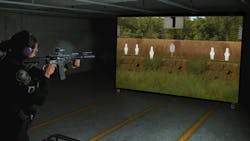
This past January, InVeris launched fats® LIVE, an innovative hybrid training system that integrates the company’s fats 100P portable projection system for accuracy, advanced data and shooter feedback, with live fire shooting.
Shooters fire live weapons at realistic scenarios projected on a self-healing rubber screen, designed to endure tens of thousands of rounds. A dual-camera hit detection system records data, with applied Department of Defense validated ballistics as its foundation.
Barrette says that the self-healing rubber screen has been a game-changer. “It’s the same rubber that’s used in fuel bladders on aircraft. It’s a self-healing rubber designed for impacts and is specific-built for the purpose that we’re using it for. The image is projected onto that and we can have the projection system installed into the baffling of the range so it can be protected from bullets.”
Law enforcement agencies can use the systems in their existing indoor shooting range by rolling the screens out on a cart on wheels. “We designed it so it’s not a permanent installation,” he says. “Typically on a shooting range, you’ve got 10 lanes of shooting, you typically have space on either sidewall know as an access lane. They can take these screens and just literally in two seconds, roll them out of the way. They’re not taking up valuable real estate that they use for something else. It’s using existing space.”
InVeris’ goal with fats LIVE was to merge the capabilities of simulators with ballistics. “You’ll see the number of shots fired, the number of hits, your group size, your mean point of impact; all the things that shooters want to know to become more proficient,” he says. “They’re going to get that capability from a simulation side, but they’re also going to be shooting real bullets. They get the sensory effects of real bullets, but they also get the capabilities of the simulation side at the same time.”
He added that having the ability to use a real firearm makes the realism that much more impactful. “If I grab a training weapon, while it may have started its life as a real weapon, it’s still a simulator. The second you pull the trigger, you know it’s a simulator. Real guns have different implications,” he says. “Where it really has value is when you get into the judgmental side with video scenarios. You’ve got hostage situations, and it scores accurately, just like you would with the simulated weapon. If you shoot the bad guy in the arm, he’s not going to die. If you shoot him in the head, he will die. You have to have that judgmental impact. You’ve got to do your de-escalation of force tactics. When you are pulling a real trigger, even if you’re pointing at a screen, you’re still putting a real bullet into a character’s head. The realism of that in the sensory perception that you have from doing that is way different.”
Barrette says that heart rate monitors were placed on shooters using fats LIVE and that spike in their heart rate was seen from the additional element of realism versus a traditional simulator. “Anytime anybody grabs a real gun, they know it’s a serious situation because you can literally kill someone with it,” he says. “Even if you’re shooting at a screen, it’s still a very real situation that you have to take all your precautions for.”
According to Barrette, fats LIVE has been well received and there has been a lot of interest shown by law enforcement agencies. Aside from training applications for officers, agencies have also seen value in the system for public safety days when the public is brought in to understand how officers do their jobs. “Many of the police departments I have spoken to have said that they love this for their public engagement days,” he says. “There are people who may not understand how tough the job is, who can grab a real gun and have to engage in a situation like that. It gives them a whole new appreciation for policing.”
fats® VR
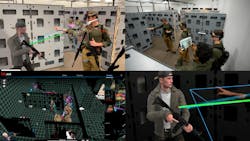
In 2021, InVeris came out with the VR-DT (Virtual Reality Decisions and Tactics) or ‘Verdict,” which was focused on training de-escalation of force in a wide variety of critical, real-world situations. The company’s next generation of fats VR system includes training in de-escalation, use-of-force and includes the use of non-lethal options. The system is designed for collective training and includes close-quarters situations. Feedback includes both real-time and After-Action Review, allowing instructors and officers to replay shooter actions from multiple views from enhanced training recognition to de-escalation training.
Barrillas says that the entire program was revamped to be more applicable for the policies and procedures of law enforcement agencies. “One of the things about the system is that it’s more geared toward AI-driven technology. It makes it easier and more fluid for the instructor to keep the validity of the scenario going,” he says. “With the new fats VR system, we empower instructors to create their own curriculum. The purpose of that is because as vendors, we don’t know how agencies like to train their officers. So, we empower them with everything they need to create their own curriculum.”

As with traditional screened simulators, fats VR minimizes the need for role players, but through the use of AI, it is able to take that ability a step further. “The system is powered by one instructor. If I want to use female characters inside my system, the officer will hear a female voice over the microphone. It doesn’t necessarily have to be a male character for a male instructor. It can be a female, an elderly man, whatever it is, but the system will adapt to that voice.” He added that the instructor is in full control of the suspect. “I can have him attack the officer. The officer’s job is to create space, as much as he can, to get that suspect off of him, then start using what he needs to do to actually take that suspect into custody,” he says. “If he hits him with a taser, he goes down, but the scenario is not over yet. He still has to place the suspect into custody.”
According to Barrillas, not only has the software advanced in short period of time, but so has the hardware. The headset is lighter, fewer computers are needed to operate the system, and the connection options are less cumbersome than in the past.
fats® AR
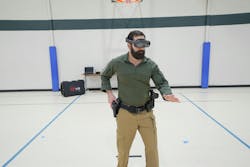
InVeris’ fats AR (Augmented Reality) Weapons Training system enables officers to train, rehearse for future live fire training and missions at the objective location or virtually with a new level of realism and performance assessment. Unlike VR systems that provide a fully virtual environment, fats AR blends real physical environments, obstacles and live team members with Computer Generated Imagery (CGI) virtual characters, avatars, and assets for a unique training experience.
Barrillas says that the new system, which was first developed for the military since 2021, but is now being marketed to law enforcement agencies as well. “I was in in Northern California recently, where this system was used at San Joaquin County’s annual squad competition. It was used as an evaluation for their operators. Over 200 operators, from about 20 agencies, were there competing, and they used the AR system as a stage,” he says.
One example of a use case is when training to respond to school shootings. Barrillas says that traditional role-playing scenarios can be complicated and involve a lot of set up and clean up. The characters in the fats AR scenarios are AI-driven. The motions and decisions aren’t repeated and can change with the scenario. “We can go and scan a school up to 10,000 square feet, and they can utilize the school for training with the system. You don’t need actors and all the stuff that goes into role playing,” he says. “The beauty of this system is, it allows you to apply your tactics, your real life skills to it, but it’s this after action. The instructor can pause it at any time, and we can review how that person is doing. He’s standing right there in real life, watching himself do the exercise.”
About the Author
 Paul Peluso
Paul Peluso
Editor
Paul Peluso is the Managing Editor of OFFICER Magazine and has been with the Officer Media Group since 2006. He began as an Associate Editor, writing and editing content for Officer.com. Previously, Paul worked as a reporter for several newspapers in the suburbs of Baltimore, MD.