Beyond the Four Rules: Rethinking Firearms Safety for Police Officers
What to Know
- The traditional four rules of gun safety remain essential but are often taught as memorized slogans rather than deeply understood principles.
- The first installment in a three-part series examines how concepts such as firearm status, trigger-finger placement and muzzle direction should be adapted to real-world law enforcement and defensive environments.
- Professional firearms training should move beyond rote compliance and focus on context, decision-making and verification.
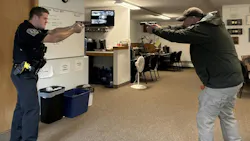
Editor's note: This is the first installment in a three-part series. Check out Part 2 next Wednesday, Oct. 7.
When I began writing for Officer.com, my first article was titled “The Value of Being a Contrarian in a Conformist Training Culture.” I chose that subject deliberately because it reflects how I have approached firearms and high-liability training throughout my career. I am not a contrarian for the sake of being argumentative, provocative or confrontational. There is little professional value in disagreeing simply to be different. The contrarian mindset I advocate is rooted instead in intellectual curiosity and a willingness to ask uncomfortable but necessary questions: Why do we do it this way? What problem was this practice, technique, or concept originally intended to solve? Is it still the best way to solve that problem? Can it be made safer, more efficient, more relevant or more consistent with what we now understand about human learning and performance? Tradition can provide an enormously valuable starting point, but it should never become the endpoint of professional inquiry.
In many respects, that mindset also represents the marriage of contrarian thinking with the higher levels of Bloom’s Taxonomy. Remembering a rule, understanding its basic meaning and applying it as instructed are important foundations, particularly for novice learners. Professional development, however, should eventually move beyond recall and compliance toward analysis, evaluation and, when justified, creation. We should be willing to deconstruct familiar or traditional practices, examine the assumptions embedded within them, compare them against evidence and operational reality, and construct better solutions when better solutions are available. That does not mean discarding established practices merely because they are old. It means respecting them enough to understand why they exist and questioning them enough to determine whether they can be improved. The traditional rules of firearms safety provide an excellent example of that process.
When Simple Rules Become Professional Doctrine
There is also a contradiction within professional firearms training that deserves examination. Police officers and other armed professionals operate in complex, rapidly changing environments in which perception, judgment, decision-making and firearm management may carry life-or-death consequences. Yet, much of our firearms training and gun-handling doctrine continues to rest upon the same short, elementary safety rules taught to someone handling a firearm for the first time. There is nothing inherently wrong with that simplicity. Foundational safety principles should be memorable, durable and easy to retrieve. The problem arises when an elementary rule becomes the ceiling of professional understanding rather than its floor. A professional should certainly be able to recite the rule, but professional competence should also require understanding why the rule exists, what risk it is intended to control, where its language may be incomplete and how its underlying principle must be applied when the environment no longer resembles a controlled firing line. The rule can remain simple. The professional’s understanding of it should not.
For establishing safe behavior with beginners, I am not convinced there are better foundational rules than the ones we already have. Their strength lies precisely in their simplicity. They are easy to remember, easy to communicate and broad enough to prevent many of the most common and catastrophic forms of gun-handling error. That simplicity is especially valuable when the learner has little experience, limited contextual understanding and only a rudimentary mental model of how firearms should be handled. At that stage, clear behavioral constraints are not merely useful. They are essential.
The mistake firearms instructors make is assuming that foundational simplicity should remain unchanged as knowledge, skill and application become more advanced. As shooters progress, and particularly as they move into defensive, occupational or law-enforcement contexts, the problems they are expected to solve become more complex. The environment becomes dynamic. Firearm status may change with purpose. Muzzle direction becomes contextual rather than fixed. Trigger-finger placement becomes tied to perception and decision-making. Ballistic accountability extends beyond a single target and a purpose-built backstop. If our understanding of firearms use becomes more sophisticated while our safety doctrine remains frozen at the introductory level, a gap eventually develops between the rule and the environment in which the rule must be applied. The foundational principle should remain intact, but its application should become more precise, contextual and professionally mature as the learner’s responsibilities expand.
Recently, in a previous Officer.com article, I wrote a sentence that, in retrospect, deserves a much deeper examination: “Range commands developed for safety and administrative control begin creeping into tactical assumptions” (Hanson, 2026b). That statement was not an argument against range commands, the traditional rules of gun safety or strict firearms safety standards. Quite the opposite. Firearms training is a high-liability activity in which a momentary lapse can produce irreversible consequences, and ranges require structure, discipline, standardization and clearly understood behavioral expectations. This is the first of a two-part examination of what can happen when we forget why those structures were created and quietly allow rules designed to control a firing line to become assumptions about how people should behave during an armed confrontation.
The traditional rules are seen by and known to virtually everyone in the firearms community:
- Always treat every gun as if it were loaded.
- Always keep your finger off the trigger until you are ready to shoot.
- Always keep the gun pointed in a safe direction.
- Always know your target and what is beyond it.
They are routinely described as the “universal” or “non-negotiable” rules of safe gun handling, and appropriately so. Yet, I have watched countless firearms safety briefings wherein those words can become ceremonial. The rules appear on the PowerPoint slide, the instructor recites them, students repeat them, somebody asks whether everyone understands and the safety-briefing box is subsequently checked. What should be a substantive discussion of risk, context and human behavior can deteriorate into four sentences that are perniciously parroted in their raw form because the curriculum says they must be spoken. Recitation is then mistaken for a deeper, contextual understanding.
That distinction is especially consequential for newer shooters. An experienced firearms instructor hears “safe direction” and may immediately visualize muzzle orientation, backstops, ballistic containment, movement, people entering or leaving the environment and the consequences of a negligent discharge. A novice shooter may hear exactly two words: safe direction. The instructor hears “know your target and what is beyond it” through years of accumulated experience involving target identification, foreground and background discrimination, overpenetration, missed shots and changing environments. The inexperienced student, however, may understand little more than “make sure there is a berm behind the target.” Both instructor and student heard the same sentence, but they did not necessarily construct the same mental model from it.
The Problem With Memorization Without Understanding
This is where the curse of expertise becomes particularly relevant. Expertise changes how information is organized and understood. Once knowledge has been deeply integrated, experts can have difficulty reconstructing what the same information looks like to someone who does not yet possess that framework. Research on expert advice and instruction has found that established experts may underestimate the difficulty novice students experience, struggle to adopt the novice student’s perspective, and communicate at levels of abstraction. That abstraction may make perfect sense to the expert; however it routinely leaves important conceptual gaps for the learner (Zhang et al., 2022). In firearms instruction, that can mean an instructor sincerely believes a safety principle has been thoroughly taught because its meaning seems self-evident to him. The problem is that it became self-evident only after years of experience the student does not yet have.
The instructor therefore has an obligation to teach beyond the slogan. What does “loaded” actually mean, and how do we know the firearm’s condition rather than assume it? What makes a direction “safe,” and can that direction change as people, vehicles and environmental conditions change? What exactly does “ready to shoot” mean, and what perceptual and decisional conditions should exist before the trigger finger moves? What does it mean to know what lies beyond a target when bullets can miss, penetrate, deflect or travel through environments occupied by people we never intended to endanger? Those questions transform four memorized statements into concepts that can actually guide behavior.
These rules have tremendous value because they simplify complex risk management into memorable behavioral constraints. For introductory, academy-level firearms instruction, that simplicity is enormously useful. Simplicity, however, should be the gateway into understanding instead of a roadblock to it. The problem arises when the overly simplified memory aid becomes doctrine, the explanation stops at the slogan, and a useful heuristic or decision-making shortcut is mistaken for a complete model of the problem. If students can recite all four rules perfectly but cannot explain why they exist, how they interact or how their application changes with context, we have demonstrated memorization, not necessarily comprehension.
There is an institutional component to this problem as well. Firearms training does not develop in a vacuum. Rules, commands, drills and instructional language are transmitted from one generation of instructors to the next, often through highly standardized certification systems. That continuity serves legitimate purposes. It promotes consistency, creates common expectations and preserves practices that have contributed to decades of safe range operations. But continuity can also create inertia. Once a particular formulation has been taught long enough, written into enough lesson plans and repeated by enough respected instructors, its familiarity becomes a substitute for examination of its original purpose.
I addressed this problem in Unlocking the Brain Code, writing that, “When the same drills, range commands, and lesson structures are repeated across generations, they become normalized. Familiarity becomes equated with legitimacy” (Hanson, 2026a, p. 25). That is not an indictment of tradition. It is a warning about what can happen when tradition stops being interrogated. A rule may remain fundamentally sound while the explanation surrounding it becomes progressively thinner. Context disappears, nuance is compressed and eventually the next generation receives the wording without necessarily receiving the reasoning. At that point, institutional inertia does not merely preserve the rule. It can preserve an increasingly simplified interpretation of the rule.
In my own training programs, I use five modified rules for safe gun handling. They are not intended as a repudiation of the traditional rules of firearms safety. They are an attempt to make explicit several things that the traditional rules leave implicit, particularly when training people who carry firearms for defensive or duty purposes. Firearms used primarily for recreation usually exist within carefully controlled environments. Firearms carried by police officers, armed professionals and lawful defenders must eventually function in environments that are uncontrolled, changing and frequently ambiguous. That difference between the controlled range and the operational environment is where administrative assumptions regarding traditional firearms safety rules can begin creeping into tactical thinking.
Traditional Rule #1: Always treat every gun as if it were loaded
Consider the traditional first rule: Always treat every gun as if it were loaded. It is elegant because it creates a conservative default. If I behave around an unknown firearm as though it contains live ammunition, I reduce the consequences of being wrong. As an introductory heuristic, it makes tremendous sense. For someone who routinely carries, stores, transports, cleans, inspects, dry practices with and trains with firearms, however, “treat it as if” is not enough. My first rule is therefore different: Always know and verify the status of your firearm. The firearm’s condition must be safe and appropriate for its intended use, environment and purpose (Critical Dynamics, n.d.).
That distinction is consequential because firearm status is not merely a safety issue in the conventional sense. It is also a readiness issue. Firearms instructors devote enormous attention, appropriately, to preventing someone from mistakenly believing a loaded firearm is unloaded. Yet the inverse error can carry equally grave consequences when the firearm is expected to be immediately operational. An unloaded firearm masquerading as a loaded firearm can have fatal consequences just as surely as a loaded firearm that has been presumed, but not verified, to be unloaded. The underlying problem in both cases is identical: The operator has substituted assumption for knowledge.
Verification Is Not the Same as Procedure
I see this regularly during drills and, perhaps more concerningly, during qualification courses. A student inserts a magazine, manipulates the firearm in whatever manner the course requires and proceeds on the assumption that the weapon is ready. What is often missing is an independent verification that a round actually chambered. The shooter knows what he intended to accomplish and may remember performing the actions normally associated with loading, but intention and mechanical sequence are not proof of firearm condition. Magazines may not seat completely. A slide or bolt may fail to strip a cartridge from the magazine and feed it into the chamber. Administrative handling, remedial actions or interruptions may leave the weapon in a different condition than the shooter remembers. If immediate defensive readiness is required, the relevant question is not, “Did I load my firearm?” It is, “Have I verified that my firearm is loaded?”
Consider the inverse. If we would never accept uncertainty when a firearm is supposed to be unloaded, why should we accept it when the firearm is supposed to be loaded? Imagine treating “I think it is unloaded” as sufficient and deciding that a redundant visual and physical inspection of the chamber, receiver, magazine well and any other location capable of containing ammunition was unnecessary. No competent firearms instructor would accept that standard. We demand verification because the consequences of being wrong are too serious to tolerate assumption.
The same logic should apply in the opposite direction. If the firearm is expected to be immediately operational, “I think it is loaded” should not be considered an adequate standard either. The condition may be different, but the cognitive requirement is identical: uncertainty should be resolved rather than accommodated. We already understand this instinctively when verifying that a firearm is unloaded. Professional gun handling should apply the same discipline when verifying that a firearm is loaded.
This is precisely why I emphasize loaded-chamber verification and demand it during training, including the appropriate use of a press check or another reliable condition-verification method suited to the specific firearm. The point is not to create another ritualized manipulation that students perform because an instructor expects to see it. The purpose is epistemic certainty. A properly performed verification closes the gap between what the shooter believes about the firearm and what is mechanically true. The shooter is not relying on memory, sequence completion or assumption. The shooter has deliberately confirmed the condition of the weapon.
The same reasoning applies in the opposite direction. When a firearm must be unloaded for cleaning, maintenance, dry-fire practice, manipulation training, storage or another administrative purpose, verification must establish that condition rather than merely presume it. In my programs, that means treating “unloaded” as a condition that must be positively established, not inferred because a magazine was removed or because somebody else said the firearm was clear. Likewise, when the firearm is supposed to be loaded for duty or lawful defensive carry, “loaded” should also be positively established. The cognitive principle is the same in both directions: Know the condition rather than assume the condition.
Training Tools Reveal the Limits of Literal Interpretation
Advanced firearms training provides an excellent example of why that distinction is crucial. Purpose-built training pistols such as GLOCK’s P- and R-series models are specifically designed for realistic firearms training, duplicating the handling characteristics, dimensions and balance of operational pistols while eliminating live-fire capability. GLOCK’s reset pistols serve a similar role in dry-fire and simulator-based training (GLOCK, n.d.).
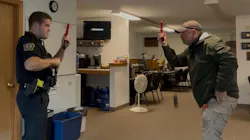
Likewise, firearms safety and training systems such as the BarrelBlok and RifleBlok allow an officer’s actual duty handgun or patrol rifle to be safely converted into a visibly identifiable, mechanically disabled, non-chambering, inert, dry-fire training platform that prevents live ammunition from entering the chamber (Law Enforcement D.R.A.W. School, 2014, BarrelBlok.com, n.d.). These tools exist precisely because higher-level training sometimes requires officers to manipulate, orient and use firearms in ways that would be wholly inappropriate if those firearms were capable of chambering and firing live ammunition. GLOCK itself describes its practice pistols as training tools intended to provide realistic handling “without any firing capability,” while the BarrelBlok/RifleBlok system is specifically designed to permit realistic training with an otherwise operational firearm that has been rendered completely safe and inert.
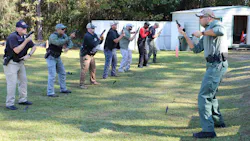
Taken literally and without context, “always treat every firearm as if it were loaded” would appear to prohibit much of this training. If the firearm must always be behaviorally treated as though it can launch a projectile, then pointing it toward another participant during properly controlled force-on-force, weapon-retention, close-contact or other high-fidelity training would seemingly violate the rule by definition. Yet sophisticated training programs, such as Law Enforcement D.R.A.W. School, safely use inert and mechanically disabled platforms precisely because the firearm’s actual safe status has been deliberately established and controlled. This does not weaken safety doctrine. It demonstrates the need for greater precision within it.
The relevant question is not whether the object looks, feels or once functioned like a loaded firearm. The relevant question is whether its current condition has been positively established and whether that condition is appropriate for the training environment. A verified inert training firearm should be managed as a verified inert training gun within a properly controlled training environment, just as a loaded duty handgun should be managed as a loaded duty pistol when operational readiness is required. Safety comes from knowing the condition, controlling the environment and matching both to the intended task, not from simple demands that every firearm exists perpetually in the same state, or pretending that it in fact does.
This is more cognitively demanding than the traditional formulation because it requires context. A firearm being cleaned should be unloaded. A firearm being used for dry-fire practice should be unloaded, with live ammunition removed from the training environment. A firearm carried for duty or lawful personal protection normally exists in a deliberately loaded condition.
A firearm being used with inert ammunition requires another condition entirely, because the critical requirement is not simply that the firearm be “unloaded,” but that live ammunition be excluded from the training environment. Even that distinction, however, deserves closer examination. The presence of dummy ammunition does not itself render a firearm inert. A conventional duty or defensive firearm loaded with dummy rounds remains mechanically capable of accepting, chambering and firing a live cartridge. The firearm cannot determine whether the cartridge presented to it was intentionally selected for training or inadvertently introduced into the system. If a live round enters a magazine, ammunition container or training sequence, the firearm will treat it exactly as it was designed to treat any other compatible cartridge. The U.S. Army documented precisely that kind of failure in a fatal training accident in which a live round became mixed with dummy ammunition, was ultimately chambered in a weapon being used for training and killed a soldier (Peaster, 2011).
That is why I draw an important distinction between training with dummy ammunition and physically rendering a firearm incapable of firing live ammunition. Systems such as GLOCK’s purpose-built Practice pistols remove firing capability from the training platform altogether, while a properly installed BarrelBlok physically occupies the chamber and prevents a live cartridge from being chambered (GLOCK, n.d.; Law Enforcement D.R.A.W. School, 2014). Those approaches introduce a mechanical barrier between training and a live-fire event rather than relying exclusively on ammunition identification, segregation and human memory. Dummy rounds still have legitimate training applications, but when the exercise involves higher-intensity manipulation, close interpersonal contact or circumstances in which firearms will intentionally be oriented in directions that would be unacceptable during live fire, I want more than the assumption that only dummy ammunition is present. I want the training system configured so that a live cartridge cannot enter the chamber in the first place. The appropriate firearm condition therefore depends on purpose, and increasingly sophisticated training should seek not merely to reduce the likelihood of a ballistic mistake, but wherever practical to engineer that possibility out of the training environment.
There is also an important learning issue here. Range culture can unintentionally teach students that completing a prescribed loading sequence is equivalent to confirming weapon status. An instructor gives the command to load. The student performs the expected manipulation. The class moves on. Because the sequence usually works, successful repetition reinforces confidence in the sequence itself. Eventually the learner may stop distinguishing between performing the loading procedure and verifying its outcome. Those are not the same thing. One is an action. The other is confirmation that the action produced the intended mechanical state.
That difference becomes particularly important outside the controlled range. Under operational conditions, there may be no instructor standing behind the shooter, no standardized command sequence and no second opportunity to discover that the weapon was not actually in the condition the operator believed it to be. A click when a shot was expected is more than a mechanical inconvenience. In a violent encounter, it can consume the very interval during which effective action was required. The lesson should therefore be established much earlier: The status of a firearm is not something we infer from what we remember doing to it. It is something we verify.
This distinction illustrates the larger problem with inherited range doctrine. A simplified safety rule can become so familiar that the simplification itself acquires authority. We eventually stop asking what problem the rule was designed to solve. Ritual replaces analysis, the learner memorizes the phrase, demonstrates compliance and passes the test. Everyone feels safer because the expected words were spoken, but safety ultimately depends on understanding the condition that actually exists rather than merely reciting the rule associated with it.
That is why I prefer “always know and verify the status of your firearm” to “treat every firearm as if it were loaded.” The traditional rule remains an excellent conservative default when condition is unknown. My version adds what the traditional rule does not expressly demand: resolve the uncertainty. If the firearm should be unloaded, verify that it is unloaded. If it should be loaded, verify that it is loaded. If the firearm’s condition directly affects safety, readiness or survival, assumption is not an acceptable substitute for knowledge.
Traditional Rule #2: Always keep your finger off of the trigger until ready to shoot
The same problem appears in the traditional instruction to always keep the finger off the trigger until ready to shoot. Again, the intent is sound. The problem is that “ready to shoot” contains ambiguity. Ready based on what? Ready because the firearm has been presented? Ready because the sights are aligned? Ready because a timer has sounded or an instructor issued a command? My corresponding rule adds an explicit perceptual and decisional requirement: Always keep your finger off the trigger and off the trigger guard until you have positively identified your target and are ready to fire a shot (Critical Dynamics, n.d.). I also teach students to index the trigger finger high along the frame-to-slide interface, creating a consistent tactile reference point that keeps the finger well away from both the trigger and the trigger guard.
That indexing position serves a purpose considerably more important than appearance or range conformity. Human beings do not maintain perfectly isolated voluntary control of individual muscles when startled, destabilized or exerting force elsewhere in the body. Research into involuntary firearms discharges has demonstrated that motor activity involving other limbs can produce increases in grip force and involuntary finger contractions, sometimes generating enough trigger pressure to discharge a firearm if the finger is already in contact with the trigger (Heim et al., 2006). Analyses of law-enforcement unintentional discharges have also documented incidents associated with startle responses, while earlier research has identified loss of balance, sudden protective reactions and forceful muscular contractions as circumstances capable of producing unintended trigger activation (O’Neill et al., 2018). Keeping the trigger finger positively indexed high on the frame therefore does more than satisfy an administrative rule. It creates physical separation between a potentially reflexive contraction and the mechanism that fires the weapon.
That may sound like a minor wording and positioning change, but cognitively and physiologically it is not. It connects trigger-finger placement to information processing rather than merely weapon presentation while simultaneously acknowledging that not every muscular response occurring during a violent encounter will be consciously initiated. The trigger is not approached by the trigger finger because a mechanical sequence has reached a particular point. It is approached because perception and decision have justified the action. Until that moment, the finger remains indexed in a location that provides a repeatable tactile reference and helps protect against an involuntary contraction becoming an unintended discharge.
There is another reason I prefer a deliberate, high tactile index, and it relates to the relationship between vision and motor action. Human movement is strongly influenced by where visual attention is directed, a perceptual-motor relationship commonly described in terms of gaze-action or perception-action coupling. The eyes do not merely observe the environment while the hands independently perform a learned mechanical sequence. Visual information helps organize, guide and continuously update motor behavior. In firearms performance, that relationship becomes particularly important when time, distance or threat conditions make a deliberate visual transition from the external threat to a sharply defined sight picture impractical. (This topic will become the focus on an upcoming featured article.)
This distinction becomes especially important when we consider how most conventional firearms drills are structured. On a square range, the student often knows almost everything that needs to be known before the drill begins. The target has already been designated. It is known to be a shoot target. The distance is known, the direction is known and the backstop is known. The shooter waits for a command or buzzer, performs a prescribed sequence and fires a predetermined number of rounds. Under those conditions, the decision to shoot was effectively made before the exercise started.
Repeat that structure thousands of times and the learner can become extraordinarily proficient at responding to the start signal. What has actually been practiced, however, may be stimulus-response execution rather than target discrimination. The finger moves toward the trigger because the buzzer sounded, the target is already known and the drill architecture has preauthorized the shot. That does not make the drill useless. It simply means we should be honest about what the drill teaches and avoid confusing clean execution on a known problem with decision-making capability in an unknown one.
Soderstrom and Bjork (2015) make precisely this distinction between performance during acquisition and durable learning. Immediate improvements in performance can occur without corresponding gains in long-term retention or transfer. In Unlocking the Brain Code, I make the same point more bluntly: “When training environments consistently favor immediate fluency, they sacrifice the variability that strengthens adaptability” (Hanson, 2026a, p. 95). The danger is not repetition itself. The danger is repetition performed under conditions so predictable that the learner becomes highly efficient at solving only the training problem. When every presentation automatically culminates in a trigger press, we may also be teaching the motor sequence to outrun the perceptual and decisional processes that should govern it.
Traditional Rule #3: Always keep your gun pointed in a safe direction
The third traditional rule instructs the shooter to always keep the gun pointed in a safe direction. My corresponding rule retains the concept but deliberately adds context: Always keep your firearm pointed in a safe direction, and let your operational environment determine what the safest direction happens to be (Critical Dynamics, n.d.). On a square range, “safe direction” is remarkably easy to understand. It is downrange, and terminates at the berm or backstop. Range architecture establishes the acceptable orientation, berms manage projectile containment and instructors can immediately correct deviation.
That structure is indispensable when several shooters are standing shoulder to shoulder with loaded firearms. The problem occurs when “downrange” becomes a cognitive model rather than a range-management convention. There is no permanent downrange in a parking lot, residence, school, stairwell, hospital, traffic stop, restaurant or rapidly changing critical incident. People move. Officers move. Other officers enter and leave positions. Innocent people can occupy what appeared to be a relatively safe direction only a second earlier. Walls, windows, vehicles and open spaces change what lies along potential projectile paths.
In an operational environment, safe direction is therefore a problem that must be continuously solved rather than a fixed geographic feature. Advanced firearms training provides another useful illustration of why “safe direction” must ultimately be understood contextually rather than merely geographically. Purpose-built training pistols such as the GLOCK 17P and 22P, along with reset models such as the 17R, exist specifically so officers can perform realistic gun-handling tasks without the firearm being capable of firing live ammunition. GLOCK describes its Practice pistols as duplicating the handling, weight, size and balance of an operational pistol while eliminating firing capability (GLOCK, n.d.). Similarly, the BarrelBlok safety system allows an officer’s actual duty or defensive firearm to be rendered inert, mechanically incapable of chambering live ammunition while retaining the dimensions, controls and handling characteristics of the weapon the officer actually carries; (Law Enforcement D.R.A.W. School, 2014, BarrelBlok.com). These systems make possible higher-intensity, higher-fidelity training in three-dimensional environments that would be unacceptable with a live, operational, or unprotected firearm.
If the traditional instruction to “always keep your firearm pointed in a safe direction” is interpreted as meaning that a muzzle may never be intentionally oriented toward another participant under any circumstances, then much of this sophisticated training would appear to violate the rule. It does not. What has changed is the verified condition of the training system and, consequently, the definition of what constitutes a safe direction within that controlled environment. A purpose-built inert training pistol, or an operational firearm that has been deliberately rendered inert, positively verified and introduced into a controlled training environment from which live ammunition has been excluded, presents a fundamentally different level and type of risk than a loaded duty weapon. This is precisely why I teach that the operational environment must determine the safest direction. “Safe” is not an abstract geographic property permanently attached to downrange. It emerges from the interaction among firearm condition, environment, purpose and foreseeable consequences. Advanced training does not abandon muzzle discipline. It requires a more sophisticated understanding of what muzzle discipline actually means. I have personally participated in advanced training programs where students demonstrated better muzzle discipline because they more fully understood, both cognitively and physically, what proper muzzle management required.
This is where representative learning design becomes important. Practice conditions do not have to perfectly duplicate reality, but the information guiding performance should increasingly resemble the information that comes into play when the skill is actually used. Barnett and Ceci’s work on transfer demonstrates why this is important. Transfer does not occur as a simple all-or-nothing property of learning. It depends in part on how dimensions of the learning environment correspond to dimensions of the later performance environment (Barnett & Ceci, 2002).
Police firearms training makes this especially consequential. Di Nota and Huhta (2019) argue that police motor performance cannot be meaningfully separated from situational awareness and decision-making. An officer does not merely execute a motor program. The officer perceives information, interprets meaning, selects an action and physically carries that action out. When training isolates the movement while systematically removing the information that should control the movement, incomplete transfer should not surprise us.
The first three traditional rules of firearms safety therefore expose a common theme. Firearm status, trigger-finger placement and muzzle direction are not merely positions or procedures to be memorized. They are problems that must be continually resolved through perception, context and judgment. The traditional rules remain indispensable, but their greatest value emerges when instructors teach the reasoning beneath them rather than stopping at the words themselves. That is where safety begins moving from administrative compliance toward durable operational understanding.
In Part Two, I will examine the traditional command to “know your target and what is beyond it,” why I believe armed professionals should instead think in terms of a two-way arc of fire, and why a fifth rule addressing a falling firearm belongs alongside the traditional four. I will also return to Rule No. 3 and challenge another deeply embedded firearms-safety maxim: “Never point a gun at anything you don’t intend to kill or destroy.” The intent behind that phrase is unquestionably sound, but its wording creates tactical, cognitive and even legal implications that deserve much closer scrutiny when we are training police officers and other armed professionals. From there, the larger issue comes into focus: how familiar safety language, administrative range commands and highly predictable training structures can gradually become embedded as tactical assumptions, even when the operational environment bears little resemblance to the firing line.
References
Anderson, L. W., & Krathwohl, D. R. (Eds.). (2001). A taxonomy for learning, teaching, and assessing: A revision of Bloom’s taxonomy of educational objectives (Abridged ed.). Longman.
Barnett, S. M., & Ceci, S. J. (2002). When and where do we apply what we learn? A taxonomy for far transfer. Psychological Bulletin, 128(4), 612-637.
Critical Dynamics, Inc. (n.d.). Five rules for safe gun handling [Training handout].
Di Nota, P. M., & Huhta, J. M. (2019). Complex motor learning and police training: Applied, cognitive, and clinical perspectives. Frontiers in Psychology, 10, 1797.
Law Enforcement D.R.A.W. School. (2014) Safety: BarrelBlok.
GLOCK Ges.m.b.H. (n.d.). GLOCK practice and reset pistols.
Hanson, K. A. (2026a, September 16). Are firearms instructors teaching proven methods or repeating tradition? Officer.com.
Hanson, K. A. (2026b). Unlocking the brain code: Exposing the limitations of traditional firearms training and high-liability instruction through neuroscience, psychology, and human performance research. Applied Threat Science Publications.
Hanson, K. A. (2026c, March 11). The value of being a contrarian in a conformist police training culture. Officer.com.
Heim, C., Schmidtbleicher, D., & Niebergall, E. (2006). The risk of involuntary firearms discharge. Human Factors, 48(3), 413-421.
Olma, J., Sutter, C., & Sülzenbrück, S. (2024). Blended police firearms training improves performance in shoot/don’t shoot scenarios: A systematic replication with police cadets. Frontiers in Psychology, 15, 1495812.
O’Neill, J., Hartman, M. E., O’Neill, D. A., & Lewinski, W. J. (2018). Further analysis of the unintentional discharge of firearms in law enforcement. Applied Ergonomics, 68, 267-272.
Peaster, R. (2011, June 1). From BBs to bullets. The United States Army. https://www.army.mil/article/58680/from_bbs_to_bullets
Soderstrom, N. C., & Bjork, R. A. (2015). Learning versus performance: An integrative review. Perspectives on Psychological Science, 10(2), 176-199.
Vickers, J. N., & Lewinski, W. (2012). Performing under pressure: Gaze control, decision making and shooting performance of elite and rookie police officers. Human Movement Science, 31(1), 101-117.
Zhang, T., Harrington, K. B., & Sherf, E. N. (2022). The errors of experts: When expertise hinders effective provision and seeking of advice and feedback. Current Opinion in Psychology, 43, 91-95.
About the Author
 Keith Hanson
Keith Hanson
Contributing Editor Keith Hanson is a career law enforcement professional with extensive experience across operational and instructional domains, specializing in firearms instruction, tactical operations training, and counterterrorism tactics. With a strong background in neuroscience and psychology, Keith is a co-creator and senior program architect of NeuralTac™, which combines neuroscience, combat psychology, neuropsychology, kinesiology, and educational sciences, drawing from the latest research in human performance, to produce advanced high-liability instructional frameworks for law enforcement agencies, contract security firms, and other armed professionals. It also aims to develop and foster advanced-level master trainers within those organizations. Additionally, as a certified Force Science analyst and certified cognitive/forensic interviewer, Keith serves as a court-recognized expert witness on use-of-force matters and provides consultation on legal strategies. He is the author of "Unlocking the Brain Code: Exposing the Limits of Traditional Firearms Instruction and High-Liability Training Through Neuroscience, Psychology, and Human Performance Research."
You can email Keith: [email protected]
And visit his LinkedIn page: https://www.linkedin.com/in/keithhanson1973/