Why Firearms Safety Rules Need More Than Range-Based Thinking
What to Know
- Traditional firearms safety rules remain essential, but applying them effectively requires judgment, target identification and environmental awareness beyond the controlled conditions of a firing range.
- Real-world incidents highlight the importance of understanding both what a bullet may strike beyond a target and what may be in the path of an adversary's gunfire during an armed encounter.
- A proposed fifth safety rule, never try to catch a falling firearm, aims to address instinctive human reactions that can lead to accidental shootings.
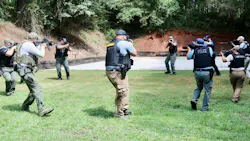
Editor's note: This is the second installment in a three-part series. Check out Part 3 next Wednesday, Oct. 14.
This is the second of a three-part examination of how firearms safety rules and administrative range practices can gradually become something they were never intended to be: tactical assumptions. In Part One, I examined the first three traditional rules of gun safety and argued that simply memorizing them is not the same as understanding them. Knowing firearm status, managing trigger-finger placement and maintaining a safe muzzle direction are not static acts. They require context, perception and judgment. The same is true of the traditional fourth rule, but this is also where the limitations of one-directional range thinking become particularly apparent.
Part One therefore focused less on replacing the traditional rules than on making their underlying demands more explicit. The traditional instruction to ‘treat every gun as if it were loaded’ became a broader requirement to know and verify the firearm’s actual status, ensuring that its condition is appropriate to its intended use rather than relying on assumption in either direction. Keeping the finger off the trigger became more than a positional command; it was tied to positive identification, perception and the deliberate decision to fire. Likewise, “keep the gun pointed in a safe direction” was reframed as a continuously changing environmental problem rather than a permanent reference to whatever happens to be downrange.
The broader lesson was that range safety principles can lose important meaning when they are reduced to memorized phrases or practiced only within predictable firing-line architecture. A shooter can become highly proficient at responding to commands, buzzers, known targets and fixed directions without necessarily developing the same ability to recognize and solve safety problems when those cues disappear. The objective is not to weaken traditional safety doctrine, but to ensure that the learner understands the problem each rule is intended to control well enough to apply that principle when the environment becomes dynamic, ambiguous and unscripted. The fourth rule brings that distinction into especially sharp focus.
Traditional Rule #4: Always know your target and what is beyond it.
The traditional fourth rule tells the shooter to know the target and what is beyond it. That remains absolutely necessary. Case in point: On Sept. 18, 2026, 39-year-old Santos Maria Chilel Soto was walking through an open field near Ellendale, Delaware, with a man and two children when she was fatally shot. According to Delaware State Police, 74-year-old Walter Moorhead was hunting deer from a ground blind, believed he saw a deer and fired his rifle, striking Soto instead. Moorhead was subsequently charged with manslaughter, possession of a firearm during the commission of a felony and three counts of first-degree reckless endangerment. The homicide investigation remains ongoing, and Moorhead is presumed innocent unless and until proven guilty.
The context was hunting rather than police firearms training, but the underlying safety lesson is universal. Seeing something that appears consistent with a target is not the same as positively identifying the target. Recognition must precede the decision to fire, and uncertainty should interrupt that sequence rather than accelerate it. “Know your target” is therefore not simply a reminder to look in the general direction of what you intend to shoot. It establishes a perceptual threshold that should be satisfied before a projectile is launched. If the shooter has not resolved what he is actually seeing, then the decision-making process is incomplete.
The second half of the traditional rule, knowing what is beyond the target, can be every bit as consequential. On Dec. 23, 2021, Los Angeles police officers responded to reports of an active shooter inside a Burlington store in North Hollywood, California. Officers eventually encountered 24-year-old Daniel Elena Lopez, who had violently assaulted customers with a bicycle lock. Officer William Dorsey Jones Jr., who was armed with a patrol rifle, fired three rounds at Elena Lopez from inside the store. Lopez was fatally struck, but one of the rounds hit the floor, changed direction and penetrated the wall of a nearby fitting room. On the other side of that wall was 14-year-old Valentina Orellana-Peralta, who had been inside the fitting room with her mother. The bullet struck and killed her (California Department of Justice, 2024).
Valentina was completely uninvolved in the confrontation. The officer could not see her, and she was separated from the engagement by a wall. Yet she was still part of the ballistic environment into which the rifle was fired. That distinction is critical. “Beyond the target” does not mean only the person visibly standing directly behind the intended target. It means the entire potential path of the projectile if the round misses, passes through, deflects, changes direction after striking another surface or continues into portions of the environment the shooter cannot see. Walls conceal people. Doors conceal people. Vehicles, furniture, glass and other surfaces can alter what a projectile does after it leaves the muzzle. The fact that we cannot see what occupies those spaces does not remove those spaces from the ballistic problem.
The legal and administrative aftermath of the North Hollywood shooting also underscores why the incident should be discussed carefully as a training example rather than reduced to a simplistic judgment about the officer. The California Department of Justice concluded in 2024 that there was insufficient evidence to support criminal prosecution of Jones. The Los Angeles Police Commission had previously determined that his first shot was within department policy but that his second and third shots were not, although investigators did not establish which of the three rounds struck Valentina. In May 2026, a civil jury found the officer and city were not negligent in her death. Those different conclusions addressed different legal and administrative questions. None changes the central firearms-safety fact: A projectile fired at an identified threat traveled somewhere the officer did not intend and killed a person he could not see.
Taken together, the Delaware and North Hollywood cases illustrate both components of the traditional fourth rule. Before firing, we must know what we are shooting at, and we must remain accountable for the environment into which the projectile is being launched. One failure concerns identification. The other concerns what happens after the trigger is pressed. Both reinforce why the rule remains indispensable.
Even so, I believe the traditional rule remains incomplete for people carrying firearms into potentially armed encounters. My fourth rule therefore requires the shooter to know the two-way arc of fire. That means considering what your projectile can strike if it misses or passes through the intended target while also considering what an incoming projectile could strike if it misses you or passes through you (Critical Dynamics, n.d.). In other words, ballistic accountability cannot end at the muzzle of your own firearm. In an armed confrontation, the geometry of danger extends in both directions.
A tragic 1997 shooting at the Barstow Station McDonald’s in Barstow, California, provides a painful illustration of why that distinction is so important. Off-duty Barstow Police Department Corporal Chris Carter was at the restaurant with his family when he learned that an armed robbery was underway. Carter reportedly helped move patrons toward safety before confronting the robber, convicted felon Kenneth Lemond, and an exchange of gunfire followed. Lemond was fatally wounded, and Carter escaped the confrontation without injury. Nine-year-old Amanda Robertson, who was visiting the restaurant with her family, was struck and killed by a round fired by Lemond during the exchange. Contemporary investigators determined that Amanda had been standing approximately 30 feet behind the officer when she was struck. She was neither participant’s intended target, yet she occupied the ballistic environment created by the gunfight.
That incident captures something the conventional phrasing of “know your target and what is beyond it” does not fully communicate. Carter needed to account for what was behind Lemond, but the lethal problem did not exist only in that direction. Once rounds began traveling both ways, Carter was also in another person’s line of fire, and anyone positioned behind or around him potentially occupied that same ballistic path. A two-way arc of fire asks the officer to understand both sides of that geometry whenever circumstances permit: What will my projectile strike if I miss or over penetrate, and what might an adversary’s projectile strike if it misses me or passes through me? That does not mean an officer can mathematically solve every variable in the middle of a rapidly unfolding gunfight. It means our training should at least teach officers to perceive the environment as a multidirectional ballistic problem rather than a one-directional shooting lane.
Traditional range architecture encourages exactly the opposite mental model. We stand on one side of a line, face one direction and send projectiles toward the other side. Berms, target placement and firing-line controls reinforce the idea that the primary safety problem exists in front of us. On the range, that model is both practical and necessary. Operational gunfire, however, is not organized that way. There is no guaranteed berm behind the threat and no clean firing line separating participants from bystanders. People move, officers move, other officers enter and leave positions, and innocent people can suddenly occupy areas that appeared relatively clear only moments earlier. A potential ballistic problem therefore has geometry in both directions, and an officer must think not only about what is behind the person presenting a threat, but also about the environment around and behind himself, his partner and everyone else present.
The point is not to turn safety rules into a complicated tactical equation or to second-guess officers who have seconds, or fractions of seconds, to respond to lethal threats. The point is to stop allowing the physical architecture of the range to define the architecture of our thinking. When the range is always linear, the learner can begin to think linearly. When the target is always obvious, the learner can begin to assume targets will be obvious. When bullets always travel toward a purpose-built berm, the learner can begin to conceptualize ballistic risk primarily in one direction. And when every problem begins with a whistle, buzzer or verbal command, the learner can become exceptionally efficient at responding to artificial start cues without developing the same sensitivity to meaningful changes in the operational environment.
The Barstow shooting is a painful reminder that real-world gunfire creates consequences beyond the intended participants. The officer’s line of fire requires consideration, but so does the offender’s. The environment behind the threat is consequential, but so is the environment behind the officer. That is why I prefer to teach a two-way arc of fire rather than stopping at the traditional instruction to know what lies beyond the target. The older rule remains correct. The expanded rule forces us to consider the entire environment through which bullets may travel.
New Rule #5: Never attempt to catch a falling firearm; let it come to rest, then recover and inspect it when safe.
My fifth rule addresses something the conventional four do not explicitly discuss: Never try to catch a gun that has fallen, slipped from your grasp or escaped positive control. Let it fall. Once the firearm has come to rest and conditions permit safe recovery, recover and inspect it appropriately (Critical Dynamics, n.d.). That rule exists because human beings possess powerful reflexive responses. When we drop a cell phone, keys or a coffee cup, our instinct is often to grab for it before it reaches the ground. That reflex may be harmless when catching a set of keys. It can become dangerous when the falling object contains a trigger, trigger guard and loaded firing mechanism.
Consider what happened in Berwick, Pennsylvania, in October 2017. Twenty-eight-year-old Kenneth Morris of Nescopeck was reaching into the back seat of a vehicle to comfort his crying child when a .357 Magnum fell from his shoulder holster. According to police, Morris instinctively attempted to catch the falling handgun and, in doing so, inadvertently pulled the trigger. The round struck him in the abdomen. He was transported to Geisinger Medical Center, where he died several hours later. Police said the entire incident, which occurred in the driveway of a home, was captured on surveillance video and was classified as an accidental shooting.
The tragedy illustrates why “never try to catch a falling gun” deserves to be taught as an explicit safety rule rather than left to common sense. The problem is not that people consciously decide that grabbing a loaded firearm by the trigger area is a good idea. The problem is that they may not consciously decide at all. A suddenly falling object can trigger an immediate, well-practiced reach-and-grab response before deliberate reasoning has time to intervene. With an ordinary object, that reflex may prevent damage. With a firearm, the same reflex can place the hand or fingers unpredictably around the trigger and controls at precisely the moment the weapon is moving beyond positive control. Good firearms safety therefore has to account not only for what people intend to do, but also for what the human nervous system may attempt to do automatically when something unexpected happens. The safest response is deliberately counterintuitive: Do not chase the gun. Let gravity win, allow the firearm to come to rest, and then recover it when the environment permits.
Good safety design anticipates predictable human behavior rather than assuming people will overcome it when surprised. That same principle should apply more broadly to firearms training. If we know humans develop habits around repeated cues, predictable sequences and environmental structure, then instructional design should account for those tendencies rather than assuming operational judgment will magically emerge once a student leaves the range.
This brings us back to range commands. Commands such as “load,” “make ready,” “fire,” “cease fire,” “unload,” “show clear” and “holster” exist because an instructor managing several armed students requires behavioral synchronization. There is enormous value in that synchronization. When one instructor must control eight, 12 or 20 shooters, ambiguity creates risk. Administrative commands reduce that ambiguity and allow the instructor to establish common conditions across the firing line.
The very characteristics that make those commands effective for range administration, however, can make them problematic when they become embedded in assumptions about skill. Students learn that an external authority tells them when the gun should be loaded, when shooting begins, when shooting ends and when the firearm is returned to the holster. They frequently know exactly how many rounds will be fired before the string begins. Targets are already identified. The problem starts on a whistle, buzzer or verbal command. It ends after the programmed number of shots or when the instructor says it is over.
Nothing about that structure is inherently wrong. The error occurs when successful performance inside that structure is treated as evidence that the learner can manage an environment in which those cues do not exist. This is why predictable training can become so seductive. The student gets faster, movements become smoother and scores improve. The instructor sees measurable progress, but the learner may simply be becoming exceptionally good at solving a problem whose answer is being provided in advance.
As I wrote in Unlocking the Brain Code, instructor education has historically had a different mandate: “They prepare instructors to run a safe range, not to understand the neurological and psychological processes that shape skill development” (Hanson, 2026a, p. 11). There is nothing insulting about that observation. Running a safe range is a critical professional competency. It is simply not identical to designing learning that transfers under uncertainty, stress and changing context.
Research on non-anticipatory firearms tasks illustrates the distinction. Smith and Boolani’s small 2024 feasibility trial used a randomized target system intended to reduce predictable target appearance and exposure. With only six participants, the study should not be overstated, but its conceptual significance is useful. The researchers were interested in accuracy, decision processing, omission errors and commission errors when shooters could not completely anticipate the problem before it appeared (Smith & Boolani, 2024). That moves training away from pure execution and toward the coupling of perception, decision and action.
Real police encounters add another variable that square-range commands cannot reproduce: meaningful physiological arousal. Baldwin and colleagues (2019), studying 64 officers during actual calls for service, found that phases of calls and incident characteristics such as weapons, arrests and use of force were associated with changes in physiological stress responses. Anderson and colleagues (2019) likewise reviewed evidence showing that acute stress can degrade skilled motor performance and that evidence-informed training may help mitigate some of that degradation.
This is an important distinction because a person standing on a familiar range waiting for the command to fire is solving a fundamentally different problem from a person interpreting ambiguous behavior during an unfolding critical incident. Increasing the shooter’s heart rate through physical exertion does not erase that distinction. Neither does yelling at the student, adding a timer or making the drill exhausting. The critical difference is informational. One environment tells the learner what the problem is. The other requires the learner to determine what the problem is.
Why, then, do these structures persist even when instructors recognize that the operational environment is fundamentally different from the range? Part of the answer is institutional inertia. Training systems accumulate history. Commands become embedded in lesson plans, drills become embedded in qualification courses, qualification courses become embedded in policy and instructor-development programs teach subsequent generations how to administer the same structures. None of that requires anyone to consciously decide that a range convention represents tactical reality. The assumption can emerge gradually simply because the convention is repeatedly inherited, reinforced and rarely separated from the purpose for which it was originally created.
In Unlocking the Brain Code, I describe the consequence of that replication directly: “What begins as a practical framework gradually solidifies into ritual” (Hanson, 2026a, p. 61). The problem is not ritual in the superficial sense of instructors mindlessly going through the motions. It is more subtle. Practices can retain institutional authority long after their original rationale has become blurred, abbreviated or forgotten. Instructors teach as they were taught, their students later become instructors, and each generation inherits not only the technique but the assumptions surrounding it. The book describes the result as instructional inbreeding, a process through which nuance disappears, contextual explanations become truncated and practices drift from their original purposes while continuing to carry the authority of tradition (Hanson, 2026a, pp. 61-62).
Once administrative range structures become embedded across generations, institutional inertia makes them increasingly difficult to separate from doctrine. Hannan and Freeman (1984) described structural inertia as resistance to organizational change that develops as structures become established and organizations increasingly depend upon reliability and reproducibility. Sydow, Schreyögg and Koch (2009) later described organizational path dependence as a self-reinforcing process in which early choices can progressively narrow later options until a particular approach becomes locked in.
Anyone who has worked in a police academy can recognize the practical version. The command sequence is written into the lesson plan. The lesson plan supports the qualification course. The qualification course is embedded in policy. Instructor schools teach instructors how to administer it. Targets and equipment have already been purchased. Historical scores allow comparison from year to year. Supervisors know what passing performance looks like, and documentation may depend upon maintaining recognizable procedures.
At that point, a range convention is no longer merely a range convention. It has become infrastructure, and infrastructure is difficult to question because entire systems grow around it. That is how institutional inertia transforms a method into an assumption. Nobody necessarily sat down and decided that an administrative command represented tactical reality. Generations of instructors simply worked inside a system in which the command was always present. Students succeeded inside that system, their success reinforced the system, and eventually removing the artificial cue can feel almost like removing safety itself because safety, administration and performance have become cognitively fused.
The Einstellung effect compounds the problem. Bilalić, McLeod and Gobet (2008) demonstrated that familiar solutions can capture attention strongly enough to interfere with recognition of better alternatives. Expertise can further increase cognitive entrenchment, particularly when established professionals have spent years succeeding within a particular framework (Zhang et al., 2022). Firearms instructors are not immune simply because we know we are instructors. Familiarity feels like truth precisely because familiarity operates so efficiently.
The answer is not to abolish range commands, discard traditional safety rules or turn every qualification into a chaotic scenario. That would misunderstand the argument in the opposite direction. Foundational learning requires controlled environments. Range administration requires standardization. Novices need reduced complexity before they can manage higher cognitive loads, and safety-critical rules should be extraordinarily resistant to casual experimentation.
The solution is better classification. Within NeuralTac, I want instructors to distinguish among safety invariants, administrative controls, instructional scaffolds and operational principles. Those categories can overlap, but they are not interchangeable. A range command may be indispensable for safely controlling 15 shooters while having almost no direct tactical relevance. A drill may be excellent for isolating trigger management while telling us very little about decision-making. A qualification may validly establish a minimum marksmanship standard while remaining incapable of establishing broader operational readiness.
Once instructors make those distinctions consciously, training architecture begins to change. Artificial cues can be retained where they are required for safety while gradually being reduced where learners should begin perceiving and solving problems independently. Variability can increase without abandoning control. Decisions can become less anticipatory without turning the range into theater. Students can be required to identify relevant information rather than merely respond to instructor-created signals.
The goal is not chaos. The goal is carefully controlled uncertainty, and that distinction sits at the heart of NeuralTac. Training does not need to become unpredictable for the sake of unpredictability. It needs to ensure that the cognitive demands being developed eventually correspond to the cognitive demands of performance. The shooter must still obey uncompromising safety constraints, but within those constraints the learner should progressively become responsible for perception, interpretation, decision and action.
That is also why I modified the traditional four rules into five. I did not do it because the old rules suddenly became unsafe. I did it because rules create mental models, and mental models carry weight. “Treat every firearm as loaded” is a useful heuristic. “Know and verify the firearm’s status and ensure that status is appropriate for its purpose” requires deeper understanding. “Point the firearm in a safe direction” is sound advice. “Let the operational environment determine the safest direction” forces the learner to continuously solve the safety problem rather than merely remember where the berm is.
“Know your target and what is beyond it” remains vital. Thinking in terms of a two-way arc of fire expands that awareness beyond range geometry. “Keep your finger off the trigger until ready to shoot” protects against negligent discharge. Connecting that action specifically to positive identification and the decision to fire ties the motor behavior to the perception that should control it. Adding the dropped-gun rule anticipates a predictable human reflex before surprise creates the opportunity for error.
None of those changes weaken safety. They move safety from memorized language toward applied cognition, which is ultimately the distinction instructors need to protect. The range is an engineered environment. Its lines, commands, target arrays, berms and procedures exist for reasons, and those reasons deserve respect. The range is also an artificial environment, however, and artificial structure should not silently become a model of the world beyond it.
The best training traditions preserve the wisdom behind a rule while remaining intellectually flexible about its application. They remember which behaviors exist because bullets cannot be recalled, which procedures exist because instructors must control multiple shooters, which drills exist to isolate components of skill and which principles are expected to survive outside the range. When we lose those distinctions, administrative control becomes doctrine, range choreography becomes tactical assumption and familiarity becomes evidence.
Eventually, we find ourselves teaching behavior not because we can explain why it belongs in the operational environment, but because it has always been present in the training environment. The traditional rules did not create that problem. We create it whenever we stop asking what each rule, command and drill was actually designed to accomplish and whether the conditions surrounding it still match the problem we expect our students to solve.
A professional training culture should be capable of preserving uncompromising safety while challenging inherited assumptions. Those objectives are not in conflict. They depend upon one another. The purpose of good safety rules is not merely to make students obedient to the range. It is to develop behavior and judgment that continue protecting people after the firing line disappears. The real test is therefore not whether the student remembers the command after qualification day. It is whether the student can still recognize, interpret and safely manage the problem when the range is gone, the script has disappeared and nobody is standing behind him to provide the answer.
A Postscript on Safety Rule No. 3: 'Always Keep Your Gun Pointed in a Safe Direction' vs. 'Never Point a Gun at Anything You Don’t Intend to Kill or Destroy'
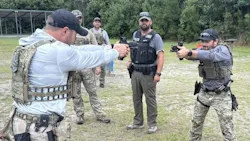
There is another common formulation sometimes substituted for the traditional third rule that deserves separate attention: “Never point a gun at anything you don’t intend to kill or destroy.” I understand what the rule is attempting to accomplish. It is intended to impress upon the shooter that muzzle direction carries serious consequences and that a firearm should never be casually oriented toward another person or object. I completely and wholeheartedly agree with that objective. I do not, however, teach that wording, and particularly in police or defensive firearms training, I believe it should be abandoned in totality. The problem is not its concern for safety. The problem is that the language creates a relationship between muzzle orientation and an intention to kill or destroy that simply does not exist across the range of circumstances in which armed professionals may lawfully and reasonably handle firearms.
From a tactical perspective, an officer may reasonably orient a firearm toward a person or potential threat without having made a decision to fire. Consider a high-risk arrest, the initial entry into a location believed to contain an armed suspect, or an encounter in which an officer reasonably perceives the possibility of an imminent deadly threat but is still gathering information and issuing commands. The officer may need the firearm immediately available and appropriately oriented while simultaneously hoping that no shot becomes necessary. Indeed, successful police encounters routinely end precisely that way. The subject complies, the threat resolves and the officer never fires. A safety rule that says muzzle orientation necessarily means the officer “intends to kill” creates a false binary: Either point the firearm somewhere else or accept that you have already formed an intention to kill the person in front of you. Neither reflects the actual perceptual and decisional continuum of a rapidly evolving encounter.
The practical problem is equally significant. Safe muzzle management is an environmental problem, not a declaration of intent. There are circumstances in which no direction is perfectly safe and the operator must continually determine which available direction presents the least foreseeable risk. That is why I prefer the instruction to always keep the firearm pointed in a safe direction and let the operational environment determine what the safest direction happens to be (Critical Dynamics, n.d.). That formulation keeps the cognitive task where it belongs: on managing the potential consequences of an unintended discharge. “Never point at anything you do not intend to kill or destroy,” by contrast, directs the learner toward a question of personal intention. Those are fundamentally different mental models. One asks, “Where can this firearm be oriented most safely right now?” The other asks, “What am I willing to kill or destroy?” Only the first is actually a muzzle-management problem.
The distinction becomes even more important from a legal perspective. The constitutional standard governing police use of force is not whether an officer subjectively “intended to kill.” Under Graham v. Connor, the question is whether the officer’s actions were objectively reasonable in light of the facts and circumstances confronting the officer, without regard to the officer’s underlying intent or motivation (Graham v. Connor, 1989). The Supreme Court has likewise held that deadly force is constrained by the existence of a sufficiently serious threat, not by an officer’s willingness or desire to kill a particular person (Tennessee v. Garner, 1985). The legal question is therefore grounded in objective necessity and reasonableness, not a subjective declaration that the officer intended to destroy the person at whom the firearm happened to be pointed.
Federal appellate decisions also demonstrate why firearm orientation occupies a more nuanced legal space than this slogan suggests. Courts have recognized that displaying or pointing firearms can be reasonable when officers confront circumstances presenting a legitimate danger, while continued gunpoint detention of people who pose no reasonable threat may become excessive. In Holland v. Harrington, the 10th Circuit observed that pointing a firearm directly at someone represents an immediate threat of deadly force and must be justified by the circumstances. In Baird v. Renbarger, the 7th Circuit similarly emphasized that “pointing a gun encompasses far too great a variety of behaviors and situations” to be evaluated without context (Holland v. Harrington, 2001; Baird v. Renbarger, 2009). That is precisely the problem with an absolutist safety slogan. The law asks what the officer knew, what danger reasonably appeared to exist and whether the officer’s conduct was proportionate to those circumstances. It does not ask whether the officer had formed an abstract intention to “kill or destroy.”
There is a litigation concern here as well. I see little value in teaching police officers language that unnecessarily equates pointing a firearm with an intention to kill. Imagine an officer later explaining under oath that academy doctrine taught, “Never point a gun at anything you don’t intend to kill or destroy.” The next question almost writes itself: “Officer, you pointed your rifle at my client, correct? And you were trained never to point that rifle at anyone you did not intend to kill?” That exchange would not establish that the officer’s conduct was constitutionally unreasonable, because subjective intent is not the controlling Graham standard. It would, however, create a linguistic problem that never needed to exist. Training language should help officers accurately articulate what they perceived, why they acted and what they were attempting to accomplish. It should not saddle them with an absolutist slogan that mischaracterizes the relationship between readiness and the actual decision to use deadly force.
This is another example of the institutional inertia discussed throughout this two-part series. Certain phrases survive because generations of instructors have repeated them, not necessarily because anyone has recently examined whether the words still communicate the concept with sufficient precision. In Unlocking the Brain Code, I describe how instructional lineage can cause language to be “repeated without examination of its cognitive precision” (Hanson, 2026a, p. 61). That observation applies particularly well here. The phrase sounds authoritative because it is familiar, and its underlying safety intention is unquestionably sound. Familiarity, however, should not immunize instructional language from scrutiny.
For me, the distinction is straightforward. I absolutely want students to understand that muzzle direction is consequential and that casually pointing a firearm at another person is unacceptable. I do not want them learning that pointing a firearm necessarily communicates an intention to kill, nor do I want their safety behavior organized around what they are willing to “destroy.” Muzzle discipline should be based on continuous risk management. The firearm should remain oriented in the safest direction reasonably available under the circumstances, and as those circumstances change, that direction may change with them. That principle is tactically coherent, practically usable and far more compatible with the legal framework governing police action. It teaches the shooter to manage the firearm rather than announce an intention.
References
Anderson, G. S., Di Nota, P. M., Metz, G. A. S., & Andersen, J. P. (2019). The impact of acute stress physiology on skilled motor performance: Implications for policing. Frontiers in Psychology, 10, 2501.
Associated Press. (2017, October 5). Cops: Man fatally shoots self when he drops gun while calming child. CBS Pittsburgh.
Baird v. Renbarger, 576 F.3d 340 (7th Cir. 2009).
Baldwin, S., Bennell, C., Andersen, J. P., Semple, T., & Jenkins, B. (2019). Stress-activity mapping: Physiological responses during general duty police encounters. Frontiers in Psychology, 10, 2216.
Bilalić, M., McLeod, P., & Gobet, F. (2008). Why good thoughts block better ones: The mechanism of the pernicious Einstellung effect. Cognition, 108(3), 652-661.
California Department of Justice. (2024). Report on the investigation into the death of Daniel Elena Lopez and Valentina Orellana Peralta on December 23, 2021. Office of the Attorney General.
Critical Dynamics, Inc. (n.d.). Five rules for safe gun handling [Training handout].
Delaware State Police. (2026a, September 19). State Police charge Maryland man with manslaughter after fatally shooting woman in Ellendale.
Delaware State Police. (2026b, September 20). Update: Victim identified, State Police charge Maryland man with manslaughter after fatally shooting woman in Ellendale.
Graham v. Connor, 490 U.S. 386 (1989).
Hannan, M. T., & Freeman, J. (1984). Structural inertia and organizational change. American Sociological Review, 49(2), 149-164.
Hanson, K. A. (2026). Unlocking the brain code: Exposing the limitations of traditional firearms training and high-liability instruction through neuroscience, psychology, and human performance research. Applied Threat Science Publications.
Holland ex rel. Overdorff v. Harrington, 268 F.3d 1179 (10th Cir. 2001).
Jany, L. (2022, November 23). Police commission rules officer broke policy in fatal department store shooting. Los Angeles Times.
Lloyd, J. (2026, May 7). Civil trial jury finds LAPD officer was not negligent in deadly Burlington store shooting. NBC Los Angeles.
Simon, S. (1997, June 18). Celebration ended in tragedy for shootout victim’s family. Los Angeles Times.
Smith, M. L., & Boolani, A. (2024). Feasibility of a non-anticipatory, random-action target system to improve shooting performance: A brief field trial. Sports, 12(11), 305.
Sydow, J., Schreyögg, G., & Koch, J. (2009). Organizational path dependence: Opening the black box. Academy of Management Review, 34(4), 689-709.
Tennessee v. Garner, 471 U.S. 1 (1985).
Victor Valley Daily Press. (2010, December 20). Former Barstow officer now bishop.
Zhang, T., Harrington, K. B., & Sherf, E. N. (2022). The errors of experts: When expertise hinders effective provision and seeking of advice and feedback. Current Opinion in Psychology, 43, 91-95.
About the Author
 Keith Hanson
Keith Hanson
Keith Hanson is a career law enforcement professional with extensive experience across operational and instructional domains, specializing in firearms instruction, tactical operations training, and counterterrorism tactics. With a strong background in neuroscience and psychology, Keith is a co-creator and senior program architect of NeuralTac™, which combines neuroscience, combat psychology, neuropsychology, kinesiology, and educational sciences, drawing from the latest research in human performance, to produce advanced high-liability instructional frameworks for law enforcement agencies, contract security firms, and other armed professionals. It also aims to develop and foster advanced-level master trainers within those organizations. Additionally, as a certified Force Science analyst and certified cognitive/forensic interviewer, Keith serves as a court-recognized expert witness on use-of-force matters and provides consultation on legal strategies. He is the author of "Unlocking the Brain Code: Exposing the Limits of Traditional Firearms Instruction and High-Liability Training Through Neuroscience, Psychology, and Human Performance Research."
You can email Keith: [email protected]
And visit his LinkedIn page: https://www.linkedin.com/in/keithhanson1973/