Why Prior Experience Can Help or Hurt Firearms Performance
What to Know
- Prior experience can accelerate learning, but it can also create negative transfer, where previously learned responses interfere with performance when a new situation requires a different solution.
- Firearms training should move beyond rote repetition and mechanical proficiency by incorporating recognition, decision-making, contextual variability and adaptive problem-solving, principles emphasized in the NeuralTac framework.
- Effective instructors must build training that helps students recognize when a skill applies, when it does not, and how to adapt under changing conditions, stress and uncertainty to create durable, transferable performance.
More on OFFICER.com
How Hydration Impacts Learning and Performance in Police Training
- From firearms ranges to defensive tactics gyms, dehydration and sodium loss may be undermining attention, decision-making and skill development long before instructors recognize a problem.
For most of my 20-plus year career as a high-liability trainer and firearms instructor, I have heard trainers speak about prior experience as though it were an unqualified advantage. The experienced shooter arrives with a foundation. The veteran officer has thousands of repetitions. The competitive shooter already understands recoil, trigger control and visual processing. The firearms instructor attending an advanced school already knows how to teach. We naturally assume that what these students have learned will make it easier for them to learn whatever comes next.
Sometimes it does.
Prior learning can accelerate the acquisition of a related skill. A shooter who understands how to establish a functional grip, manage recoil and press a trigger without significantly disrupting the sights does not need to begin again every time a new pistol is placed in his hands. Much of that capability can transfer positively from one weapon system to another. The same is true of an officer who has learned to move with balance, process visual information and maintain awareness while performing a physical task. Existing skills can provide a framework upon which new capabilities are built.
When Experience Creates Interference
Prior learning, however, is not always an ally. Sometimes yesterday’s training becomes today’s interference. In motor learning, negative transfer occurs when a previously learned skill, movement pattern or stimulus-response association interferes with the acquisition or performance of another skill. The learner does not simply fail to use prior knowledge. He applies prior knowledge that is inappropriate for the present problem. The old response may be familiar, efficient and deeply rehearsed, but it does not fit the new task.
That distinction should concern every firearms instructor because our students do not enter training as blank slates. They arrive with accumulated habits from previous classes, agency programs, competitive shooting, military service, hunting, private practice, internet videos and sometimes decades of professional experience. Some of those habits are beneficial. Some are harmless. Others may be incompatible with what the current problem requires.
The more thoroughly a response has been practiced, the more likely it may be retrieved when the learner perceives a familiar cue. That can be beneficial when the cue and response remain properly matched. It can become dangerous when the situation merely resembles the conditions under which the response was learned.
This is why negative transfer is not simply a problem of poor mechanics. It is often a problem of recognition, retrieval and selection. The shooter may possess the correct technique. He may have demonstrated it repeatedly during instruction. Yet when the pace increases, the environment changes or uncertainty is introduced, the older response reappears.
The student did not necessarily forget the new technique. The old one won the competition for retrieval.
That competition helps explain an experience familiar to nearly every instructor. We demonstrate a new movement, provide coaching and watch the student perform it correctly during deliberate repetitions. The student appears to understand. He may even become smooth and confident. Then we introduce time pressure, movement, an unfamiliar firing position or a decision-making requirement. Suddenly, the old behavior returns.
The student who learned to keep his feet planted while firing becomes rooted to the ground when the drill accelerates. The shooter who was taught to immediately perform the same remedial action whenever a firearm stopped firing launches that response without observing the actual condition of the weapon. The officer who has completed thousands of command-driven draw strokes begins moving toward the handgun as soon as he hears a familiar verbal cue, even though the evolving situation does not yet justify presenting the weapon.
These are not necessarily failures of motivation or discipline. They are often predictable products of learning.
Why Similar Tasks Can Produce the Wrong Response
The scientific literature on transfer has long recognized that similarities between two tasks do not guarantee beneficial transfer. In some cases, similarity increases the risk of interference because familiar features activate a response that is only partially appropriate. Transfer depends on what the learner perceives as common between the original and new tasks, which elements actually control performance, and whether the response required in the new setting is compatible with the one previously learned (Barnett & Ceci, 2002).
This becomes especially important in firearms training because many of our tasks share visible similarities. The shooter is holding the same pistol. The target looks familiar. The equipment is unchanged. The action begins from the same position. Yet the purpose of the task, the available information and the appropriate response may be completely different.
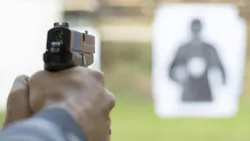
A paper target appearing in front of a shooter during a qualification course ordinarily means that the shooter should fire the prescribed number of rounds. A person appearing in the shooter’s visual field during a real encounter does not mean the same thing. That person must be perceived, identified and evaluated. The presence of an object in the person’s hand may require further discrimination. The person’s behavior, proximity, direction of movement, access to others and relationship to the environment all matter.
If training repeatedly teaches that the appearance of a target is the signal to draw and fire, the student can become extraordinarily efficient at solving a problem that reality will not present in that form. The shooter may be fast, accurate and mechanically polished while remaining poorly prepared to determine whether a shot should be fired.
This is one of the central concerns addressed through NeuralTac. NeuralTac principles treat firearms performance as more than the reproduction of physical movements. Functional performance emerges from the relationship among perception, cognition, decision-making, motor execution, feedback and adaptation. A shooter must not merely know how to execute a response. The shooter must recognize the conditions that make that response appropriate, inhibit it when those conditions are absent and transition to another response when the situation changes.
The Limits of Repetition and Blocked Practice
Traditional firearms instruction often separates mechanics from context for understandable reasons. New shooters need stable conditions in which to learn foundational movements. They may need to perform a skill slowly and deliberately before they can perform it rapidly. They may benefit from repeating the same movement several times while establishing basic coordination.
The problem begins when that early acquisition structure becomes the final training structure. Blocked practice, in which one skill is performed repeatedly before moving to another skill, can improve immediate practice performance. The learner knows what is coming and does not need to reconstruct the action plan before each repetition. Performance often becomes smoother and faster within the training session. That improvement can be mistaken for durable learning.
The contextual interference literature demonstrates why instructors must be cautious about making that assumption. Shea and Morgan’s foundational research showed that practice involving greater interference could impair performance during acquisition while improving retention and transfer afterward (Shea & Morgan, 1979). Later reviews found broad support for contextual interference effects, although those effects vary with task complexity, learner experience and the relationship among the skills being practiced (Magill & Hall, 1990; Wulf & Shea, 2002).
That qualification matters. Random practice is not magical, and difficulty is not inherently productive. Throwing several complicated tasks at an unprepared student does not automatically create learning. Guadagnoli and Lee’s challenge-point framework helps explain that the learning value of a task depends on the interaction among the task’s difficulty, the learner’s current ability and the information the learner can successfully process (Guadagnoli & Lee, 2004).
A novice struggling to safely load, grip and fire a handgun does not need a rapidly changing array of ambiguous threats, moving targets and complex tactical decisions. The student may not yet possess enough control over the basic task to benefit from those demands. For that learner, the additional complexity may produce confusion rather than adaptation.
An experienced shooter, however, may learn very little from performing another 50 identical presentations against an unmoving target after being told exactly when to draw, exactly how many rounds to fire and exactly where those rounds should go. The exercise may provide repetitions, but it removes most of the recognition and selection demands the shooter will face outside the drill.
NeuralTac training addresses this through progressive variability. We first establish sufficient control over the movement. We then introduce meaningful distinctions. We vary conditions without losing sight of the objective. Eventually, we require the learner to select among available actions rather than simply execute the action announced by the instructor.
Applying Variability to Malfunctions and Reloads
Consider stoppage/malfunction training. A common approach is to create one type of stoppage and have students repeat the prescribed clearing sequence. The shooter experiences the same problem, receives the same cue and performs the same response. With enough practice, the manipulation can become fast and visually impressive.
The learner may still be unable to manage an unexpected weapon problem.
If every stoppage has required the same action, the shooter may learn a simple association: When the gun does not fire, perform this sequence. That association does not require meaningful observation. It does not require the shooter to distinguish an empty pistol from a magazine problem, a failure to fire, a failure to extract, an out-of-battery condition or a more complex obstruction. The shooter is not learning to interpret the condition of the weapon. He is learning to launch a rehearsed motor program whenever the gun fails to produce the expected result.
In a predictable drill, that response works because the instructor has arranged the problem to match the solution. In another context, the same response may waste time, worsen the condition or distract the shooter from a more urgent tactical need.
Good malfunction instruction should certainly develop efficient manipulations, but it should not end there. Students must encounter different conditions without always being told which condition is present. They must learn to use available information, including the position of the slide, the condition of the trigger, the status of the magazine and the visible state of the chamber. They must learn that movement, communication, disengagement, access to cover or transition to another defensive option may take priority over standing in place and repairing the handgun.
The goal is not to turn an emergency into a slow mechanical inspection. The goal is to build recognition so the shooter can rapidly select a response that fits the actual condition rather than reflexively applying the response practiced most often.
Reloading provides another example. We often teach an emergency reload as a tightly organized sequence. The empty magazine is released, a replacement is acquired and the pistol is returned to service. That technique may be appropriate when the firearm is empty and immediately needed.
Problems arise when students learn to associate any perceived opportunity to reload with dropping the magazine and performing the same sequence. A partially loaded magazine may be discarded during a lull. The shooter may initiate a reload without confirming whether one is necessary. He may fail to consider ammunition management, available cover, movement, communication or the status of the environment because his attention has narrowed around completing the familiar manipulation.
The answer is not to abandon repetition. The answer is to place repetition within a larger learning architecture. Students can initially practice the mechanics of different reloads under controlled conditions. Once those movements are sufficiently stable, training should present changing weapon states and contextual demands. Sometimes the correct response is an emergency reload. Sometimes it is a proactive replenishment. Sometimes it is movement before manipulation. Sometimes it is using the ammunition already in the gun. Sometimes it is doing nothing.
The instructor should not announce the answer before every repetition.
Teaching Selection Instead of Following Commands
The same principle applies to ready positions, use of cover, movement and weapon presentation. A shooter may be capable of demonstrating several ready positions on command while having no ability to select among them. If I call out “high ready,” the shooter assumes high ready. If I call out “compressed ready,” the shooter assumes compressed ready. That proves the student can follow instructions. It does not prove the student understands how environmental geometry, other people, muzzle orientation, physical contact and the need to perform additional tasks should influence the position of the weapon.
To develop functional skill, I must eventually present a problem without naming the solution. A narrow passage, a person moving in front of the shooter, a requirement to open a door or the need to control another person should constrain the available movement. The student must perceive those constraints and organize the weapon accordingly.
This approach reflects ecological and constraints-led concepts incorporated into NeuralTac. Movement is not treated as a rigid answer retrieved independently of the environment. It is shaped by the interaction of the individual, the task and the conditions in which the task occurs. Skill is demonstrated not by reproducing one idealized movement under every circumstance, but by achieving the intended outcome while adapting to relevant constraints.
Variable practice is useful because it helps the learner discover what must remain stable and what must change. Schmidt’s schema theory proposed that learners develop generalized relationships among initial conditions, movement parameters, sensory consequences and outcomes rather than storing a completely separate command for every possible action (Schmidt, 1975). Practicing meaningful variations can help the learner adapt a skill to conditions not encountered in exactly the same form during training.
That does not mean instructors should create arbitrary chaos. Variability must serve the learning objective. Changing target distance, visual information, shooting position, time availability, lighting, movement direction or the presence of other people may be valuable when those variables affect the skill being developed. Adding noise, physical exertion or confusion merely to make training feel intense may contribute little if those additions do not require relevant adaptation.
Stress, Habit and Conditional Automaticity
Stress also deserves careful consideration. Instructors frequently say that people “revert to their training” under stress. That phrase is directionally useful but incomplete. People do not necessarily retrieve the most recently taught response or the response the instructor considers tactically correct. They are often drawn toward responses that are familiar, strongly associated with the perceived cue and available under the conditions of the moment.
Stress can narrow attention, affect working memory and alter the balance between goal-directed and habitual control. Research suggests that acute stress can increase reliance on habitual responding, particularly when deliberate control is already taxed (Schwabe & Wolf, 2009, 2013). That does not mean stress mechanically forces everyone into an old habit. It means that strong stimulus-response associations may become more influential as cognitive demands increase.
This makes poorly designed automaticity dangerous. Instructors often say that a movement should be repeated until it becomes automatic. Automaticity is valuable only when the automated response remains properly connected to the cue that should trigger it.
A rapidly executed wrong response is not expertise.
In firearms training, conditional automaticity is the better objective. The shooter should be able to execute a selected response efficiently without devoting excessive conscious attention to each mechanical component. At the same time, the response must remain governed by perception and context. The student must know what should initiate the action, what should inhibit it and what changing information should cause it to stop or transition.
Shoot and no-shoot exercises illustrate the difference. If students receive hundreds of repetitions in which every target exposure requires gunfire, adding an occasional no-shoot target near the end of training does not erase the dominant association. The learner has been taught that target appearance predicts shooting. The no-shoot becomes an exception placed inside a system overwhelmingly organized around firing.
A better progression changes the meaning of target appearance. The presentation of visual information should prompt assessment rather than automatically release a trigger press. Some presentations require fire. Others require verbal commands, movement, observation or restraint. Some begin as nonthreatening and become threatening. Others initially appear suspicious but never develop into an immediate threat.
The student must learn that seeing is not the same as identifying and that identifying a potential weapon is not the same as establishing justification to fire. A pistol in another person’s hand may be highly relevant, but the person’s actions, direction, relationship to others and surrounding circumstances remain part of the decision.
Negative transfer also appears when experienced shooters transition among weapon systems. An officer accustomed to one pistol may reach for a control that is located elsewhere on another pistol. A shooter moving between rifles may apply a manipulation appropriate to one operating system but not the other. These errors can occur even when the shooter can verbally explain the difference.
That is not evidence that the student is careless. It is evidence that the old movement has been learned well.
I tell experienced students that their prior response was appropriate for the system in which they developed it. The problem is not that they failed to learn. The problem is that they learned so effectively that the response remains highly available. Our task is to build a reliable distinction between the two systems.
That requires contrast. The student should handle the systems close enough together to perceive the differences, but not under so much initial pressure that every error becomes reinforced. The instructor should explicitly identify which features are shared and which are not. Practice can then progress toward mixed presentations in which the student must recognize the platform, retrieve the correct manipulation and detect any reversion to the older pattern.
External attentional focus may also assist motor learning. Research by Wulf and colleagues has repeatedly found that directing attention toward the intended effect of a movement can improve performance and learning compared with directing attention toward isolated body movements (Wulf, 2013; Wulf & Lewthwaite, 2016). In firearms instruction, this does not mean that body mechanics should never be discussed. It means instructors should avoid making students excessively dependent on consciously controlling every joint, muscle and body segment.
When correcting recoil management, for example, the instructor may produce better learning by directing the student toward maintaining the relationship between the pistol and the target through the firing cycle rather than delivering an elaborate sequence of internal commands about elbows, shoulders, wrists and fingers. The desired result can organize the movement while the instructor intervenes selectively when a mechanical constraint prevents success.
Diagnosing Learning Instead of Directing Performance
Feedback must also be managed carefully. Constant, immediate correction can improve practice performance while making the student dependent on the instructor. Guidance research suggests that excessive augmented feedback may temporarily support performance but weaken learning when that support is removed (Salmoni, Schmidt, & Walter, 1984).
I have seen students who can perform well only while an instructor stands beside them issuing continuous corrections. The moment the coaching stops, the performance deteriorates. The instructor has become part of the task.
NeuralTac principles favor a deliberate reduction in external guidance as competence develops. Students should increasingly evaluate their own performance, identify the cue that influenced their decision and describe what they perceived before acting. After an error, I may ask what they saw, what they expected, what response began to emerge and what information they failed to use.
Those questions are not empty debriefing rituals. They help reveal whether the problem occurred in perception, decision, movement selection or execution. A mechanical error and a selection error may look similar from the firing line, but they require different interventions.
If a student cannot physically perform the technique, additional decision-making complexity will not solve the problem. If the student can perform the technique but selects it at the wrong time, another hundred isolated repetitions may accomplish very little. If the student knows the correct response but reverts under speed, practice must progressively increase time pressure while maintaining the requirement for accurate selection.
This is where instructor diagnostics become more important than instructor performance. Our job is not to show students how skilled we are. Our job is to identify why their performance is failing and design conditions that make the necessary learning possible.
Retention and transfer tests should therefore play a larger role in firearms education. Performance at the end of a drill does not tell us whether learning will persist. The student should be tested after time has passed, under altered conditions and without the same prompts, target arrangement or instructor guidance used during acquisition.
That may be uncomfortable because delayed testing often reveals that apparent mastery was temporary. It is still better to discover that weakness during training than during a violent encounter.
The central lesson of negative transfer is that training teaches more than movement. Every repetition also teaches the learner what to notice, what to expect, what can be ignored, when to begin acting and which response should feel normal. Those associations can become more influential than the instructor’s verbal explanation of the technique.
We must therefore stop asking only whether students can perform a skill. We must ask whether they can recognize the problem the skill was designed to solve. Can they distinguish it from a similar problem that requires another response? Can they inhibit the familiar action when the necessary conditions are absent? Can they adapt the movement when the environment changes? Can they detect when the initial response is failing and transition without freezing or blindly repeating it?
That is functional skill.
Good firearms instruction does not discard foundational repetition. It gives repetition meaning. It progresses from control to contrast, from contrast to variability, and from variability to recognition and decision. It develops mechanics without separating those mechanics permanently from perception. It acknowledges that stress may expose the strongest association rather than the instructor’s preferred technique. It tests learning after the cues, coaching and predictable sequences have been removed.
Most importantly, it recognizes that prior experience is not automatically beneficial simply because it is extensive. A student can become highly proficient at solving the wrong problem. A familiar response can be executed quickly, confidently and completely out of context.
Our responsibility as instructors is not merely to add techniques to a student’s inventory. It is to help the student organize those techniques around the conditions that justify their use.
The final objective is not a shooter who possesses more movements. It is a shooter who perceives more accurately, selects more intelligently, acts more efficiently and adapts when the problem changes. That is the difference between performing a drill and developing a durable, transferable capability.
It is also the difference between training that looks successful and training that remains useful when yesterday’s answer no longer fits today’s problem.
References
Barnett, S. M., & Ceci, S. J. (2002). When and where do we apply what we learn? A taxonomy for far transfer. Psychological Bulletin, 128(4), 612–637. https://doi.org/10.1037/0033-2909.128.4.612
Guadagnoli, M. A., & Lee, T. D. (2004). Challenge point: A framework for conceptualizing the effects of various practice conditions in motor learning. Journal of Motor Behavior, 36(2), 212–224. https://doi.org/10.3200/JMBR.36.2.212-224
Magill, R. A., & Hall, K. G. (1990). A review of the contextual interference effect in motor skill acquisition. Human Movement Science, 9(3–5), 241–289. https://doi.org/10.1016/0167-9457(90)90005-X
Salmoni, A. W., Schmidt, R. A., & Walter, C. B. (1984). Knowledge of results and motor learning: A review and critical reappraisal. Psychological Bulletin, 95(3), 355–386. https://doi.org/10.1037/0033-2909.95.3.355
Schmidt, R. A. (1975). A schema theory of discrete motor skill learning. Psychological Review, 82(4), 225–260. https://doi.org/10.1037/h0076770
Schwabe, L., & Wolf, O. T. (2009). Stress prompts habit behavior in humans. Journal of Neuroscience, 29(22), 7191–7198. https://doi.org/10.1523/JNEUROSCI.0979-09.2009
Schwabe, L., & Wolf, O. T. (2013). Stress and multiple memory systems: From “thinking” to “doing.” Trends in Cognitive Sciences, 17(2), 60–68. https://doi.org/10.1016/j.tics.2012.12.001
Shea, J. B., & Morgan, R. L. (1979). Contextual interference effects on the acquisition, retention, and transfer of a motor skill. Journal of Experimental Psychology: Human Learning and Memory, 5(2), 179–187. https://doi.org/10.1037/0278-7393.5.2.179
Wulf, G. (2013). Attentional focus and motor learning: A review of 15 years. International Review of Sport and Exercise Psychology, 6(1), 77–104. https://doi.org/10.1080/1750984X.2012.723728
Wulf, G., & Lewthwaite, R. (2016). Optimizing performance through intrinsic motivation and attention for learning: The OPTIMAL theory of motor learning. Psychonomic Bulletin & Review, 23(5), 1382–1414. https://doi.org/10.3758/s13423-015-0999-9
Wulf, G., & Shea, C. H. (2002). Principles derived from the study of simple skills do not generalize to complex skill learning. Psychonomic Bulletin & Review, 9(2), 185–211. https://doi.org/10.3758/BF03196276
About the Author
 Keith Hanson
Keith Hanson
Contributing Editor Keith Hanson is a career law enforcement professional with extensive experience across operational and instructional domains, specializing in firearms instruction, tactical operations training, and counterterrorism tactics. With a strong background in neuroscience and psychology, Keith is a co-creator and senior program architect of NeuralTac™, which combines neuroscience, combat psychology, neuropsychology, kinesiology, and educational sciences, drawing from the latest research in human performance, to produce advanced high-liability instructional frameworks for law enforcement agencies, contract security firms, and other armed professionals. It also aims to develop and foster advanced-level master trainers within those organizations. Additionally, as a certified Force Science analyst and certified cognitive/forensic interviewer, Keith serves as a court-recognized expert witness on use-of-force matters and provides consultation on legal strategies. He is the author of "Unlocking the Brain Code: Exposing the Limits of Traditional Firearms Instruction and High-Liability Training Through Neuroscience, Psychology, and Human Performance Research."
You can email Keith: [email protected]
And visit his LinkedIn page: https://www.linkedin.com/in/keithhanson1973/