Inside the Joint Operations Facility Model for Modern Emergency Response
What to Know
- Joint Operations Facilities unify multiple emergency and city services into a single, efficient hub, reducing duplication and improving communication.
- Design features include reinforced structures capable of withstanding F-5 tornadoes, redundant utilities, and energy-saving geothermal systems.
- The facility enhances response capacity, with increased dispatch stations and support for large-scale events like the FIFA World Cup™.
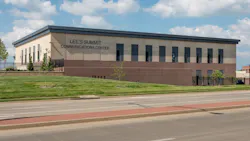
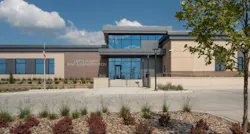
There is a shift in modern public safety infrastructure to create more agile, unified facilities that improve emergency readiness by removing duplication and improving cross-departmental communication. By integrating multiple public safety and emergency management functions into one shared operational hub, the Joint Operations Facility (JOF) model redefines operational efficiency.
Hoefer Welker recently demonstrated the power of this approach with the newly completed 43,600-square-foot facility in Lee’s Summit, Missouri. This model not only maximizes building real estate but fundamentally transforms safety and efficiency.

Efficiency Through Consolidation
Concentrating investment into a singular hub allows cities to invest in one communications center, one backup power system and one set of support spaces instead of building and maintaining those resources in multiple locations. The Lee’s Summit project, for example, integrates emergency operations, city IT, traffic management, fire administration, fire training and co-located dispatch centers.
“Our new Joint Operations Center isn't just about modernizing our capabilities today; it’s about the security and longevity of our growing city. The facility enhances our team’s overall performance, creates numerous efficiencies and maximizes our taxpayers' resources all by bringing together critical public safety functions within the JOC,” said John Boenker, deputy police chief for the city of Lee’s Summit. “Colocating our teams within this collaborative space advances our response times, streamlines our communications and provides the technology to protect and serve our community for any crisis that may hit.”
Consolidated facilities also give municipalities more flexibility to adapt as service demands, staffing models and emergency response needs change over time.
Resilience for the Unexpected
Natural disasters are both sudden and unavoidable, and a city’s public safety infrastructure must remain operational when communities need it most. True preparedness is directly embedded into the structural blueprints of a facility, strategically engineered to withstand catastrophic impacts while maintaining absolute stability during weather emergencies.
Resilience is more than just keeping the building standing; it’s keeping critical utilities functioning. In the initial design phases of the project, it’s important to work alongside the design team to determine capabilities for the protection of utilities, as our team did for Lee’s Summit’s JOF. Taking safety beyond baseline building codes, approximately half of the facility’s design includes a hardened precast concrete ICC-500-rated shell capable of withstanding an F-5 tornado, backed by redundant natural gas and diesel power systems, ensuring continuity during catastrophic events. Precast insulated concrete panels and a double-T precast structure form the roof, acting as a reinforced lid for the facility. Additionally, storm-resistant windows were selected for durability and to allow daylight into the spaces. The non-hardened portion of the building, which is primarily office and support spaces, has the ability to break away without compromising the structural integrity of the hardened areas or affecting any utilities throughout the emergency operations center, training rooms, and dispatch center.
By utilizing geothermal mechanical systems and optimized generator sizing, cities can achieve significant long-term energy and operational savings. To maximize efficiency and resilience, the Lee’s Summit JOF includes a 72-hour underground water reserve and a geothermal mechanical system. The geothermal mechanical system will provide nearly $425,000 in energy savings over the next 20 years compared to a traditional system. By having an energy-efficient mechanical system of this capacity, less electrical power is needed and the generator size was able to be reduced, which saved an additional $255,000.
Unified Response for Complex Events
In addition to advanced resources, a JOF fosters seamless collaboration. While police and fire maintain distinct tactical specialties, their communications often overlap. An integrated facility brings these teams together into a shared daily workflow. This readiness is critical, particularly for major events.
As the U.S. prepared for millions of visitors during the FIFA World Cup™, host cities like Kansas City could utilize JOF facilities for efficient, streamlined operations. For the Kansas City metro, the new Lee’s Summit facility offers 34 dispatch stations, nearly tripling previous dispatch capacity. Its robust data networks and state-of-the-art data and radio infrastructure helped the city handle spikes in emergency calls. The facility was designed for growth, with a floor plan that provides the immediate capacity to absorb neighboring county or city emergency personnel for additional support during large-scale events that demand mutual aid.
Investing in Personnel
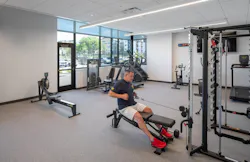
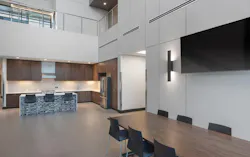
Like any civic facility, a JOF is only as effective as the personnel running it. Consolidated buildings allow cities to invest in quality-of-life amenities that attract and retain top talent. Outdoor patios, centralized kitchens, wellness gyms and gathering spaces build a cohesive operational culture, while biophilic design elements such as natural lighting and dedicated quiet rooms for decompression directly combat staff burnout.
The Takeaway
Ultimately, the JOF approach is an investment in the future of public safety. By replacing isolated facilities with an integrated hub, municipalities can foster cross-functional collaboration and innovation. Consolidating services impacts more than savings on infrastructure, energy or maintenance; it builds a fortified operational foundation designed to endure the unexpected.
About the Author
 Chris Krumrei, AIA, NCARB
Chris Krumrei, AIA, NCARB
Vice President, Hoefer Welker
Chris Krumrei’s comprehensive project experience includes roles within all areas of planning, design, and construction documentation. He is talented in creating virtual 3D representations of the design, which aids in early conceptual analysis and design development options. This imaging also provides the opportunity to do a site/building fly-through to gain a realistic project perspective. Chris also understands the importance of adapting the project design to the client’s needs, both functionally and aesthetically.
 Nick Lawler AIA, NCARB, LEED AP BD+C
Nick Lawler AIA, NCARB, LEED AP BD+C
Associate Principal, Hoefer Welker
Nick brings extensive experience and has managed and supervised multiple judicial, commercial, and institutional projects for both private and government clients. He has worked closely with contractors to bring designs that reflect the client’s vision and mission from charrette to completed construction. He enjoys the challenge of configuring a building on a unique site and then delivering a facility that supports its operation and enhances employees’ overall performance with functionality and flexibility.