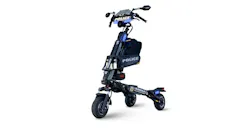
Electric “scooters” are all over the place now — often on the sidewalk or in the road when you’re trying to walk or drive through. But the history of patrol tools that officers stand on for use has not been illustrious. There were some two-wheeled and three-wheeled fixed-suspension electric tools, but virtually all of them had challenges that made them less than optimal for police work. They either had batteries that died too quickly, fixed suspensions that meant use only on smooth, flat surfaces, or had riding balance issues that simply couldn’t be trained away. Meet a new type of electric patrol vehicle that has none of the challenges of the older tools and unexpected benefits every agency can appreciate: The TRIKKE POSITRON.
Our team was tasked with testing a TRIKKE POSITRON, and that testing process started when we first saw it at IACP. One member of our team was perplexed upon seeing the new electric transportation and patrol vehicle. It wasn’t like anything he’d seen. Where previous riding tools had been bulky and heavy-looking, the POSITRON looked almost skeletonized and moved like nothing our team had previously experienced. One of the TRIKKE team members explained that was because it was structured like nothing before. Weighing less than 90 pounds (as seen on the IACP floor), it folded up for transport in the back of a patrol vehicle, and when folded into duty format, the two “legs” operated independently. So, here was this three-wheeled vehicle that we were told would hold up to 300 pounds, that handled better than anything we’d seen, and that didn’t require a flat surface to be ridden on. TRIKKE even makes an “off-road” model (the POSITRON 72V XL) with larger all-terrain tires, high torque and speed, and built for heavier riders up to 350 lbs.
That 72V XL is the base upon which the POSITRON Police Spec model is built. Upgraded with direct input from former law enforcement officers, the Police Spec model is purpose-built for patrolling areas that might not be conducive to bicycle, mounted or foot patrol. With a top speed of up to 44 mph and a range of up to 35 miles, the independent suspension gives it stability and terrain capability. The QuickSwap Lithium-Ion battery allows for use across a full patrol shift and quick handoff from one shift to the next. The Police Spec model comes equipped with a headlight, a 3-tone siren, 7-panel emergency lights (red and blue displayed at IACP) and a segmented gear bag allowing for organization.
All of that is great information, but the big questions are, how does it ride? And is there much of a training curve?
One member of our test team was provided with access to a test unit and was riding it within three minutes. While there is training provided with the units if an agency purchases them, the learning curve is not steep for operation. It was interesting to watch the test team member originally be so stiff and careful on the unit until he realized that the independent suspension, ergonomic handlebars and controls, and smooth acceleration/deceleration all empowered him to move more naturally. The training brief before he started his first test ride was essentially, “Here are the safety considerations for putting it in and out of your patrol vehicle. Here’s how you set it up for patrol use. These controls are here. Go.” That particular test team member even commented how much fun it was to ride the TRIKKE POSITRON.
TRIKKE’s design team has done all the work to make the POSITRON 72V XL immediately deployable upon receipt by your agency. Charge the batteries. Provide your assigned officers with the necessary safety training and some practice ride time. Then put them on duty and watch the patrol efficiency and community engagement that can occur in parallel through the use of such tools.
OFFICER Media Group is proud to award the TRIKKE POSITRON 72V XL our “Tested – Field Rated” Seal of Approval.