Basics Covered: Law Enforcement Indoor Firing Range Design
What to know
- As firearms training evolves, law enforcement agencies planning new indoor firing ranges must account for greater flexibility, safety considerations and the need for dynamic, scenario‑based training rather than static qualification shooting.
- Architect Raymond Lee of FGM Architects Inc. outlined those considerations during a Station Design Conference presentation, explaining how modern police ranges differ from commercial facilities in space, layout and training capabilities.
- Lee said well‑designed ranges can support a wide range of training needs, from weapon zeroing to movement drills and entry training, helping agencies improve officer safety and readiness.
More on OFFICER.com
Same Gun, Different Lessons: Why Firearms Training Shouldn't Be a One-Size-Fits-All Proposition
- The second part of OFFICER Magazine's look at the limits of skills transfer in interdisciplinary firearms training highlights where combat and self-defense instruction crosses over—and differs—with law enforcement.
When it comes to designing an indoor firing range, there have been a lot of advances in firearms training over the years, including tactics, gear and technology. With that in mind, what do law enforcement agencies need to consider when designing a new indoor firing range?
With the 2026 Station Design Conference taking place May 19-21 at the Grand Sierra Resort & Casino in Reno, Nevada, OFFICER Magazine decided to look back on a session from last year’s conference in Glendale, Arizona. Raymond Lee, AIA, FGM Architects Inc., who has been an active part of the law enforcement track of the Station Design Conference over the years, presented “The Basics of Law Enforcement Indoor Firing Range Design,” covering all facets of what agencies must keep in mind when designing a new range.
Law enforcement specific
First, Lee went into what separates a law enforcement firing range from a commercial range. “Commercial ranges tend to be in a static position. You stand at a line, and you shoot. Most ranges were like that up until about the 1990s. Even law enforcement ranges. We stand at a line, we shoot. So, fixed positions, booths, target retrievers, the whole nine yards,” he says. “Law enforcement ranges today allow for dynamic training. We move around and shoot. We do different things. We don’t always put booths in there. We don’t always put target retrievers in there. We do a lot of different things within it.”
Because of this, he says there are more concerns designing a law enforcement range compared to a commercial range. This includes space concerns and the ability to use material props and other elements like sound, lighting and building materials.
Range training
According to Lee, one of the questions he gets asked the most by law enforcement agencies is what kind of training they can do in a range besides simply qualifying. He says expanded purposes include weapons training, working on sights to zeroing targets and a variety of other things.
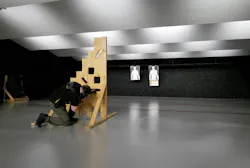
“Qualifying is the most basic task. How about positional training and working with weapons in different ways? How about using different elements like the Viking Tactics VTAC Barricade Trainer for figuring out how do I shoot in weird positions if I’m under fire?” he says. “Entry drill training is important. I believe enforcement needs to practice how to enter a room on a more regular basis. This is a perishable skill. We need to work on this type of training to keep your people safe.”
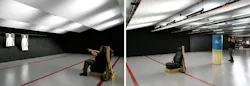
He also mentioned the idea of using a firing range for live-fire vehicular engagement training. “A low-tech way to do it is to bring a car seat in as a prop if your range isn’t big enough, or if you don’t want the possibility of a patrol vehicle being shot. You can still practice live-fire training from a vehicle.”
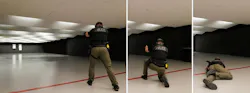
Lee also spoke about introducing movement drills in an indoor firing range. “That type of drill is something we see a lot of. Training on how to shoot and reload while moving, taking cover and other movement drills. Those are things that can help keep your people safe and alive in times of crisis.”
Another thing to consider is the lighting of the range. “A lot of things can happen at night when everything is dark. Low-light training is important, and we can set up lighting so you can work on different types of law-light drills,” he says, adding that agencies must be upfront about their training needs. “The types of training scenarios and what you are looking to achieve in your training program is important for us to know from a design point of view.”
Not one size fits all
Finding the right size for a law enforcement range is one of the most important factors when it comes to design. One of the first things to consider is the width. “Width matters. We want a lot of width, because it gives you more space to move and more places to set up props,” says Lee.
“For us as designers, we want to know what you really need in a range. How many times have we been told, ‘I want a 50-yard range’ or ‘I want a 100-yard range’? Well, those options can be costly. Or, ‘We want a 10-position range.’ Ok, you have a 30-person agency, and you want 10 positions?” he says. “Let’s figure out what you really need and how we can design the range to meet your goals.”
Sheriff’s departments, for example, often have hundreds of deputies. Having them complete their required qualifying can be difficult if the range is not large enough. Knowing what types of advanced training tasks and how often per year you are planing to train is crucial. “We need the range to support the training program you would like. So, you may need something wider. We look at how long your different training program cycles are. How many different ones will you run each year? Will you have different training quarterly or monthly? How do we get your people through all the different kinds of training in a reasonable amount of time?”
Lee says that the type of training used by an agency also can affect the length of the range. “If you’re doing a lot of rifle training work, you would probably want a longer range if you can afford it, versus using scaled distance
simulation targets,” he says. “The types of training you are planning for can even affect access requirements — Do we want to use a variety of props, and do we need to have vehicle access? The type of weapons used in training will determine the selection of the bullet trap and the ballistics required on the walls and ceiling.”
Other range considerations
Other considerations include adding police light bars, sound and other distraction elements, according to Lee. “We get people that ask us for sound distractions. I sometimes think that’s somewhat strange because trainees should be wearing ear protection. We can provide noise distractions in the rage, but the noise levels are like being at a rock concert, so you can actually hear something. But I understand the need for distractions while conducting live-fire training,” he says. “There’ are many things we can do in a range. There is also a lot of information that we need to know from you, which hopefully you can provide.”
Another consideration is how an agency’s officers prep for shooting in the range. “Traditionally, you see a range prep room. You go in there and load up and then enter the range. More and more, though, we’re starting to see people prep on a range on a table or bench instead of going back and forth to another room. Then another way you can do it is by having movable carts on the range, which can be moved around to where you need them.”
One more thing to keep in mind is if multiple agencies will use a shared firing range, Lee said. “You need to consider storage requirements because agencies will not want to carry equipment back and forth to their stations. Each agency using the range would want to have their own specialized equipment storage.”
About the Author
 Paul Peluso
Paul Peluso
Editor
Paul Peluso is the Managing Editor of OFFICER Magazine and has been with the Officer Media Group since 2006. He began as an Associate Editor, writing and editing content for Officer.com. Previously, Paul worked as a reporter for several newspapers in the suburbs of Baltimore, MD.