Latino Officers Poised to Become Chicago Police Department's Largest Racial Group
What to Know
- Chicago Police Department demographics are on track to reach a historic milestone, with Latino officers expected to surpass white officers as the largest racial group in the department's rank-and-file before the end of 2026.
- The shift reflects broader changes in Chicago's population and recruiting trends, with Latino officers increasing by more than 40% since 2017 while the number of white officers has declined significantly.
- City leaders, academics and police reform advocates said a more diverse force can strengthen community relationships and improve representation, though they noted diversity alone does not eliminate concerns about police misconduct or accountability.
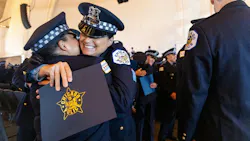
In the coming months, for the first time in the 191-year history of the Chicago Police Department, white officers will no longer be the largest racial group in the department’s rank-and-file.
Data from the city’s Office of Inspector General shows that likely before the end of 2026, Latino officers will overtake white officers as the plurality in the department.
For many, the literal changing face of the department will take it further from the ingrained imagery of its past, when the sons of immigrants from Ireland and other points in Europe may have been the first to come to mind. In short, this is not Richard J. Daley’s CPD.
The shift in the department’s workforce largely mirrors the shifting demographics of the city overall, according to Dick Simpson, professor emeritus at the University of Illinois Chicago and a former Chicago alderman.
“Since the city’s founding back in the 1830s, as soon as they had a police force in the decades that followed, there was always a majority — and usually a very strong majority — of white police officers,” Simpson told the Tribune. “It is now a much larger Latino population than we’ve ever had in Chicago’s history and, over time, that begins to affect the composition of city employees.”
“As the racial population has changed,” he said, “we’ve become a multicultural city.”
As of June 2026, CPD employed 4,403 white officers, a sharp decline from the 6,217 on payroll in August 2017. The number of Latino officers, meanwhile, has increased by more than 40 percent since then, now totaling 4,158, records show.
There are about 2,300 Black CPD officers, approximately 20 percent of the department, and that figure has largely held steady over the last decade.
The trend shows no sign of slowing. As of June, more than half of the 328 recruits in the Police Department’s training academy identified as Latino. Just 49 identified as white, while 80 identified as Black, according to OIG data.
Ald. Silvana Tabares represents the 23rd Ward on the Southwest Side, home to scores of police officers and other city employees.
“Latinos are moving toward the police department for much the same reason that other ethnic groups did in the past,” Tabares told the Tribune. “They see it as an honorable profession where they can make a difference and also provide for their families. Latinos, they prioritize upward mobility. They see an opportunity to enter an honorable profession that gives them purpose, along with a salary and a pension to be in the middle class.”
Tabares also noted recent instances where Latino CPD officers were shot or killed in the line of duty. Several of those officers, she said, lived in her ward on the Southwest Side.
“There’s a perception that Mount Greenwood is where all the police live. It’s not true,” Tabares added. “We’re doing a mural in West Lawn, in my ward, on Pulaski Road and 68th Street — on the Southwest Side, it’s a Latino community — to honor officers (Luis) Huesca, (Enrique) Martinez and (Andrés) Vasquez Lasso because they all lived in this community. We hold them up as heroes and as examples.”
Ald. Peter Chico, 10th, worked as a CPD officer for a decade before his election to the City Council. His ward covers the East Side and Hegewisch neighborhoods on the Far South Side, both heavily populated by Latino residents. Like Tabares, Chico said the hiring of more Spanish-speaking officers helps engender trust among city residents.
“We want Chicagoans who grew up in the city, understand the culture, understand the neighborhoods, understand the way of life of our communities,” Chico said. “The Spanish-speaking piece is an important piece, make no mistake about it.”
“It’s a job that allows you to provide for yourself, for your family,” Chico added. “When you have these officers living in the community, they’re also our baseball coaches, they’re a part of the local school council. They’re a part of the fabric of the community they live in.”
The evolution of CPD’s racial makeup comes as the department searches for its next permanent superintendent following Larry Snelling’s retirement earlier this month. Throughout its history, CPD has had just one Latino superintendent, Matt Rodriguez, who led the department from 1992 to 1997.
Asked if CPD hiring trends should play a factor in the ongoing superintendent search, Chico said, “I think it should be looked at, but at the end of the day we want the best possible candidates for the job. The job of superintendent is such a critical position in the city that we want to make sure that we get that right.”
Ald. Julia Ramirez represents the 12th Ward, also on the Southwest Side, which covers the Brighton Park and McKinley Park neighborhoods. Last year, federal immigration agents taking part in “Operation Midway Blitz” were a regular presence throughout the ward.
“It’s a struggle for me to see some of these agents that may look like us, enforcing this federal law and criminalizing people that look like us,” Ramirez said.
The increase in Latino city employees isn’t limited to just the Police Department, Ramirez said, but other agencies, too.
“This has been a really big shift, I think, all throughout the city departments, even us as alders,” Ramirez said. “We’ve seen that trend of a lot of people from these specific areas (of Chicago) that are looking for jobs and opportunities and leadership in all different city departments instead of just the police.”
Meanwhile, the city and police department both remain under a federal consent decree sparked by the 2014 killing of Laquan McDonald by a former CPD officer. At present, the highest ranking Latino officer in CPD is Angel Novalez, chief of the department’s Office of Constitutional Policing & Reform. Novalez was one of three finalists to become CPD superintendent in 2023.
That year, the department unveiled its three-year “Racial Equity Action Plan” that sought to bolster racial equity within the police department and strengthen community ties.
“The REAP focuses on recruiting and retaining a diverse workforce that mirrors the demographics of Chicago,” former superintendent Snelling wrote. “Strategies involve targeted recruitment efforts, understanding barriers to joining or staying with CPD, and assessing hiring processes for equity. Training initiatives aim to incorporate racial equity principles, impartial policing, and community building into annual and recruit training, ensuring that members are well-equipped to serve the community fairly and without bias.”
CPD assignment data, also made public by OIG, show Latino officers are often distributed to parts of the city with high rates of Spanish speakers, such as Little Village and Humboldt Park.
Records from the Civilian Office of Police Accountability, though, show that since 2023, more Latino CPD officers have been accused of wrongdoing than any other racial group.
Craig Futterman, a clinical professor of law at the University of Chicago and founder of the Civil Rights & Police Accountability Project, said police departments “that reflect the community they serve” are better suited to foster “legitimacy, relations, trust, (and a) willingness to engage” with members of the public.
Futterman cautioned that, as have white officers, Latino and Black CPD officers have been found to commit serious, even criminal, misconduct — Ronald Watts and Reynaldo Guevara, among others. But Futterman also pointed to a 2021 study that found greater racial diversity among police officers “can lead to a reduction in overall police violence in the city.”
The findings also supported “the theory that having more officers with sensitivity and empathy toward community members who’ve been impacted by racism and discriminatory policing in Chicago, can lead to meaningful reductions in racially disparate treatment and force by police.”
“Big picture and bottom line, this is a good thing,” Futterman said.
_____________
©2026 Chicago Tribune.
Visit chicagotribune.com.
Distributed by Tribune Content Agency, LLC.