Best and Worst Places to Be a Police Officer—How Did Your State Rank?
What to Know
- Approximately 800,000 U.S. law enforcement officers operate under heightened scrutiny following high-profile incidents, prompting policy reforms and safety measures.
- States vary significantly in compensation, training, and safety conditions, affecting recruitment, retention, and overall police effectiveness.
- California, Connecticut, and Illinois rank highest overall, with strengths in training standards and safety protections, while D.C. leads in opportunity and competition.
A new analysis highlights how state-level policies, compensation, and safety conditions continue to shape the law enforcement profession, as agencies nationwide work to recruit and retain qualified officers under increased public scrutiny.
According to a study by WalletHub, approximately 800,000 law enforcement officers across the United States are operating in an environment marked by heightened attention following several high-profile use-of-force incidents. In response, the U.S. Department of Justice and various local agencies have implemented policy changes, including bans on chokeholds and restrictions on no-knock warrants in certain situations. These measures reflect ongoing efforts to address accountability, reduce risk, and strengthen community trust.
Despite these challenges, the report underscores that many officers continue to perform their duties under hazardous conditions. Policing remains more dangerous than many other professions, reinforcing the need for agencies to offer competitive compensation and comprehensive benefits to maintain staffing levels and operational readiness.
The analysis notes that the average annual salary for law enforcement officers is approximately $77,270. Benefits packages often include retirement contribution matches, tuition assistance, generous leave policies, take-home vehicles, and access to health and fitness resources. However, the report emphasizes that compensation and working conditions vary significantly by state, influencing recruitment and retention outcomes.
Beyond pay, the study points to organizational culture and public trust as key factors in attracting officers. Departments that maintain transparency and avoid issues related to corruption or misconduct are more likely to appeal to prospective candidates, particularly in a profession where public perception can directly impact morale and effectiveness.
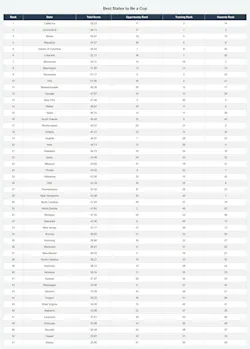
WalletHub evaluated all 50 states and the District of Columbia using 30 indicators of “police-friendliness.” These metrics include median income for officers, police deaths per 1,000 officers, and state and local spending on police protection per capita.
Among the top-ranked states, the data reflects differing operational strengths that may influence agency strategy and officer decision-making:
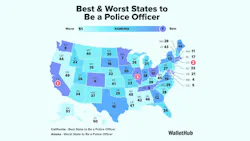
California ranked first overall with a total score of 59.33, supported by strong training standards (No. 2). While its opportunity and competition ranking (No. 11) and job hazards and protections ranking (No. 14) are more moderate, the state’s emphasis on training and resources may contribute to officer preparedness and risk mitigation.
Connecticut placed second with a score of 56.73, despite ranking last (No. 51) in opportunity and competition. The state’s top ranking in training requirements and No. 2 position in job hazards and protections suggest a highly structured environment focused on officer safety and professional standards, which may offset fewer available positions.
Illinois ranked third with a total score of 56.07, demonstrating balance across all categories, including No. 5 in training requirements and No. 10 in job hazards and protections. Its mid-range opportunity ranking (No. 18) indicates a relatively stable environment for both recruitment and retention.
Maryland came in fourth with a score of 54.57, supported by consistent performance across training (No. 6) and job hazards and protections (No. 8). While its opportunity ranking (No. 38) is lower, the state’s overall profile suggests a focus on officer safety and structured training.
The District of Columbia ranked fifth with a total score of 54.02, driven by the nation’s top ranking in opportunity and competition. However, it placed last (No. 50) in job hazards and protections, indicating potential operational risks that agencies and officers must weigh despite strong hiring demand and career mobility.
“Some states make protecting and serving the public in a law enforcement career more appealing than others,” said Chip Lupo, WalletHub Analyst. “The best states for police officers offer competitive compensation, supplemented by solid training that helps minimize the chances of deadly violence between officers and civilians. State-level policies like ‘red flag laws’ or ‘Blue Alerts’ also contribute to a better environment for police.”