The Hidden Equipment Problems Officers Don't Discover Until It's Too Late
What to Know
- Law enforcement agencies too often confuse equipment that is reachable under ideal training conditions with equipment that remains truly accessible during real-world encounters involving movement, stress, injury, awkward positions or one-handed operation.
- Author Keith Hanson introduces the concept of "negative equipment interactions," which occur when gear placement, clothing, body position or physical impairment interferes with an officer's ability to access or deploy another piece of equipment.
- Agencies and instructors to test duty gear under realistic conditions, including support-hand-only operation, seated and grounded positions, stress exposure and changing environmental constraints, to identify hidden equipment failures before they emerge in critical incidents.
More on OFFICER.com
Are Firearms Instructors Creating Better Shooters or Just Better Performers?
- A shooter who performs well under constant coaching might not have learned the skill, and motor-learning research explains why effective firearms training must build adaptable decision-makers, not just fast shooters.
There is a simple assumption buried inside much of law enforcement equipment selection and training: If an officer can reach a piece of equipment during training, the equipment is accessible. I am increasingly convinced that this assumption is incomplete. Accessibility is not merely a question of whether an officer can place a hand on a pistol, TASER, magazine, handcuff case, baton or tourniquet while standing comfortably on a range. The more important question is whether the officer can reliably access and operate that equipment when posture changes, movement becomes violent, attention is divided, physiological arousal rises and several pieces of equipment suddenly begin competing for the same physical space. We also need to ask a question that is too often ignored: Can the officer still access and operate that equipment when one hand or arm is injured, incapacitated, occupied or otherwise unavailable?
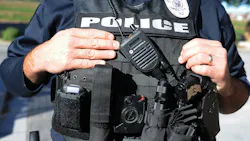
Anyone who has spent enough time around cops and firearms instructors has seen equipment setups that look perfectly reasonable while the officer is standing upright with both hands available. The handgun clears the holster. Magazines come out smoothly. The TASER is accessible. The radio microphone is exactly where the officer wants it. Handcuffs, gloves, medical equipment and other tools occupy their assigned positions. Then the officer kneels, sits in a cruiser, goes prone, tries to draw while moving laterally, shoulders a patrol rifle or gets physically entangled with another person, and suddenly something that never appeared problematic becomes very problematic. An outer-carrier pouch interferes with the elbow during the handgun draw. A rifle sling catches on the radio microphone. The vest prevents the hand from entering the normal path used to access a magazine. A baton carrier that is easily reached while standing becomes effectively pinned while seated. A seat belt crosses equipment that the officer believed was accessible. A winter coat changes tactile landmarks the officer has relied upon for years.
Now remove one hand from the problem entirely. The officer's dominant hand is injured, trapped underneath the officer, being used to control a subject, holding pressure on a wound or simply unavailable because the officer landed on that arm during a struggle. The officer now has to access a strong-side handgun with the support hand, reach ammunition with that same hand, or deploy another piece of defensive equipment from a position and direction for which the equipment may never have been tested. The same problem occurs in reverse when the support arm becomes unavailable and the dominant hand must perform tasks normally divided between both hands. A setup that seemed perfectly functional with two healthy hands may suddenly become a mechanical puzzle.
The Problem of Negative Equipment Interactions
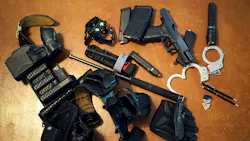
My good friend and colleague Jason Speller, of the South Carolina-based Law Enforcement D.R.A.W. School, which stands for “Developing Rapid Ability with Weapons,” describes these problems as negative equipment interactions. Speller’s curriculum devotes significant time to addressing these interactions both conceptually and through practical application (Law Enforcement D.R.A.W. School LLC, 2026). A negative equipment interaction occurs when one component of an officer's equipment, clothing, vehicle environment, physical position or bodily condition interferes with the perception, access, movement or motor sequence required to operate another piece of equipment. I have come to adopt the term in my own training curricula because it means exactly what it says, simply and efficiently. Importantly, the concept should include the officer's own body because injury, incapacitation or the temporary loss of a limb fundamentally alters the equipment environment. A duty belt and outer carrier are not simply storage systems. Once an officer trains with them, they become part of the officer's learned motor environment, and their arrangement influences how movement is learned, how efficiently it is executed, and how reliably it transfers when circumstances change. This distinction between what looks successful during training and what remains functional when conditions change is consistent with a broader argument I make in Unlocking the Brain Code: Observable performance during practice is not the same thing as durable capability. A shooter can produce clean repetitions, fast times and acceptable scores in a familiar environment while the underlying skill remains more context-dependent than either the student or instructor realizes. Immediate fluency can create an illusion of proficiency if the skill has never been tested across variability, uncertainty, altered physical conditions and stress (Hanson, 2026). Equipment configuration belongs squarely inside that discussion because an officer can demonstrate flawless access with two hands while standing upright without demonstrating that the same equipment relationship will survive injury, entanglement, unconventional posture or forced support-hand operation.
Automaticity Has Limits
When people first learn a complex physical task, movements generally require considerable conscious attention. The learner thinks through the sequence, and the actions may initially be hesitant, segmented and inefficient. With practice, however, individual movements begin to combine into larger motor units. Di Nota and Huhta describe this process in police training as motor chunking, in which smaller components eventually become concatenated into larger behavioral sequences that can be executed with less conscious effort (Di Nota & Huhta, 2019). Consider the handgun draw. A new shooter may consciously think about establishing a grip, defeating retention, clearing the holster, orienting the firearm and presenting the pistol. An experienced officer generally does not experience those elements as independent decisions because, with sufficient learning, they become integrated into a procedural action.
That is one of the enormous benefits of automaticity. Automaticity allows highly practiced behavior to occur with considerably less demand on working memory and conscious attentional control, which matters because officers still have other problems to solve. An officer may be assessing hands, movement, distance, bystanders, verbal behavior, cover, another officer's location and the changing legal justification for force while simultaneously performing physical actions. Research on police performance under stress suggests that this distinction between highly practiced behavior and cognitively demanding behavior is important. Arble, Daugherty and Arnetz found that physiological arousal can affect different police performance domains differently, with communication and cognitively demanding functions potentially more vulnerable than well-rehearsed tactical behavior (Arble et al., 2019). Anderson and colleagues similarly concluded that acute stress can degrade skilled motor performance, although evidence-informed training may mitigate some of that degradation (Anderson et al., 2019).
The problem is that automaticity is specific to the movement relationships that were actually learned. An officer may possess a highly automatic dominant-hand draw from a duty holster while possessing comparatively little experience accessing that same handgun with the support hand. Those are not necessarily the same skill performed on opposite sides. The spatial relationship between the hand, retention system, torso and holster changes dramatically when the opposite hand must cross the body to access equipment positioned for dominant-side use. Retention devices that have been operated thousands of times by one hand may suddenly have to be manipulated from an unfamiliar angle with different fingers, different wrist orientation and different tactile information.
Motor-learning research gives us an important caution here. Intermanual transfer, sometimes called bilateral transfer, does occur, meaning that learning with one limb can produce some performance benefit in the opposite limb. The effect, however, is not simple or uniform. Research has found that the magnitude and direction of transfer can depend on the task, handedness and the specific performance variable being measured (Chase & Seidler, 2008). From a training perspective, the implication is straightforward: We should not assume that because an officer is highly competent with the dominant hand, the nervous system has automatically created an equivalent support-hand solution.
What Happens When a Hand Disappears?
That becomes especially important when we talk about one-handed handgun access. A dominant-hand-only draw from a strong-side holster is usually compatible with the equipment's original orientation because the holster was positioned for that hand. A support-hand-only draw from that same holster presents an entirely different biomechanical problem. Body armor, outer-carrier pouches, belt equipment and the officer's own torso may obstruct the cross-body path. The holster's retention system may be difficult to manipulate from the opposite direction. What appears reachable in an administrative inspection may prove functionally inaccessible when the officer is seated, on the ground or unable to rotate freely.
Magazine access creates the same problem. Consider an officer who carries spare pistol magazines on the belt opposite the handgun. With both hands functioning, the support hand may access those magazines efficiently because the system was designed and practiced around that relationship. If the support arm becomes incapacitated, the dominant hand may now have to reach across the body to equipment oriented for the opposite hand. Depending on pouch angle, retention design, body type, belt position and outer-carrier interference, that movement may range from mildly inconvenient to effectively impossible from certain positions. The magazine itself has not changed. The motor problem has.
The increasing use of outer uniform carriers adds another dimension. Many officers now carry ammunition, medical equipment, radios and other tools on the torso rather than exclusively on the duty belt. There are legitimate ergonomic reasons for doing so, but moving equipment onto the carrier changes the reach geometry. A magazine pouch mounted high on the support side may work beautifully during a conventional two-handed reload, yet its accessibility should also be evaluated when the support hand is unavailable and the dominant hand must retrieve the magazine. Conversely, equipment placed on the dominant side of the carrier needs to be considered from the perspective of support-hand-only access. A pouch that technically can be touched by either hand is not necessarily a pouch that can be opened, indexed and used reliably by either hand under stress.
This distinction is critical. Touching equipment is not the same thing as accessing equipment, and accessing equipment is not the same thing as deploying it. When officers conduct equipment checks, they should be concerned not only with whether the opposite hand can physically reach an item, but whether the full required interaction remains possible when one side of the body is unavailable. Retention mechanisms, flap orientation, elastic tension, buckle placement and the proximity of adjacent equipment can all influence whether a nominally ambidextrous location is actually functionally ambidextrous.
The issue extends beyond firearms and magazines. A TASER is another device with a learned location, grip orientation and deployment pattern. If it is positioned specifically for support-hand access, what happens when the support hand is incapacitated and the dominant hand must retrieve it? If policy or training uses a cross-draw arrangement, has the officer actually practiced accessing that configuration when normal torso movement is restricted? If the dominant hand is unavailable, can the support hand access the TASER without first moving other equipment or visually searching for it? These questions become particularly important because the TASER and handgun exist within the same force-option environment, where equipment differentiation and motor-program competition already deserve close attention.
Why Gear Placement Matters Under Stress
The literature surrounding firearm and TASER conducted energy weapon confusion illustrates why equipment arrangement cannot be separated from human action. Williams examined documented weapon-confusion incidents through human action and human-error theories and identified mechanisms consistent with capture errors and action-execution slips (Williams, 2023). Kroll and colleagues likewise examined firearm and electrical-weapon confusion incidents and found that the risk, although very small, is real and that equipment positioning has historically been associated with that risk (Kroll et al., 2022). The broader lesson is not simply about where to carry a TASER. It is that equipment location, repetition, orientation and the relative strength of competing motor patterns can shape behavior under pressure.
The expandable baton presents another useful example. An officer may normally deploy the baton with the dominant hand from a carrier positioned for that movement. If the dominant arm is injured or pinned, can the support hand access the baton from the same location? If the baton is positioned behind other equipment, does cross-body access require torso rotation that may not be possible during a physical struggle? If the officer is seated in the cruiser or on the ground, can either hand still reach it? A baton carrier that appears perfectly reasonable during inspection may become effectively unusable once the officer's posture, available hand and freedom of movement change.
These are not obscure hypotheticals. Incapacitation does not necessarily mean catastrophic injury. An arm can become temporarily unavailable because the officer is using it to protect the head, hold a radio, maintain control of a suspect, manage a shield, stabilize against a fall, open a door, apply pressure to a wound or retain another piece of equipment. Practitioner training literature has long recognized that one-handed firearms manipulation is relevant whenever one hand cannot be used, not simply when that hand has been physically injured (Bertomen, 2022). That broader definition matters because it moves one-handed performance out of the category of exotic “wounded officer” training and into the much larger category of foreseeable task constraint.
This is where equipment interference becomes far more interesting than a simple ergonomics problem. Automaticity works because the nervous system has developed an efficient solution to a familiar problem. The hand knows where the equipment is. The body knows how to orient around it. The sequence has been practiced enough that little conscious supervision is required. If the learned solution suddenly does not work because the usual hand is unavailable, however, the officer is no longer simply executing the established motor program. The nervous system has encountered a new problem and may have to inhibit the normal response, locate an alternative access path, manipulate unfamiliar retention mechanisms and execute a motor sequence that has received far less practice.
The timing could hardly be worse. Baldwin and colleagues monitored officers during actual calls for service and found that encounter phases and factors including weapons, arrests and use of force were associated with significant physiological responses (Baldwin et al., 2019). Under excessive arousal, attentional control may narrow, cognitive flexibility may decrease and the ability to process multiple sources of information can deteriorate. Renden and colleagues found that increased anxiety degraded police arrest and self-defense performance and changed movement behavior (Renden et al., 2014). Nieuwenhuys and Oudejans similarly demonstrated that anxiety can degrade handgun shooting performance and alter officer behavior (Nieuwenhuys & Oudejans, 2010; Nieuwenhuys et al., 2012).
This produces what I consider the central equipment-training problem: Automaticity reduces the need for conscious control, but equipment interference suddenly demands conscious control again at the same moment acute stress may be reducing the cognitive resources available to provide it. Add an incapacitated dominant hand, an inaccessible support-side magazine or a holster that has never been operated from the opposite side, and the officer may now be solving a mechanical problem while simultaneously managing a threat, injury, movement and decision-making. The worst time to discover that an equipment configuration is effectively one-handed is when the hand it depends upon is the hand you no longer have available.
Research on police load carriage reinforces the broader argument that equipment changes movement. Ramstrand and colleagues found that police load-carriage configurations altered trunk, pelvis, hip and arm movement during walking, with evidence that officers adapted to some equipment changes over time (Ramstrand et al., 2016). Ramaj Jewett and colleagues found that law enforcement equipment affected functional movement measures including shoulder mobility and rotary stability (Ramaj Jewett et al., 2023). Sax van der Weyden and colleagues found that duty-belt and tactical-vest loads influenced muscular activity and that simultaneous cognitive demands reduced postural stability (Sax van der Weyden et al., 2023). None of these studies tells us where a particular officer should place a magazine or baton, but together they demonstrate why treating equipment placement as a static administrative question misses the underlying human-performance problem.
One particularly useful study examined handgun holster position. Campbell and colleagues evaluated police officers using hip and thigh holsters and found no significant overall advantage in draw time or accuracy for one location over the other. Familiarity mattered, with officers demonstrating greater draw success when using the holster position with which they were accustomed (Campbell et al., 2013). That finding should matter whenever agencies change holsters, move equipment or alter outer-carrier configurations because moving the equipment changes the learned relationship between the officer and the tool.
One-handed and support-hand performance makes that lesson even more important. An officer may be deeply familiar with a holster when operating it conventionally and almost completely unfamiliar with the exact same holster when accessing it with the opposite hand. Likewise, an officer may have thousands of repetitions retrieving magazines from a belt-mounted pouch with the support hand and almost none retrieving those same magazines with the dominant hand. Familiarity with the equipment should therefore not be confused with familiarity with every access solution the officer may eventually need.
Testing Equipment Beyond the Range
This is one reason slow, predictable training can conceal equipment problems. When officers know exactly what they are about to do, they can subtly prepare for it. They adjust their feet, reposition the torso, move clothing, clear equipment or compensate for an awkward reach before the drill begins. During a planned one-handed exercise, they may even unconsciously orient the body in anticipation of the known task. The drill still looks successful, but success under predictable conditions may tell us more about adaptation to the drill than about whether the equipment remains accessible when the loss of a hand is unexpected.
Within the NeuralTac framework, equipment should therefore be treated as part of the constraint structure surrounding human performance. The performer, task and environment interact continuously, and injury or temporary incapacitation is itself a change in the performer constraint. A pistol draw performed with the dominant hand while standing square on a range is one motor problem. The same draw with the support hand is another. Retrieving a belt-mounted magazine with the hand for which the pouch was positioned is one problem. Reaching that same magazine with the opposite hand while seated, kneeling or supine is another. Accessing a carrier-mounted magazine, TASER or baton while one arm is unavailable changes the problem again.
This is not merely theoretical within the instructor-development environments in which we work. In our NeuralTac instructor-development programs, as well as other law enforcement, firearms and defensive-skills programs we work with and endorse, officers and operators are specifically tested and assessed for what we refer to as negative equipment interactions. The objective is not simply to determine whether an officer can touch or retrieve a piece of equipment under ideal conditions. The entire equipment system is evaluated while posture, movement, available limbs, force options and task demands change because those changes are often what expose problems that remain invisible during conventional range work.
That assessment can reveal a vest-mounted pouch that obstructs the normal handgun draw, a magazine carrier that works efficiently with the support hand but becomes extremely difficult to access with the dominant hand after support-side incapacitation, or a belt-mounted magazine that cannot be reliably reached cross-body from a seated or grounded position. It may expose a holster retention system that an officer operates automatically with the dominant hand but struggles to defeat with the support hand, or a carrier-mounted magazine whose angle and retention make opposite-hand extraction impractical. Similar interactions can occur when a rifle sling catches on a radio microphone, body-worn camera or medical pouch, when a baton becomes inaccessible from certain positions, or when the normal TASER deployment hand is injured, occupied or pinned.
The purpose of this testing is not to prescribe a universal duty-belt or outer-carrier configuration. Different body types, assignments, equipment requirements and agency policies make that unrealistic, and the available research does not establish one ideal arrangement for every officer. The objective is instead to identify failure points in the individual officer-equipment system before those failure points emerge during a real confrontation. An instructor should be able to distinguish between equipment that is technically present, equipment that is technically reachable and equipment that remains functionally available when the officer's normal movement solution has been disrupted.
Building Resilient Equipment Systems
The NeuralTac question should therefore move beyond, “Can the officer reach it?” We should ask whether the equipment relationship remains functional when one hand disappears from the equation, whether the opposite hand can actually complete the necessary deployment, whether another piece of equipment interferes with that movement and whether the skill survives altered posture, stress and environmental constraint. NeuralTac emphasizes retention, transfer and adaptability rather than assuming that visible fluency under one set of circumstances proves general competence. In high-liability training, the meaningful measure of a skill is not simply whether the officer can perform it when everything is working. It is whether useful capability remains when something important stops working.
Equipment should therefore be behaviorally validated rather than merely visually inspected. That does not mean creating unsafe range practices or improvising techniques outside manufacturer guidance, agency policy and qualified instruction. One-handed and support-hand training introduces legitimate safety issues that require careful instructional design and appropriate training equipment. What it does mean is that officers should have opportunities within controlled environments to discover whether their setup remains functional when normal hand availability, posture and movement are altered.
Instructors should pay close attention to compensations during that process. If the support hand cannot access the handgun without moving another pouch, that is information. If the dominant hand cannot retrieve a support-side magazine from the outer carrier without excessive torso rotation, that is information. If one-handed access requires the officer to look down and visually search for equipment that is normally located by touch, that is information. If a sling repeatedly catches on the same item, that is information. If the baton, TASER or medical equipment becomes inaccessible when the hand normally assigned to it is unavailable, that is information. Those are not minor imperfections to ignore simply because the officer eventually completed the exercise. They are evidence about the relationship between equipment design, placement and the officer's actual motor options.
Training under appropriately managed stress also matters because representative pressure can reveal weaknesses that calm repetition conceals. Nieuwenhuys and Oudejans found that officers who trained shooting skills under anxiety later maintained performance more effectively under pressure than officers who trained under low-anxiety conditions (Nieuwenhuys & Oudejans, 2011). Anderson and colleagues likewise argue that scenario-based training can help officers retrieve essential skills under conditions more closely resembling those in which they may ultimately be needed (Anderson et al., 2019). The goal is not to turn every equipment check into an ordeal or simply make training harder for the sake of making it harder. It is to progress from deliberate exploration toward representative testing so that failure points appear during training rather than during an actual confrontation.
There is also an organizational implication. Agencies frequently change holsters, body armor, outer carriers, TASER models, magazine pouches, body-worn cameras, radios and medical equipment for perfectly legitimate reasons. Administratively, the new equipment may be issued in a morning, but neurologically, the officer's relationship with that equipment cannot be issued at all. It has to be learned. If placement changes, the normal access sequence may change with it. If equipment moves from the belt to the carrier, cross-body access may change. If a retention system changes, support-hand operation may change. If an agency never evaluates those changes under one-handed conditions, it may never discover that the new configuration eliminated an option the previous configuration allowed.
There is a significant distinction here between equipment familiarization and equipment integration. Familiarization tells the officer where an item is, how it operates and perhaps how to use it under ordinary conditions. Integration means that the equipment has been incorporated into the officer's larger perceptual-motor system and tested against the other equipment, movements and constraints that may accompany its use. That distinction mirrors the broader learning principles I discuss in Unlocking the Brain Code, where the central concern is not whether a student can demonstrate a skill immediately after instruction, but whether the capability survives contextual change and remains retrievable when conditions are no longer ideal (Hanson, 2026).
This also requires humility from instructors. We should be careful about declaring that an equipment setup “looks good” based on our own preferences or because it functions well during conventional bilateral drills. An arrangement that works exceptionally well for one instructor's body, handedness, assignment and movement patterns may perform differently for another officer. There is no research-supported universal arrangement that eliminates every negative interaction. What science gives us instead is a more useful process: expose the system to meaningful variation and observe where it begins to fail.
That process also changes how we should think about the phrase “train like you fight.” Taken literally, the phrase is overly simplistic because no controlled training environment can reproduce every variable of an actual violent encounter. A more useful goal is to train across enough relevant variation that the officer develops adaptable solutions rather than dependence on one idealized context. That means changing posture, changing available hands, changing equipment relationships and occasionally introducing the kinds of competing demands that force the officer to retrieve the skill rather than simply execute a memorized drill.
The same principle applies to instructor development. The instructor's job should not end with demonstrating a preferred equipment setup or teaching an officer how to use each tool independently. The instructor should understand how to evaluate the system created when those tools are worn together and used by a particular officer. That requires watching how the officer moves, identifying compensations, testing access from different positions and asking what changes when one limb is unavailable. A negative equipment interaction is frequently not obvious until the movement exposes it, which means an instructor who evaluates only static placement may never see the actual problem.
That is ultimately where duty equipment has to prove itself. The belt, vest, holster, TASER, baton, magazines, restraints, radio, camera and medical equipment are not independent objects hanging on an officer's body. Together they create a physical environment through which learned actions must occur. Every addition changes that environment, every relocation changes it again, and the temporary or permanent loss of one hand changes it more dramatically still. Our nervous systems can adapt to those changes, but adaptation requires exposure, practice and testing. It cannot simply be presumed because an officer performs well with two healthy hands.
In police training, we spend enormous amounts of time trying to create automaticity because we understand the value of behaviors that remain available when conscious attention is occupied elsewhere. We should recognize the other side of that principle. Automatic behavior is most reliable when the physical environment and the available motor system continue to support the movement that was learned. When injury, entanglement or equipment interference removes part of that system, the officer may be forced to stop executing and start solving. That transition may take only fractions of a second, but policing is a profession in which fractions of a second can matter.
The next time we evaluate a duty setup, I would move beyond asking whether everything fits or whether every item can be reached with the hand normally assigned to it. I would ask whether the handgun can still be accessed when the dominant hand is unavailable, whether magazines mounted on the belt or outer carrier can be reached and used by either hand, whether a TASER or baton remains available when its normal deployment hand is injured or occupied, whether one piece of equipment obstructs another and whether the entire arrangement continues to function when posture and movement are no longer ideal. A duty setup that works with two healthy hands while standing comfortably on a range has passed only the easiest test. The real test begins when movement, stress, injury and urgency change the problem.
References
Anderson, G. S., Di Nota, P. M., Metz, G. A. S., & Andersen, J. P. (2019). The impact of acute stress physiology on skilled motor performance: Implications for policing. Frontiers in Psychology, 10, 2501. https://doi.org/10.3389/fpsyg.2019.02501
Arble, E., Daugherty, A. M., & Arnetz, B. (2019). Differential effects of physiological arousal following acute stress on police officer performance in a simulated critical incident. Frontiers in Psychology, 10, 759. https://doi.org/10.3389/fpsyg.2019.00759
Baldwin, S., Bennell, C., Andersen, J. P., Semple, T., & Jenkins, B. (2019). Stress-activity mapping: Physiological responses during general duty police encounters. Frontiers in Psychology, 10, 2216. https://doi.org/10.3389/fpsyg.2019.02216
Bertomen, L. (2022, December 18). One-handed reloading. Officer.com.
Campbell, A., Roelofs, A., Davey, P., & Straker, L. (2013). Response time, pistol fire position variability, and pistol draw success rates for hip and thigh holsters. Human Factors, 55(2), 425-434. https://doi.org/10.1177/0018720812453466
Chase, C., & Seidler, R. D. (2008). Degree of handedness affects intermanual transfer of skill learning. Experimental Brain Research, 190(3), 317-328. https://doi.org/10.1007/s00221-008-1472-z
Di Nota, P. M., & Huhta, J.-M. (2019). Complex motor learning and police training: Applied, cognitive, and clinical perspectives. Frontiers in Psychology, 10, 1797. https://doi.org/10.3389/fpsyg.2019.01797
Hanson, K. A. (2026). Unlocking the brain code: Exposing the limits of traditional firearms instruction and high-liability training through neuroscience, psychology, and human performance research. Applied Threat Science Publications.
Kroll, M. W., Melinek, J., Martin, J. A., Brave, M. A., & Williams, H. E. (2022). Confusion between firearms and electrical weapons as a factor in police shootings. Forensic Science, Medicine and Pathology, 18(3), 280-287. https://doi.org/10.1007/s12024-022-00457-6
Law Enforcement D.R.A.W. School LLC. (2026). D.R.A.W. School handgun training. https://drawtraining.com/
Nieuwenhuys, A., & Oudejans, R. R. D. (2010). Effects of anxiety on handgun shooting behavior of police officers: A pilot study. Anxiety, Stress, & Coping, 23(2), 225-233. https://doi.org/10.1080/10615800902977494
Nieuwenhuys, A., & Oudejans, R. R. D. (2011). Training with anxiety: Short- and long-term effects on police officers' shooting behavior under pressure. Cognitive Processing, 12(3), 277-288. https://doi.org/10.1007/s10339-011-0396-x
Nieuwenhuys, A., Savelsbergh, G. J. P., & Oudejans, R. R. D. (2012). Shoot or don't shoot? Why police officers are more inclined to shoot when they are anxious. Emotion, 12(4), 827-833. https://doi.org/10.1037/a0025699
Ramaj Jewett, B., Tomes, C., Voigt, K., & Mokha, G. M. (2023). The effects of equipment carriage on functional movement quality among law enforcement officers. Ergonomics, 66(12), 2277-2287. https://doi.org/10.1080/00140139.2023.2199954
Ramstrand, N., Zügner, R., Bæk Larsen, L., & Tranberg, R. (2016). Evaluation of load carriage systems used by active duty police officers: Relative effects on walking patterns and perceived comfort. Applied Ergonomics, 53, 36-43. https://doi.org/10.1016/j.apergo.2015.08.007
Renden, P. G., Landman, A., Geerts, S. F., Jansen, S. E. M., Faber, G. S., Savelsbergh, G. J. P., & Oudejans, R. R. D. (2014). Effects of anxiety on the execution of police arrest and self-defense skills. Anxiety, Stress, & Coping, 27(1), 100-112. https://doi.org/10.1080/10615806.2013.810213
Sax van der Weyden, M. N., Kearney, J. W., Cortes, N., Fernandes, O., & Martin, J. R. (2023). Common law enforcement load carriage systems have limited acute effects on postural stability and muscle activity. Applied Ergonomics, 113, 104091. https://doi.org/10.1016/j.apergo.2023.104091
Williams, H. E. (2023). Weapon confusion: TASER CEWs, firearms, and human error theories. Criminal Justice Review, 48(4), 495-514. https://doi.org/10.1177/07340168221123238
About the Author
 Keith Hanson
Keith Hanson
Contributing Editor Keith Hanson is a career law enforcement professional with extensive experience across operational and instructional domains, specializing in firearms instruction, tactical operations training, and counterterrorism tactics. With a strong background in neuroscience and psychology, Keith is a co-creator and senior program architect of NeuralTac™, which combines neuroscience, combat psychology, neuropsychology, kinesiology, and educational sciences, drawing from the latest research in human performance, to produce advanced high-liability instructional frameworks for law enforcement agencies, contract security firms, and other armed professionals. It also aims to develop and foster advanced-level master trainers within those organizations. Additionally, as a certified Force Science analyst and certified cognitive/forensic interviewer, Keith serves as a court-recognized expert witness on use-of-force matters and provides consultation on legal strategies. He is the author of "Unlocking the Brain Code: Exposing the Limits of Traditional Firearms Instruction and High-Liability Training Through Neuroscience, Psychology, and Human Performance Research."
You can email Keith: [email protected]
And visit his LinkedIn page: https://www.linkedin.com/in/keithhanson1973/