Less-Lethal Tools Evolve as Agencies Balance Gear, Training and Effectiveness
What to Know
- Law enforcement agencies are expanding their less-lethal toolkits to include TASERs, compliance gloves, and specialized shotgun munitions, aiming for safer de-escalation options.
- The definition of 'less-lethal' includes tools that modify behavior without causing lethal injury, such as flashlights used as impact weapons or visual deterrents.
- Technologies like the TASER 10 improve deployment effectiveness, reducing the need for other less-lethal options and minimizing cross-contamination risks.


Just as the Industrial Revolution has accelerated as it’s evolved, so has the speed with which new tools are being developed for law enforcement, specifically less lethal tools for the purposes of this article. We’ve come a long way from the wooden batons and chemical mace that were common 50 years ago. As we’ve evolved, we’ve also added more items to the average patrol officer’s equipment load and, as it turns out, all of the equipment might not be necessary. However, this is one of those times when, “It’s always better to have it and not need it than to need it and not have it.” So, let’s examine what’s common to be carried and used.
So that we didn’t limit the potential less-lethal list, we reached out to several different law enforcement agencies, some police departments and some sheriff’s offices. It turns out that their patrol officers are all carrying some variation of the same equipment, although the agencies seem to differ slightly in what they consider a less-lethal tool.
One police agency representative listed their less-lethal tools as: OC spray, baton and TASER (different models as the agency transitions to the TASER 10 across the next two years). A sheriff’s office representative listed their less-lethal tools as OC spray, baton, TASER, flashlight and dedicated 12g shotgun. Obviously, the shotgun isn’t carried on the patrol deputy’s person, but apparently every deputy has the option of having a less-lethal shotgun in their patrol vehicle. When asked what makes a tool qualified to be called “less lethal,” one use of force instructor stated that it was “… anything that is deployed that modifies the subject’s behavior without creating a lethal risk or potentially lethal injury.” Such a definition explains why at least one agency listed flashlights as a less-lethal tool. When asked specifically about that, the use of force instructor, who also happened to be a low-light operations instructor, pointed out that a bright enough light, properly manipulated, could prevent a subject from having a clear visual line of attack, and if the subject did get close enough to physically attack (without a weapon), the flashlight could be used as an impact weapon. Given the agency’s policies and general orders on the deployment of impact weapons, such use would always be less lethal.
One sheriff’s office listed the Compliant Technologies CD3 glove on their approved less-lethal tool list but found it used by more corrections deputies than patrol deputies. The duty assignment and expected interactions seemed to be the deciding factor in who chose to carry/wear the CD3 gloves.
When asked about patrol less-lethal technologies, Cpt. Nathan Funchion of the Calvert County Sheriff ’s Office in Maryland stated, “Since we’ve switched to the TASER 7, we’ve seen a reduction in the use of other less-lethal tools by our patrol deputies.” The follow-on conversation revealed that since the CCSO switched to the TASER 7, the deputies have been able to more consistently create the effective circuit during deployments of the tool, and the agency increased its training regimen with it. The use of the TASER is favored as it reduces the chance of cross-contamination if OC spray is deployed as well as reducing the chance of injury if a baton is deployed.

That same sheriff’s office, in a forward-thinking posture, began to transition the agency shotguns to less-lethal use only as they put into place their patrol rifle program across the past two decades. As a result, each deputy who wants one and has been trained has a dedicated less-lethal shotgun in their patrol vehicle. Cpt. Funchion noted that they only use 12g bean-bag rounds, simplifying the training regimen as well as the ammunition purchase process.
It’s worth noting that in today’s law enforcement market, there is a plethora of 12g “special munitions” available, but each different type brings the burden of additional training. As an example, Lightfield Ammunition produces six different types of 12g less-lethal ammo with projectiles made from different materials and each designed for engagement at different ranges.
While researching less-lethal options for this article, we also found something called “The Alternative” from a company called Alternative Ballistics. The Alternative is an attachment that is placed on the duty sidearm when a less-lethal option is desired but the engagement range might be greater than other options or when the other options aren’t available. The Alternative can be carried on the duty belt or vest, placed on the duty sidearm and used for the first shot using the energy of the 9mm projectile to propel a larger and heavier spherical impact device. The mount for the projectile falls off of the duty handgun when the shot is fired leaving the weapon clear for follow-on, potentially lethal, shots as necessary.
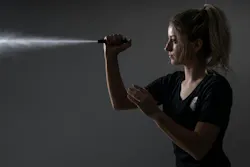
It’s interesting to note how many less-lethal tools are now viewed as deescalation options if time and circumstances permit their use even when lethal force may be justified. This is another indication of how the law enforcement community and the industry that supports it are doing everything they can to save lives. It’s further proof of what we have said all along: we don’t want to shoot people. Sometimes we have no other option except to sacrifice the life of an officer or an innocent bystander.
Keeping that outlook and motivation in mind, it’s clear that the less-lethal tool industry will continue to evolve as more manufacturers seek new and innovative ways to provide law enforcement professionals with less- or non-lethal options. With every new tool, though, there is an attached cost of purchase, training and add-on equipment that the patrol professionals must carry. Any agency adding to its less-lethal arsenal or wanting to upgrade its current less-lethal tool capability must keep ASP Inc. all of that in mind.
About the Author
 Lt. Frank Borelli (ret), Editorial Director
Lt. Frank Borelli (ret), Editorial Director
Editorial Director
Lt. Frank Borelli is the Editorial Director for the Officer Media Group. Frank brings 25+ years of writing and editing experience in addition to 40 years of law enforcement operations, administration and training experience to the team.
Frank has had numerous books published which are available on Amazon.com and other major retail outlets.
If you have any comments or questions, you can contact him via email at [email protected].