HK VP9A1-B Makes Strong Case as a Duty Handgun
What to Know
- The VP9A1-B features a recoil-operated, Browning-type locking system with a polygonal barrel, ensuring accuracy and durability.
- Over-engineered with maritime serrations, suppressor-height sights, and patented HK charging supports for reliable performance in demanding environments.
- The handgun is fully ambidextrous with interchangeable grip panels, allowing for a customizable fit tailored to individual shooters.
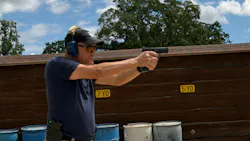
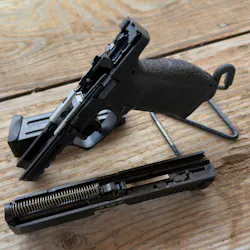
I tested the Heckler & Koch VP9A1-B 9mm duty handgun. Shooting this gun made me rethink my duty gun choices. The VP9A1-B is one of the several VP9 variants of this design. They are all recoil-operated, Browning-type linkless locking system guns designed for duty and concealed carry. I honestly get confused on the variants, but they generally come with a 4.09- inch or 4.53-inch polygonal barrel. This one was the 4.09-inch version with the push-button mag release.
It weighs just under 23 ounces unloaded, the “sweet spot” for a duty gun.
Most VP9s, in general, look pretty space-age. They have almost full-length serrations, fulllength rails, and tactile indexing points. Unlike other brands of duty guns, the VP9 has always looked like what I would attach to an automated defensive system like a drone. That is, it looks more sci-fi than a real gun.
This has a lot to do with HK over-engineering. For example, the rear cocking serrations give ample purchase for the average hand. If they just had this for clearing a jam, I would be happy. They added truck-bumpersized suppressor-height sights, whose rear sight has a canted front surface strong enough for one-handed, thrust-down-the-beltline clearing. There is a little extra purchase on the magazine bases, plus a recess cut in the mag well, just in case the user needs to rip the mag away for a forced reload. On top of that, there are patented HK charging supports, which stick out behind those milled slide serrations.
Talk to an HK user. There isn’t a single type of ammo failure that scares them. That’s over-engineering.
Are you the kind of officer who checks his gun often? I do. Most manufacturers just call the front serrations of the handgun “front serrations.” HK calls them “maritime serrations.” I picture using this particular gun on a rolling deck, with waves splashing over me, a scenario in which I would never place myself. Rocking decks mean oceans, and oceans mean sharks. Not for me. However, maritime serrations should tell you that even if your hand is covered with barnacles, you’ll be able to press-check your gun. They offer that kind of grip. There is also a striker indicator, which is easily seen from the rear of the gun.
Unlike other gun tests, I just loaded up some magazines and began pounding 3D targets. My son owns a VP9. It differs from the one I’m testing by the magazine release lever. The VP9A1 has a button. Others have a lever on the side of the trigger guard, which is pressed downward to drop the magazine.
Besides the magazine configuration, it feels exactly the same as other VP9s. The trigger press is smooth and crisp, and the reset is short.
If you are going to work immediate action drills (Tap, Rack, Target), I would use gloves. The slide cuts will work your hands.
VP9 owners have a healthy respect for the polygonal rifling when the shots are past 25 yards. I generally get 50-100 fps faster velocities when I compare cartridges shot through a VP9 with other guns with conventional rifling.

I started to mount an optic on this VP9 but realized I did not have the correct mounting plate. The VP9A1-B does come optic-ready, but the mounting plates are a separate purchase. HK has a list of their plate types and which optics they fit. The sights are a law enforcement officer’s dream. The rear is black with serrations, while the front has a tritium insert. This system gives a clean, simple alignment that is easy to pick up under time pressure. They give an unobtrusive picture for the optics user. They are also strong enough for one-handed training all day long, whether cocking on the belt, holster lip or boot.
The VP9A1 is ambidextrous. The grip area is symmetrical, and there is a slide release on both sides of the frame. No one that tried this gun found they had to change their grip to use any of its controls. The index on the trigger was consistent, and acquiring the Master Grip was natural.
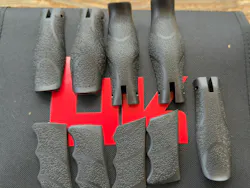
The VP9 comes with fully interchangeable grip panels, which include a full set of interchangeable back straps and side panels. Users can custom-fit each gun. There are actually 45 different configurations possible with this kit.
The VP9 is available with 20, 17, 15, or 10-round magazines. The 15-round magazines seat flush with the bottom of the gun. However, the 20-round magazines don’t really stick out that far. It works perfectly well in a duty holster.
I had to run the 20-round magazine a little just to feel the balance. The VP9 already shoots rather smoothly because of the recessed area for the web of the hand. Coupled with the extra weight and the counterbalance of the 20-round magazine, it feels like a well-compensated handgun. I recommend using this for duty. It probably would be a good idea to have this as the reload rather than the magazine inserted into the firearm initially. Anyone who wears a duty holster in the bucket seats of a patrol car will know exactly what I’m talking about.
The VP9 can be made to fit any hand, but the way it fits is the important aspect. Once the shooter gets their length of pull dialed in, they are connected to a gun that points naturally and sits deeply into the hand.
HK magazines are of the quality one would expect for a severe-environment duty gun. They are smooth inside and out, with heavy steel around the feed lips.
The VP9 is an easy field strip. One must remove the magazine in order to unlock the takedown lever. The slide just comes off the frame without a pull of the trigger. I found that I could reach all of the recesses of the frame with a brush and swab with little effort.
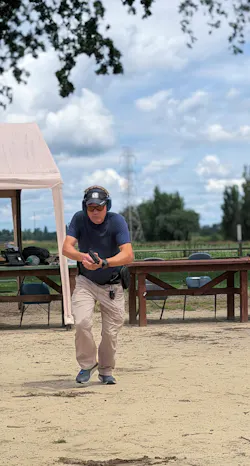
Your decision on purchasing a firearm should be based on how few distractions the firearm presents to your shooting style. When making this decision, how the gun fits matters most. How the gun operates makes up the rest of the equation. Anyone can stand on a static range and achieve a perfect sight alignment. A gun that fits the shooter well allows the shooter to make accurate shots under time pressure while moving. I found the HK VP9A1 to be an effortless shooter.
Would I use the HK VP9A1 for duty? Yes! There are so many subtle advantages of this gun over other duty guns. For a duty gun with this barrel length, it has more rail options, grip panels, easier maintenance, and more configuration options than most of its competitors. It is a solid shooting platform with no-nonsense features.
About the Author
 Officer Lindsey Bertomen (ret.), Contributing Editor
Officer Lindsey Bertomen (ret.), Contributing Editor
Lindsey Bertomen is a retired police officer and retired military small arms trainer. He teaches criminal justice at Hartnell College in Salinas, California, where serves as a POST administrator and firearms instructor. He also teaches civilian firearms classes, enjoys fly fishing, martial arts, and mountain biking. His articles have appeared in print and online for over two decades.