Duty Gear is More Than It Used to Be
What to Know
- Early law enforcement gear was minimal, typically limited to uniforms, badges, and duty belts with essential tools.
- Modern gear includes a wide array of equipment such as body cameras, electronic citation devices, patrol vehicle modifications, and advanced communication tools.
- Technological advancements are leading to the integration of GPS tracking, biometric monitoring, and miniature cameras directly mounted on officers or their gear.
More on Officer.com
This article appeared in the September/October 2026 issue of OFFICER Magazine
There was a time that when a rookie officer got hired, his check sheet for gear issued was a half-page long. There simply wasn’t that much to be documented: uniforms, armor, duty belt, holster, magazine pouch, radio pouch, flashlight pouch/ring, nightstick and ring, and… that was about it for smaller agencies. In fact, some smaller agencies only issued uniforms (which included badges and insignia) and duty belts with some pouches but not a holster or duty weapon. There are agencies still today that let officers purchase their own sidearm and holster to suit it within certain guidelines.
As law enforcement evolved, the gear issue check sheets got longer and then became one long sheet in digital format. Agencies became more detailed in what they document, as even low-cost items, if issued in enough quantity, can add up to significant cost. Unless it was worn against the skin, any item issued had to be returned when the officer retired or otherwise left the agency.
What we get issued today, especially at larger agencies, requires a lot more paperwork to keep track of. Let’s take a look at what typical duty gear looks like in the modern world ... and maybe see if we can figure out what it might evolve into.
First let’s start with the universal equipment. Uniforms are required and vary widely. Day uniforms, evening and overnight uniforms, dress uniforms, modified duty uniforms, and more. The “uniform” should include ties as required, badges, name tags, rank insignia and other pins as required by the General Orders. Some agencies issue footwear while others don’t. Hats are usually issued if they are part of the uniform and winter outerwear/gloves as well. The winter uniform may be different depending on region because wearing a parka over an outer armor carrier complete with mounted gear could make officers look grossly obese — and therefore unprofessional. In replacement of the parka, insulated undergarments and outer sweaters or insulated armor carriers might be added in to the issue. Rain gear is often issued and required to be carried in the patrol vehicle, but this author has never seen anyone but state police wearing such.
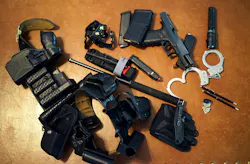
As much as we carry gear on our external armor carriers now, the duty belt is still a necessity along with a holster, magazine pouch, handcuffs, handcuff pouch, collapsible baton and pouch, nitrile gloves and pouch, narcan (or similar) and pouch, OC spray and pouch, and more. Some agencies issue just a tourniquet and carrier, while others issue an Individual First Aid Kit (IFAK) sometimes called a “blowout kit” or something similar. A flashlight and pouch is often issued, but sometimes the General Orders allow for an officer to provide their own within specifications. That’s all the most basic of gear that an officer should be issued and would need to go on patrol ... on foot.
Second, we have to look at the technology that is or can be issued. An electronic control device (TASER) is often issued along with an extra cartridge depending on which model of TASER it is. Every officer is, or should be, issued a body-worn camera and the requisite docking station/upload equipment for their patrol car. Many agencies today issue each officer a laptop computer, and some agencies issue cell phones simply because the General Orders have requirements for or restrictions on cell phone use (some of which can’t be applied to personally own phones). Printed ticket books are quickly becoming a thing of the past with e-citation handhelds replacing them and being an item often issued per officer. Some have their own built-in printer, but a rare few require the patrol vehicle to have a printer on board. Which brings us to the vehicle and more.
Third, we should look at items that can be issued but depend on agency size, etc. The biggest item would be the patrol vehicle itself and everything normally carried in it. But that “everything” can include breaching gear, a first-aid kit, AED, roadside assistance equipment, a portable printer, ALPR system, a radio, a charging/docking station for body-worn cameras, a dash camera, a prisoner transport camera, specific response kits (think active shooter) and more.
Officers who are issued a patrol vehicle (that they don’t share with others) often modify the vehicle to suit their particular needs and assignment. For instance, a patrol officer who carries a rechargeable flashlight as part of his duty gear might have the wire or docking station to put the flashlight in to keep it “topped off.” An officer who is assigned a drone would have the requisite equipment in the back for storage, extra batteries, controls, etc.
All of that is part of the contemporary duty gear issued, and we didn’t even touch on things like a patrol rifle, magazines for the same, or trauma kits. We haven’t listed out everything an officer might carry on a Special Assignment/Action Team or who works Civil Disturbance response on call. Some agencies issue protective eyewear and hearing protection to each officer, while other agencies only have them available at the range for firearms training.
The bottom line is that “duty gear” today encompasses a lot more than it did even five or ten years ago. And what might the future look like?
As we move into an age of constant GPS tracking, video documentation and even video monitoring performed by supervisors, we should expect more technology to find its way onto the officer and/or the officers’ weapons. Weapon-mounted cameras already exist but aren’t widely used ... yet. Helmet-mounted cameras exist, but if they’re being used, it’s largely by SWAT teams. What happens when cameras with transmitters shrink to be comfortably mounted on the stem of protective eyewear? Then the camera could see everywhere the officer looked — or at least in front of the direction he’s facing.
The tagging and tracking of every piece of gear is inevitable and being done in some small ways by law enforcement agencies already. Technology to monitor biometrics exists and is evolving regularly, soon small enough to be worn comfortably and report regularly. The future is full technology integration, and each item is a new piece of “duty gear.”
About the Author
 Lt. Frank Borelli (ret), Editorial Director
Editorial Director
Lt. Frank Borelli is the Editorial Director for the Officer Media Group. Frank brings 25+ years of writing and editing experience in addition to 40 years of law enforcement operations, administration and training experience to the team.
Frank has had numerous books published which are available on Amazon.com and other major retail outlets.
If you have any comments or questions, you can contact him via email at [email protected].