The New Professional Police Appearance: Why Officer Attire Needs to Evolve with a Plan
What to know
- The balance between appearance, performance, and agency image is crucial, with leadership adjusting standards to reflect societal expectations and technological advancements.
- Uniform types have evolved from formal dress blues to versatile tactical gear, accommodating modern equipment and body armor for officer safety and efficiency.
- Grooming standards have relaxed over time, allowing beards, jewelry, and varied hairstyles, but safety and risk mitigation remain key considerations.
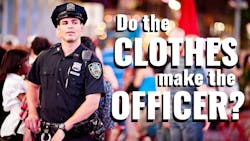
"In matters of style, swim with the current; in matters of principle, stand like a rock."
—Thomas Jefferson
We need to have a conversation.
No, we’re not going to discuss politics, religion, immigration, the Super Bowl (or the halftime shows). We are going to have a serious talk about … uniforms and what “professional appearance” means in contemporary terms.
To open the conversation, I’m going to take you back to when I first began police work. No, Christ wasn’t a corporal, and I didn’t ride a dinosaur. That said, it was the early 1980s and maintaining a professional appearance meant something fairly different from what it does now. Further, depending on where you were regionally, it was very different indeed.
As part of this conversation, we’re going to talk about grooming standards, a variety of uniform types, special assignment uniforms and more. I encourage you to comment or email ([email protected]) your thoughts. It’s my belief that general law enforcement “professional appearance” is constantly evolving, but I also believe that we should be consciously planning and guiding it rather than letting uniform industry developments blaze an indirect path.
Grooming standards
The first General Orders I operated under (after getting out of the Army) dictated grooming standards concerning hairstyle and length, prohibited beards, restricted mustaches, defined acceptable sunglasses and strictly listed what jewelry could or couldn’t be worn by each gender.
The male uniform haircut disallowed hair touching the ears, collar or eyebrows. It had to be maintained in a neat and trimmed appearance at all times in uniform. Beards were strictly prohibited unless a shaving profile was written by a dermatologist, and if such occurred, then the beard had to be kept trimmed at no longer than quarter-inch total length. The mustache was not allowed to extend past the corners of the mouth, nor below the upper line of the lip, nor appear bushy or unkept. Mirrored sunglasses were prohibited in some places and issued in others.
Some general orders went so far as to dictate maintenance of fingernails, limit color of fingernail polish for female officers, etc. “Hanging jewelry” was prohibited unless it was unseen and worn under the uniform. “Dangling earrings” were prohibited as were rings that “protruded too far from the hand, so as to appear as a weapon if the officer had to strike someone.”
A lot has changed since those early days (for me) in uniform. Beards are quite commonplace now, and I’ve seen plenty of officers with nail polish, bracelets and necklaces. I’ve seen some with earrings that, while not “dangly,” still present a potential
grab-target for violent suspects. The same can be said about beards if they’re allowed to grow too long.
While I appreciate the loosening of some seemingly unnecessary grooming restrictions, it’s still good to remember that they might serve an officer survival/risk mitigation purpose and practice them from that perspective.
Uniforms
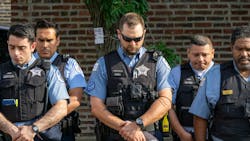
We had “full dress blues,” often referred to as Class A uniforms, and they were rarely worn. Interestingly, they were similar to what a lot of agencies had as their daily uniform back in the 1940s and 1950s. Our Class B uniform was gray pants with a single stripe with a blue shirt, short sleeve or long sleeve depending on the date (not the weather). A tie was mandatory with long sleeves and prohibited with short sleeves (as if anyone wanted to wear a tie with a short sleeve shirt?). The Class C, or utility uniform, was plain utility blues, often compared to the uniform a car mechanic of the time would wear, with a tie optional with the long sleeves. Every uniform had a hat, with the Class A and B often being the same, while the Class C was a matching (to the uniform) blue ball cap.
With all that in mind, I remember reading in the late 1990s about a sheriff’s agency in Texas that had as their daily uniform, “clean jeans free of holes or tears, a button-down shirt, boots and a hat.” The duty belt was leather and looked more like a cowboy belt (based on what I learned from the movies, right?) than a duty belt. My duty belt was black leather with brass snaps and keepers. When black nylon with hook-and-loop came along, it was the coolest thing I’d ever seen—except for those Texas deputies with their stamped brown leather gun belt, matching holster and magazine pouches with a single handcuff case. It never occurred to me, or concerned me, that there was no place on the belt for a radio, flashlight, nightstick, etc. Based on something I read back then, that same sheriff’s agency issued stainless steel Walther PPK/S handguns as a secondary weapon and mandated that it be pocket-carried on the support side. I remember thinking how cool it would be to work for that Sheriff and enjoy such a comfortable uniform.
On today’s streets, you are just as likely to see a utility blue uniform (or the equivalent) covered by an external body armor carrier and that carrier serving as an equipment platform because of all the gear that’s been added to an officer’s “load out.” Where the duty belt used to carry a sidearm, spare ammo, chemical weapon, handcuffs and a nightstick, now we’ve added medical gloves, an IFAK, TASER, body-worn camera, overdose treatment and more. Realistically, the fit officers simply don’t have enough waistline to have a duty belt with enough room to carry it all. The armor/equipment carrier vest not only gives us the space to carry the gear but also helps avoid long-term lower back injuries by taking some of the weight off the hips and moving stuff off the belt in the middle of the back. Worn and equipped with thought, that vest adds to a professional “clean” appearance and has the psychological impact of making officers appear bigger than they are … and that still matters to an awful lot of criminals.
Special assignments
There were always exceptions in the General Orders for officers on special assignments. Undercover work was the most obvious with “modified grooming standards” and “apparel suitable to the day’s work.” In other words, grow your hair, sport a beard and wear grungy jeans with a stained field jacket because you were doing vice operations or drug enforcement.
Special Operations—the SWAT team—had its own uniform, as well. Unless a team member was also doing undercover work, the grooming standards remained, were sometimes even stricter, and the uniforms were basically utility blues (Class C) all the time. Back then, bicycle patrol was just becoming a thing and the uniform was some modification, usually involving short pants, of the Class C uniform.
In today’s world, we’ve learned to take public perception into consideration and that can change dependent on the officer’s assignment. “Soft” uniforms are often found on school resource officers, community relations officers, liaison officers for a variety of organizations law enforcement has to coordinate with and more. The only mistake (in my opinion) I sometimes see is when detectives dress too comfortably and miss an opportunity to project the full professional appearance. It might be comfortable, but does it give some members of the public the perception of a lazy or slovenly officer? It’s something we need to think about.
Where are we today?
Uniforms, grooming standards, special assignments uniforms and more have changed quite a bit in the past 20 to 40 years. While the Class B uniform used to be the usual daily wear, now we see uniforms that are almost more tactical than what SWAT wore in the 1970s and '80s. But there’s a reason for that: We have a lot more equipment to carry, and body armor is far more common than it was back then. Even in the early 1980s, I was the rare officer who always wore body armor, and the “old guys” made fun of me because “it won’t do you any good if you get shot in the head.” It’s odd to think about, but portable radios were just becoming a thing in the late 1970s, no useful flashlight was smaller than four+ C-cell batteries and most impact weapons were wooden or polycarbonate batons. As a sidenote, most of us were still carrying revolvers in the 1970s as well.
In today’s world, cost, performance, comfort and appearance are all balanced—or at least agencies try to. Uniforms can vary within an agency from highly professional and formal appearing to focusing on comfort and movement based on the assignment. We have the widest variety of unique assignments that the profession has seen in my four decades of experience and it speaks well of leadership that they adjust General Orders on grooming and uniforms accordingly. The balance has to be maintained between appearance, performance and agency representation.
About the Author
 Lt. Frank Borelli (ret), Editorial Director
Lt. Frank Borelli (ret), Editorial Director
Editorial Director
Lt. Frank Borelli is the Editorial Director for the Officer Media Group. Frank brings 25+ years of writing and editing experience in addition to 40 years of law enforcement operations, administration and training experience to the team.
Frank has had numerous books published which are available on Amazon.com and other major retail outlets.
If you have any comments or questions, you can contact him via email at [email protected].