Smoke and Mirrors: Inside the Secret Networks Keeping Synthetic Drugs on Store Shelves

By Michael W. Brown, Global Director of Counter-Narcotics Technology at Rigaku Analytical Devices
America is confronting an increasingly visible but poorly understood drug crisis in which seemingly innocuous products sold openly in retail stores may contain hazardous compounds designed to evade existing narcotics controls. Although these products may contain no prohibited chemicals, they can include dangerous substances and are often deliberately mislabeled to circumvent consumer-safety laws.
These compounds are engineered to mimic the psychoactive effects of drugs such as cocaine, ecstasy, and opioids. However, their molecular structures are altered to avoid narcotics-control laws, often making definitive identification possible only through analysis in state forensic laboratories.
In September 2026, two University of Mississippi students died hours apart in separate incidents that prompted investigations into kratom-related products reportedly sold through nearby retail outlets. While the precise circumstances surrounding those deaths were still being investigated, the cases raised concerns about the availability and chemical composition of these products. In a separate case, a 19-year-old student in Texas died after taking products commonly sold in gas stations.
These cases illustrate how easily potentially lethal compounds can reach consumers under labels such as supplements, mood enhancers, or herbal remedies.
However, hiding in plain sight on gas station shelves and in specialist retailers known as head shops is a family of synthetic or semi-synthetic blended products, commonly classified as novel or new psychoactive substances (NPS). Marketed as herbal incense, potpourri, or bath salts, these products feature colorful, professionally designed packaging that can make them appear safe or regulated, even as their chemical composition may vary substantially over time.
NPS products pose significant health risks to unsuspecting consumers and create challenges for law enforcement officers investigating their origin, distribution, use, and potential role in criminal activity. Investigative challenges are compounded by intentional product mislabeling, packaging disclaimers, and inconsistent product names.
The distribution networks behind NPS products bear little resemblance to conventional cartels with fixed supply chains and identifiable leaders. Instead, they operate through flexible global networks of concealed individuals and shell companies, making the supply chain difficult for law enforcement to disrupt. Even when authorities prosecute a retailer and seize its stock, the network can simply rebrand the product and resume sales.
The storefront is only the first layer
Network owners want law enforcement to assume these small retailers are run by individual owners who coincidentally latched onto the NPS trend. This is incorrect, as the criminal networks driving the NPS pipeline often operate through interconnected businesses, shared commercial logistics, and layered corporate ownership structures, complicating efforts to identify the individuals responsible. Sometimes, the "nominee owner" is often just a manager working for one of these corporations.
On the surface, these networks appear to operate legitimate businesses, limiting the effectiveness of traditional narcotics interdiction strategies. The networks use no money-laundering structures or clandestine smuggling operations. The operations rely on legitimate suppliers, standard transportation services, and commercial bank accounts.
Furthermore, the companies involved hold legitimate commercial leases and business licenses and file annual tax returns because NPS sales revenue is mixed with legal retail receipts from tobacco, electronics, and convenience items. Mixing illicit drug revenue with legitimate sales qualifies as trade-based money laundering, but proving this requires in-depth, cross-agency investigations. Jurisdictional differences create another problem. A compound restricted in one state may be treated differently across the border, and distributors adjust warehousing or transportation accordingly.
Another complication is that these substances can be imported pre-packaged and ready to sell, or locally manufactured from imported precursor chemicals, primarily from Asia and South East Asian countries. Quality often varies, sometimes even within the same consignment.
As a result, law enforcement can struggle to identify NPS products and the networks distributing them, even with the latest presumptive analysis tools. This complicates on-site seizures and forces officers and prosecutors to prove criminal intent rather than possession.
A challenge for officers in the field
One tactic used by NPS traffickers that poses a challenge for law enforcement officers conducting investigations is the intentional labeling of products as “not for human consumption.” This disclaimer can create a legal loophole, potentially shielding head shop owners from responsibility when customers purchase and consume these substances. NPS users sometimes rely on social media and coded messages to identify which products are intended for consumption despite carrying labels that claim otherwise.
Traffickers also make use of misleading packaging, inconsistent product names, and inaccurate ingredient labeling. This also creates significant investigative challenges as officers cannot always rely on product labels or packaging to accurately represent the chemical composition of the materials being sold. This uncertainty can complicate investigations, particularly when products with similar branding contain different chemical formulations.
This turmoil disrupts intelligence gathering tied to specific brand names and creates hurdles in prosecution because law enforcement must individually analyze the precise chemical composition of each confiscated package. The task is further complicated by how quickly these compounds can be modified to alter their molecular fingerprint.
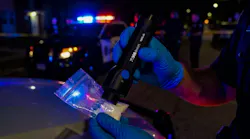
Field-based presumptive identification technologies, such as Raman spectroscopy, can help address this challenge by providing an initial chemical assessment of suspected substances rather than relying solely on packaging or product claims. When a substance is represented in the instrument's reference library and present at a detectable concentration, Raman analysis can help officers identify potential chemical components, supporting more informed decisions about evidence handling and further investigation.
However, emerging NPS compounds may not yet be represented in existing reference libraries, while complex mixtures and low concentrations can complicate identification. An inconclusive or no-match result does not establish that a substance is safe or free of controlled chemicals. Presumptive analysis serves as an important first step in the identification process, with confirmatory laboratory testing providing the additional analytical evidence needed to establish a substance's identity.
Because not all departments have access to presumptive analysis technology, the limited number of forensic laboratories face a growing backlog because unidentified powders, liquids, and plant materials are repeatedly submitted for mass spectrometry analysis. These forensic bottlenecks delay trial proceedings and divert vital resources from other criminal investigations.
The Federal Analogue Act was designed to address this chemical ‘tweaking’, but prosecutions remain evidence-intensive, as prosecutors must prove that a chemical is "substantially similar" in both molecular structure and effect to a Schedule I or II controlled substance. They must also prove it is "explicitly intended for human consumption". Effectively combatting NPS distribution requires cooperation across law enforcement agencies to empower authorities to disrupt the entire supply chain, not just one store.
Follow the company, the cash and the property
NPS identification is only one part of the case; a storefront case may produce an arrest but still leave the network intact. Investigators also need to establish who manufactured the product (including the importers of products or precursors), who supplied it and marketed it, and who profited from NPS revenues. They also need to determine who owns the retail premises, which companies rented them, and whether any hidden holding companies are behind the primary lessee.
This requires cross-agency cooperation to investigate corporate filings, leases, invoices, shipping records, payment processors, tax records, and communications that can reveal links that are invisible from behind the counter. Prosecuting distributors under federal conspiracy laws requires investigators to gather extensive evidence to prove that separate companies knowingly participated in the same criminal scheme.
The supply chain may also cross borders. Some precursors and finished products are legal where they are produced, limiting foreign enforcement options until investigators can prove a controlled substance, false declaration, or other offense. Importer records, customs data, package tracking, and intelligence cooperation are therefore especially important.
Three ways agencies can regain the initiative
The legal loopholes and hidden company structures provide NPS networks with a much safer operational environment than traditional narcotics cartels. However, the advantage shifts when agencies treat every encounter as part of a wider intelligence cycle designed to degrade the networks. Authorities can pursue three strategies, each requiring a distinct approach and closer coordination among local, state, and federal agencies.
- Target the supply chain and financial networks: Instead of concentrating resources on street-level stores and vendors, counter-narcotics task forces should target weaknesses higher in the supply chain. Enforcement efforts should focus on domestic importers, regional chemical-production laboratories, and the banking systems that support the trade. Investigators can use beneficial-ownership records created under the Corporate Transparency Act to trace shell-company networks, disrupt senior coordinators, and seize the funds that keep these distribution networks operating.
- Modernize presumptive analysis and laboratory response: Addressing the NPS threat requires stronger forensic testing capabilities. Law enforcement agencies should invest in advanced analytical tools, develop shared libraries of chemical reference data, and establish regional forensic centers that can rapidly identify NPS and any new synthetic opioids. Regularly updating presumptive analysis tools with the latest reference libraries will help officers in the field in identifying unknown substances. Rapidly evolving chemical formulations and differences in substance scheduling can complicate investigations. These challenges reinforce the importance of accurate chemical identification, information sharing, and confirmatory laboratory analysis.
- Integrated criminal, regulatory and public-safety action: Effective enforcement also requires multi-agency task forces that combine resources from federal law enforcement (DEA, FBI, HSI), tax and financial authorities (IRS-CI, FinCEN), postal inspectors, customs officers, and state and local police units, all focused on head shop distribution networks. Rapid information sharing can connect an overdose, a retail buy, an imported package, and a financial account to tag the whole network. Criminal investigations could also be paired with aggressive administrative and regulatory enforcement, including business license revocations, zoning enforcement, state tax audits, and asset forfeiture proceedings targeting commercial real estate properties that house repeat-offender head shops. Raising operating costs and legal risks for landlords and business owners will degrade the commercial foundation supporting the NPS supply chain.
The current state of NPS networks exposes gaps in the law, forensic capabilities, and conventional enforcement strategies, but these gaps are not insurmountable. By tracing the supply chain and its finances, modernizing testing and scheduling systems, linking reference data to presumptive analysis devices, and coordinating criminal, regulatory, and administrative actions, authorities can move beyond isolated retail seizures and disrupt the networks and loopholes that sustain the NPS market.

About the Author
Michael W. Brown is the global director of counter-narcotics technology at Rigaku Analytical Devices. He has a distinguished career spanning more than 32 years as a Special Agent for the Drug Enforcement Administration (DEA). Most recently, he was the DEA Headquarters staff coordinator for the Office of Foreign Operations for the Middle East-Europe-Afghanistan-India. Prior to that, he served as the country attaché in India and Myanmar, providing foreign advisory support for counter-narcotic enforcement. He also spent 10 years in Pakistan as a special advisor to the US Embassy on various law enforcement issues. Michael is a graduate of the United States Ranger Training Battalion and holds a master’s degree in Interdisciplinary Technology and Management from the University of Eastern Michigan. Contact him at [email protected]