Flying High: BRINC is Helping Make DFR a Reality for Law Enforcement
What to Know
- BRINC has grown to become the second largest drone manufacturer in the U.S. and the world's largest public safety drone company, focusing exclusively on public safety applications.
- The company's strategic alliance with Motorola Solutions enhances integration of drone data into command centers, improving dispatch efficiency and evidence management.
- BRINC's drones, including Lemur, Responder, and Guardian, are designed for high-risk law enforcement scenarios, featuring capabilities like live streaming, thermal imaging, and autonomous operation.
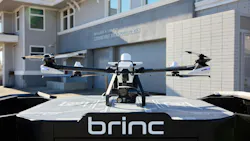

When new technology gains a foothold in law enforcement, new products from a variety of companies usually flood the industry. While the influx of drone technology over the last 10-plus years has led to more solutions on the market, Drone as a First Responder (DFR) has proven a more complex task for most manufacturers. Multiple companies with experience in building drones for consumer, commercial and military applications have become key players in the space, but one company built from the ground up for public safety has quickly made a name for itself.
Founded in 2019 by then-teenager Blake Resnick, BRINC has grown by leaps and bounds in the past five years. From its early days of building tactical drones to its current existence as a full-service drone company bolstered by investments by Motorola Solutions, it’s clear why more law enforcement agencies are putting their trust in BRINC.
During the Motorola Solutions Summit in Orlando this past spring, Resnick spoke to OFFICER Magazine about his company’s progress, including the Guardian DFR drone that was unveiled at BRINC’s headquarters in Seattle in March.
“A lot has changed for BRINC over the course of the last 5-plus years. Today, we’re just about the second largest drone manufacturer in America, and we’re the world’s largest public safety drone company,” he says. “That’s a huge differentiator for us. Most drone companies focus on the consumer market, or they focus on the military market. They treat public safety as an afterthought. That isn’t us at all. Our entire universe is building the best possible tools for public safety. As we’ve grown and gained organizational capability, we’ve been able to materialize that response drone vision.”
A growing alliance
The strategic alliance with Motorola Solutions, which made it the exclusive North American public safety reseller of BRINC’s DFR technology, has only strengthened in the past calendar year. In July, BRINC announced a $125 million financing round led by Motorola Solutions, among other investors. The investment brings BRINC’s total capital raised to well over a quarter billion dollars and will fuel the company’s mission to deploy 911 response drones at the 80,000 police and fire stations across the United States.
The alliance aims to bring BRINC’s drone technology into Motorola Solutions’ command center software, CommandCentral Aware. Once the data and video footage are brought in, the company’s Assist AI program can identify 911 call keywords such as “heart attack” or “allergic reaction” and help dispatchers determine more quickly whether a payload-equipped drone should be deployed to the scene. There is now an emergency button on the company’s APX NEXT smart radios that can prompt the Guardian drone to dispatch when an officer is in distress.
“Motorola Solutions is excited to enable the next generation of DFR programs through our strategic alliance with BRINC by connecting their drones to public safety agencies’ central nervous systems — their command centers,” Jeremiah Nelson, Corporate Vice President at Motorola Solutions, said in a statement. “Agencies can get eyes on the scene faster, deliver lifesaving support before first responders arrive, and securely capture and store drone footage in our integrated digital evidence management software.”
An expanding portfolio
Resnick started his engineering career at the age of 14 with an internship at McLaren Automotive. He spent time at Tesla Motors and then worked at DJI — the world’s largest drone manufacturer, which holds about 90% of the global market.
Having grown up in Las Vegas, he knew people who were along the Strip on Oct. 1, 2017, when a mass shooting during the Route 91 Harvest Music Festival left 60 people dead and left at least 413 others injured.
“That’s what got me thinking about your line of work,” he told the audience during a general session during the Motorola Solutions Summit. “I reached out to Las Vegas’ SWAT team and they agreed to have lunch with 18-year-old me, which was good, because I wasn’t totally sure they were going to do that. Initially we talked a lot about what happened, but then the conversation broadened to the rest of their jobs. The high-risk warrant searches and barricades and hostage rescue missions that they have to deal with on a daily basis,” he says. “I thought if they just had a way to get eyes and ears in these places, that that would be a lifesaving capability for them. And I thought I could build that. I went back to my mom’s house and engineered the first version of what became the Lemur drone, which was our first product. I showed that to the SWAT team and ultimately went on over a dozen SWAT callouts with them to watch it be deployed in real environments and make it better. At the end of that, they became our first customer, which is something that we’re still incredibly grateful for.”
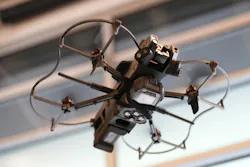
According to Resnick, the mission of the Lemur drone is to take off from an armored vehicle during a barricade situation, fly up to a target structure, look around the structure, find a vulnerable window, and then shatter it out. Then when the drone is inside it uses a small LiDAR, which generates about half a million points per second, to draw a floor plan of the structure that the drone is clearing. It streams the video live to the officers who are operating it. It has a 4K camera, a night vision system and a thermal imager. The drone can even push open partially ajar interior doors. If it ever crashes and lands on its back, it can flip itself over, take back off and continue a mission. It also was the first drone in the world to have an built-in two-way audio system. It can enable crisis communication and allow dangerous situations to be de-escalated.
“From the beginning, I also had this vision of drones arriving at the scene of emergencies with first responders,” Resnick says. “I was familiar, though, with how technically complex it would be to build a citywide network of drones and recharging pods that could integrate with computer-aided dispatch. That felt a little out of scope for a teenager without any money.”
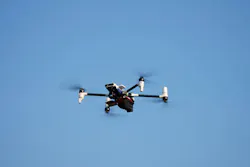
In 2024, BRINC unveiled what it touted as the first-ever purpose-built 911 response drone, the Responder. Coupled with a docking station, the solution gave agencies an option for Drone as a First Responder, a concept that was beginning to gain steam in several cities, both big and small, across the country.
Resnick says that feedback from public safety agencies on the Responder has been good, but that his team has also learned a lot from manufacturing its first DFR drone. “Responder works off of an LTE mesh network, but there are certain parts of the country where their geography is complicated, so mesh networking doesn’t work that well,” he says. “We’ve noticed that, and that is one of the things that has inspired integrating Starlink on our next-generation systems. The flight time for Responder is industry-leading for a drone of its size, but that’s another area where we have gotten feedback. Agencies want to stay at the scene of an emergency for a very long duration.” Resnick says this pushed BRINC to build a larger drone to increase the power output. “When you build a larger drone, you can get better performance out of it and carry a larger payload.”
The company that started with the Lemur, which is used by a quarter of the SWAT teams in the country, and produced the Responder, which is used by hundreds of public safety agencies in the United States as a DFR solution, has now turned its attention to its largest and most advanced DFR drone, the Guardian.
The Guardian drone
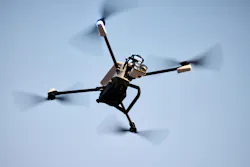
In March, BRINC unveiled its newest advancement, the Guardian. Visually, the new unit dwarfs its Responder counterpart. Resnick told the audience at the Motorola Solutions Summit that the Guardian is the drone that he would have first engineered if he had unlimited resources when first starting the company. “It’s cool to finally be in a place where it’s possible for us to take projects on like this. It’s just about the most capable 911 response drone ever. I would also say it’s more of a direct police helicopter competitor than the drone industry has ever produced.”
The Guardian can fly for over an hour with a top speed of 60 mph. It also has an integrated Starlink panel, giving it unlimited coverage range. “We think that combination of features at top speed, flight time and Starlink will allow this drone to effectively engage in vehicle pursuits, which I think is just going to be a huge social good,” says Resnick. “As everyone here is aware, vehicle pursuits are very dangerous for everyone. They are dangerous for officers, dangerous for suspects, and dangerous for the general public. Why engage in them at all when you can send a drone and follow a car until it parks and then take follow-on action from there?”
The Guardian also has a substantial camera payload. It includes a mounted HD thermal imaging system with optical zoom. Resnick touts it as the best thermal imager available on a drone, allowing first responders to see hotspots and structure fires and allowing them to effectively conduct search and rescue missions. “We’ve managed to package two 1280-resolution thermals on Guardian, allowing you to zoom in and out of your thermal picture without losing any quality, which is pretty incredible. We also have two 4K visual sensors on this drone, enabling 640 times total zoom.”
Despite the differences between the three drones — Lemur, Responder and Guardian — they can all be operated with the same controller simultaneously. Resnick says that a fair number of public safety agencies have already purchased the Guardian with the first customer deployments happening at the start of next year and production beginning in the fourth quarter of this year.
About the Author
 Paul Peluso
Paul Peluso
Editor
Paul Peluso is the Managing Editor of OFFICER Magazine and has been with the Officer Media Group since 2006. He began as an Associate Editor, writing and editing content for Officer.com. Previously, Paul worked as a reporter for several newspapers in the suburbs of Baltimore, MD.