2027 State of the Industry Projection Survey Results Summary
What to Know
- Over 56% of law enforcement agencies expect their budgets to grow in 2027, primarily for vehicles, salaries, and training.
- A significant majority (91%) anticipate either budget growth or stability, with only 9% expecting cuts, indicating industry resilience.
- All responding agencies have or plan to implement body-worn camera programs, aiming for 100% coverage where not already in place.
More on Officer.com
Download the 2027 State of the Industry Projection Survey Report at officer.com/55407705
As OFFICER Media Group has done for the past nine years, in partnership with our sponsor Damascus Gear, this summer we sent out a survey invitation, asking our readership to answer 33 questions regarding their budget in the coming year. As many agencies are already in their 2026-2027 budget year (started July 1), or they are in the planning stages of their 2027 budget year (starting October 1 parallel to the federal budget year), we believe that the information we get back is fairly accurate and of value. Whereas other organizations offer information on what law enforcement budgets were three or more years ago, through the data in this survey we get a glimpse of what budgets are or will be in 2027 — next year. We encourage you to review the information so you can use it to support or justify your own budget requests/changes or to get ideas of what other agencies are doing in the coming year that you perhaps haven’t thought of yet.
The survey was distributed to our readership and received a strong response. As we were seeking reasonably accurate forward-looking budget information, we wanted to see the majority of our respondents among the higher ranks. Command staff, to include Majors and higher, accounted for 41% of the responses we received, empowering a strong expectation of accuracy in budget projection. 28% more were comprised of Lieutenants and Captains, ranks that can be “command staff” in smaller agencies and area or group commanders in bigger jurisdictions. The remaining 31% of respondents were First Sergeants or lower in rank, but we don’t dismiss their input. At smaller agencies, a Patrolman First Class could be the third highest-ranking officer and well versed in the agency budget, if not in charge of part of it.
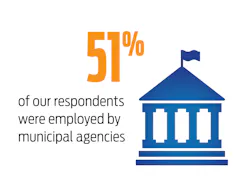
In terms of agency type, 51% of our respondents were employed by municipal agencies. “Municipal” means every incorporated town or city of any size, from the town with a population of 800 and less than 10 police officers to New York City with its population of over 8.5 million and the largest police agency in our country with approximately 35,000 officers. It’s almost funny that NYPD has more officers than many cities have citizens. 29% more were representing county jurisdictions, with 8% from state agencies, 5% from campus police departments, 4% from federal agencies, and the remaining 3% representing “Other” to include hospitals, transit, private and tribal agencies.
Now what we’re hoping to glean from the responses we receive is whether the industry — that being law enforcement and the industry that supports it — is growing, contracting or remaining neutral. Overall, we obviously hope that the industry is growing, but we consider neutrality (no growth, no reduction) good as well. While some say that a static budget actually means having to cut the budget somewhere because costs continue to go up, that’s not a financial analysis we delve into. We try to keep it simpler and more forthright: is the agency budget going to grow in 2027 over 2026? Is it going to stay the same? Or is it going to be reduced?
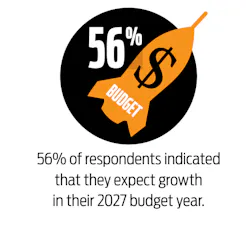
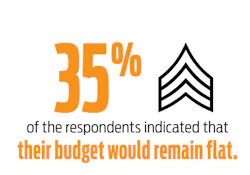
56% of the respondents indicated that their department budget will be growing in 2027. That may be just barely over half, but it’s over half just the same. Over half of the responding agencies in the United States are seeing or anticipate seeing growth in their operational budget for the coming budget year. An additional 35% indicated that their budget would remain flat, seeing neither growth nor reduction. Added together, that means that 91% of the responding agencies indicated growth or maintenance budgets, with only 9% indicating any type of anticipated cuts in funding. For agencies projecting budget growth, they indicated the intent to spend those funds on fleet vehicles, salary, firearms, less-lethal tools and training.
The survey provided us with additional information regarding types of weapons carried, any intention to change primary/authorized weapon(s) or caliber and more. It’s worth noting that every agency responding has a program for body-worn cameras, and where there isn’t 100% usage, they plan to expand to 100%.
The full report is available for download online at no cost. It’s a go-to resource if you need to justify budget requests to your governing body or to get ideas for what other agencies are doing that you might want/need to at yours. Again, we’d like to thank our sponsors, Damascus Gear, for their annual support in this endeavor. Stay safe!
Download the State of the Industry Report at officer.com/55407705

About the Author
 Lt. Frank Borelli (ret), Editorial Director
Lt. Frank Borelli (ret), Editorial Director
Editorial Director
Lt. Frank Borelli is the Editorial Director for the Officer Media Group. Frank brings 25+ years of writing and editing experience in addition to 40 years of law enforcement operations, administration and training experience to the team.
Frank has had numerous books published which are available on Amazon.com and other major retail outlets.
If you have any comments or questions, you can contact him via email at [email protected].