In the Clear: Training Police to Navigate High-Risk Intersections
What to Know
- Intersections account for 25% to 40% of crashes involving patrol vehicles, with higher rates when including fire and ambulance services.
- Training challenges include limited realistic scenarios; creative solutions like reconfigured courses and video analysis are used to improve officer preparedness.
- Sirens have limited effectiveness due to technological and environmental factors; innovations like the Rumbler and GPS alerts could enhance emergency vehicle visibility.
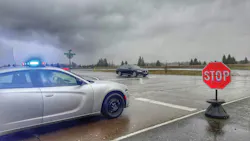
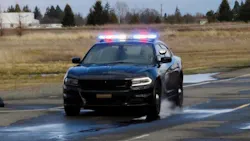
When it comes to officer safety on roadways and traffic safety in general, a lot of attention is often paid to the actions of officers outside of their patrol vehicles. While one of the most dangerous places an officer can find themselves is on the side of a road, another hazardous location is inside of a patrol vehicle while traveling through an intersection.
This spring, the National Law Enforcement Officers Memorial Fund held a webinar to discuss traffic safety data as part of its partnership with the National Highway Traffic Safety Administration. During the webinar, Nick Bruel, Senior Program Manager for the NLEOMF, was joined by Kelly Couch, a retired officer from the San Francisco Bay Area who has served as an emergency vehicle operations instructor for the last 10 years at the Oregon Public Safety Academy.
Couch, who caught the attention of the NLEOMF after writing an article on intersection risks and siren limitations for the Peace Officers Research Association of California (PORAC) Magazine, spoke about some of the challenges for instructors and what steps officers can take to help keep themselves and the public safe while responding to emergency calls.
“It’s something that I feel bad about because we should have been talking about it a lot more,” Bruel says, noting that numerous cases have been identified in which both officers and civilians have been killed due to a patrol vehicle entering an intersection without slowing down and making sure it was clear. “I’m glad that we are talking about it now.”
Alarming trends
According to the NLEOMF at the time the webinar was recorded, from 2022 to 2026 there have been 26 reported fatal crashes involving law enforcement officers at intersections. The injury reports from 2026 reflected 31 injury crashes at intersections involving officers. Couch found that crashes at intersections are common for emergency vehicles, with such incidents accounting for somewhere between 25% and 40% of all crashes involving patrol vehicles. If fire service vehicles and ambulances are added to that number, the percentage rises to a much higher rate.
Couch recalls and incident that occurred while he was still employed as an officer in California where a motorcycle officer was responding to an urgent priority call at a multi-lane intersection and was struck at high speed. The officer was seriously injured but ultimately survived. Couch says that he took a lot away from the crash. It was later discovered through the investigation that the officer’s view was blocked by someone in a turn pocket, and he didn’t see the car coming through. “If you ride a motorcycle or you’ve been out on the road on one, you know that the visibility issues with motorcycles are critical. People just don’t see you as much, and the sirens aren’t as loud. I think for officers out on the road riding motorcycles, they must be especially careful when they’re navigating intersections.”
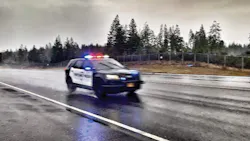
Training challenges
Couch says that he was motivated to write an article on intersection clearing because the skill has been a challenge to work on in the training environment, noting that the way driving courses are traditionally set up is not well suited for training in intersection clearing. He says that this problem calls for instructors to become more creative in how the training is handled.
“We have a really nice driving course here in the state of Oregon, but we only really had two areas,” he says. “We had an area where we could set up a four-lane intersection, and we had one other intersection that we didn’t really utilize when we were lapping. We kind of did some reconfiguring to create at least one more intersection. We had our four-way, and then we created a couple of more using some portable stop signs. I think that with some creativity we could at least broach that subject and provide some sort of exercises as an emergency vehicle operations trainer where we can train officers to some degree in intersection clearing.”
He says the type of training also differs depending on the type of area an agency covers. “Intersections vary greatly from a rural area, where it may be just a side street coming onto a main thoroughfare, a single lane in each direction, or a four-way intersection, to more urban areas where we could have multiple lanes in each direction with turn pockets and it is often controlled by a stoplight.”
The Oregon Public Safety Academy is the state’s sole training facility for law enforcement officers. Because of this, there isn’t a lot of classroom time. “We really try to give briefings and exercises and spend a majority of the time out on our driving course so the recruits get time behind the wheel,” says Couch. “But we do spend a little bit of time talking about issues in the classroom at the beginning of most of their training sessions, and we usually do a debrief at the end.”
The academy’s driving instructors also make use of publicly available videos, poring through dashcam videos on YouTube of officers doing a good job clearing an intersection and other instances where an officer didn’t clear an intersection properly and it resulted in a collision. “It’s a good training tool to illustrate the point that these crashes do happen and you need to be cautious clearing intersections,” he says.
A useful exercise centered around intersection clearing that the Oregon Public Safety Academy conducts on its training course leads up to a pursuit scenario. Two patrol vehicles are sent through an intersection, and the second is told to proceed cautiously, even though there is no traffic present. “In the real world, oftentimes if a car is either engaged in a pursuit or navigating an intersection with lights and sirens, the other people at the intersection will look and think, ‘Wow, look at the excitement that just passed by,’ and not really realize that there may be another police vehicle or emergency vehicle approaching,” says Couch. “So, we stress that during our training sessions, too. If you’re the second vehicle navigating an intersection, either running a Code 3 run or a lights and siren run, or if you are in a pursuit, you should be a little bit extra cautious in the intersection clearing.”
The problem with sirens
Despite their presence in all emergency vehicles, Couch claims that emergency sirens have limited effectiveness and that this impacts the ability for an officer to clear an intersection. “Anyone who has been on the job long enough — driving a firetruck, ambulance or police car — you figure out pretty quickly that people just oftentimes don’t hear you when your siren is engaged. This relates to intersections but even just passing vehicles on a multi-lane roadway or other areas. I think it becomes pretty apparent quickly that sirens aren’t always effective. They’re greatly impacted by speed, terrain, if they’re in a city environment or a rural environment.”
According to Couch, some of the limitations of sirens can be attributed to proliferation of technology in civilian vehicles. There are more distractions inside civilian vehicles than ever. Navigation systems, entertainment systems and cell phones. Newer cars also are better insulated, causing drivers not to hear it right away. The Oregon Public Safety Academy runs a siren audibility drill exercise where recruits are put into two of its training vehicles and conduct a lower speed pass at about 40 miles an hour of a car while running the siren and then conduct a higher speed pass. “We have had recruits in our ‘soft car,’ acting as the citizen vehicle, raise their hands up as soon as they heard the siren in the approaching car,” he says. “It was pretty eye-opening to all involved in that, especially on that higher speed pass with a car passing you at 75 or 80 miles an hour. The siren wasn’t heard essentially until the passing car was in the blind spot of the soft car.”
Couch spoke about newer technology such as the Rumbler by Federal Signal. The Rumbler is a traffic-clearing emergency speaker that provides a secondary, low-frequency duplicate tone alongside a traditional siren in order to penetrate solid materials, allowing vehicle operators and nearby pedestrians to feel the sound waves.
Another possible solution he cited is an notification sent to drivers’ GPS applications to notify them that an emergency vehicle is approaching. “I would love to see that in my lifetime be a standard thing,” he says. “That would make officers responding to emergencies or engaged in pursuits safer.”
Real-world training
As an instructor, Couch makes sure to remind recruits that although the academy driving course may be beautiful, it’s not realistic. “There isn’t traffic out there. Usually, we will put other cars out on our driving course to create traffic at times in some exercises, but these are all people who know what’s going on,” he says. “There aren’t pedestrians, there aren’t people on bicycles, there aren’t those things. So, we try to talk about that, particularly related to clarity intersections. I try to remind our police recruits that this is a great training environment, but when you hit the real world, things are different.”
According to Couch, the goal of emergency vehicle operations instructors should be to prepare officers to clear intersections when out in the real world, but a lot of the responsibility also falls on their field training officers.
“It really falls on the field training officers once a new officer is out on the road to really instill good habits in intersection clearing and make sure they are doing it consistently every time,” he says. “Especially with multilane intersections where you have multiple through lanes and turn lanes and it’s controlled by a light.”
Read Kelly Couch’s PORAC article: officer.com/55390517
Watch the NLEOMF webinar: officer.com/55390519
About the Author
 Paul Peluso
Paul Peluso
Editor
Paul Peluso is the Managing Editor of OFFICER Magazine and has been with the Officer Media Group since 2006. He began as an Associate Editor, writing and editing content for Officer.com. Previously, Paul worked as a reporter for several newspapers in the suburbs of Baltimore, MD.