Shifting Into High Gear: 2026 Model Year Michigan State Police Vehicle Evaluations
What to Know
- Testing included a variety of vehicles such as SUVs, pickups, and motorcycles, with a focus on acceleration, top speed, braking, and overall safety features.
- Manufacturers are increasingly developing police-specific vehicles to meet law enforcement needs for durability, safety, and operational efficiency.
- Braking performance remains a key focus, with recent tests showing significant improvements in stopping distances across various vehicle types.
- The evaluations reflect a trend toward larger, more versatile vehicles like the Ford Expedition SSV and Dodge RAM, catering to specialized law enforcement roles.
As law enforcement fleets continue to evolve, the Michigan State Police Precision Driving Unit’s annual Vehicle Evaluations continue to hold importance among agency purchasers. The past decade has seen the phasing out of traditional police sedans and the rise of larger crossovers, SUVs and pickup trucks. Over the past few years, electric vehicles have started to gain traction as well, and while they aren’t a mainstay yet, continued testing and research can be used to measure their viability.
Lt. Nicholas Darlington, who heads up the Precision Driving Unit and oversees the Vehicle Evaluations, spoke to OFFICER Magazine about the vehicles submitted for testing, this year’s results and some of the trends he’s observed.
Going electric
Before going into detail about this year’s testing, Darlington spoke about a milestone for the Michigan State Police as the agency put its first electric vehicle on the street this past January. A 2024 Ford Mustang Mach-E was assigned to the secured properties division for use by State Property Security Officers (SPSOs), who are armed, uniformed members who specialize in general law enforcement and security services around the Capitol and at state-owned and leased facilities in the Lansing area.
“We wanted to explore an electric vehicle and get a little bit of internal working knowledge of it,” says Darlington. “Obviously, we’ve tested the cars and we know what they’re capable of doing, but we wanted to get it into a real-world use case kind of scenario.” He added that there was existing infrastructure already in place downtown for electric vehicles. “It really wasn’t a big lift for us to be able to put a car there and get some feedback on it,” he says. While the division isn’t expected to put a lot of miles on the vehicle, there is a lot that can be learned from the data that will be collected, including how the battery holds up during the cold winter months. “I’m really looking forward to diving into it a little deeper after it’s been in place for about a year and seeing what potential savings there are, what’s working and what’s not working on the car. I think this was a good bridge for us for right now, to get some working knowledge of how the car holds up. So far, they seem to be pretty pleased with it.”
New additions
While the Chevrolet Blazer EV PPV was the only electric vehicle tested last year, the Ford Mustang Mach-E GT returned to the testing pool this year.
“I think the biggest obstacle for a lot of these other OEMs is, for us to test a vehicle, it does have to be VINed as a police-specific vehicle,” says Darlington. “The fact that you take a civilian vehicle and then it goes to a third-party outfitter, really doesn’t meet our criteria for testing a car. I think it’s a little bit of that hurdle for these other OEMs in the EV category are trying to figure out.”
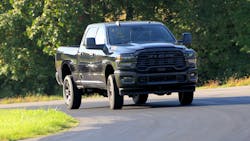
Another addition was the inclusion of the Dodge RAM for the first time. “This is the first time we’ve ever tested a three-quarter ton pickup truck,” he says. “Overall, it performed pretty well. I think that Dodge is looking to learn from this test and figure out how they can improve on it. But overall, the truck performed quite well for a three-quarter ton pickup truck.”
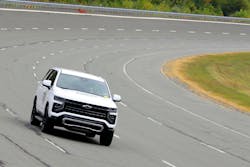
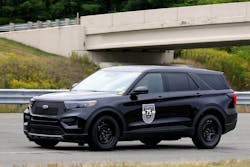
Late last year, Ford Pro introduced the Expedition SSV to the market, which adds yet another option for law enforcement agencies looking for larger storage, towing and seating capacity. Special service vehicles, like the Expedition, can be used for non-pursuit duties like K-9 units, traffic support, or command posts. Ford Pro previously released the F-150 Lightning Pro SSV. Darlington says that that while neither vehicle has been submitted for testing, it does show a continued trend in agency needs. “They’re obviously finding that there’s a niche for agencies needing larger vehicles for increased towing capacity and more room,” he says. “I think they’re trying to figure out how they can fill that need.”
Motorcycle testing
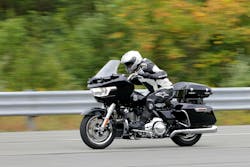
Three years ago, the Michigan State Police made a change in testing for police motorcycles by only performing the acceleration top speed and brake testing. This year saw the introduction of the new 2026 Harley-Davidson Police Road Glide, which features a fixed fairing and differs from the company’s past Police Electra Glide and Police Road King. “It’s a pretty nice motorcycle and a very nice machine.” he says. “I think the biggest thing with that fixed fairing is really just the overall comfort and ergonomics of the motorcycle. There is a lot less wind buffering. It sounds like, from talking to my rider, the motorcycle is much more stable at the higher speeds.”
It was also the first time Honda submitted a motorcycle for testing, with the Honda NT1100 Police. “I had a great conversation with Honda who was interested earlier this year in entering our testing,” says Darlington. “From my understanding, this motorcycle was primarily being used over in Europe and they are trying to introduce that into the market over here. That model performed quite well and I’d compare it more to the BMW.”
Key takeaways
While most of the vehicles submitted were carry overs from past years, Darlington says that he appreciates the amount of work and effort that the manufacturers put into the vehicles to keep officers safe.
“I continue to be impressed with the braking results from these vehicles,” he says. “Especially for us working out on the freeway, we are accustomed to seeing higher speeds, but it’s also very important for us to stop. That extra effort that they put into the development of the braking systems in these vehicles is what is kind of remarkable to me.”
Darlington added that the work that has gone into the braking systems of some of the larger vehicles is evident by the stopping distance that the vehicles put out. “It is obviously a testament to the engineering that they’re putting into these vehicles,” he says.
Testing results
The Michigan State Vehicle Evaluations is broken into two separate days. This year, the first day of testing, which focused on acceleration and top speed, and brake testing, took place on Sept. 13 at the Chelsea Proving Grounds, which is owned by Stellantis. Day 2 of testing took place on Sept. 15 at the Gratton Raceway, which is where the dynamics testing was performed.
The acceleration and top speed results: The Chevrolet Tahoe 5.3L RWD and 5.3L 4WD went 0-60 mph an average of 7.39 seconds and 7.83 seconds with a top speed of 130 mph and 124 mph, along with an overall average deceleration rate of 29.31ft/ s2; and 29.74 ft/s2; and a projected stopping distance from 60 mph of 132.09 ft and 130.19 ft respectively.
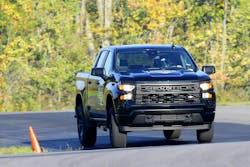
The Chevrolet Silverado Z7X 4WD and Z71 4WD went 0-60 mph an average of 7.37 seconds and 7.29 seconds with a top speed for both of 114 mph, along with an overall average deceleration rate of 25.85 ft/s2; and 27.45 ft/s2; and a projected stopping distance from 60 mph of 149.81 ft and 141.07 ft respectively.
The Chevrolet Blazer EV AWD went 0-60 mph an average of 5.14 seconds with a top speed of 130 mph and an overall average deceleration rate of 29.40 ft/s2; and a projected stopping distance from 60 mph of 131.70 ft.
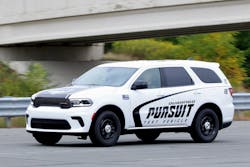
The Dodge Durango 5.7L AWD and 3.6L AWD went 0-60 mph an average of 7.24 seconds and 8.26 seconds with a top speed of 130 mph and 128 mph and an overall average deceleration rate of 27.44 ft/s2; and 27.33 ft/s2; projected stopping distance from 60 mph of 141.10 ft and 135.27 ft.
The Dodge Ram 2500 6.4L 4WD went 0-60 mph an average of 8.41 seconds with a top speed of 103 mph and an overall average deceleration rate of 22.76 ft/s2; and a projected stopping distance from 60 mph of 170.13 ft.
The Ford Police Interceptor Utility 3.0L EcoBoost AWD, 3.3L Hybrid AWD and 3.3L AWD went 0-60 mph an average of 5.95 seconds, 7.52 seconds and 8.19 seconds with a top speed of 148 mph, 136 mph and 136 mph along with an overall average deceleration rate of 28.21 ft/s2;, 26.92 ft/ s2; and 29.51 ft/s2; and a projected stopping distance from 60 mph of 137.24 ft, 143.82 ft and 131.23 ft.
The Ford F-150 Police Responder 3.5L EcoBoost 4WD went 0-60 mph an average of 5.68 seconds with a top speed of 121 mph and an overall average deceleration rate of 26.11 ft/s2; and a projected stopping distance from 60 mph of 148.31 ft.
The Ford Mustang Mach-E GT AWD went 0-60 mph an average of 4.03 seconds with a top speed of 124 mph and an overall average deceleration rate of 31.62 ft/s2; and a projected stopping distance from 60 mph of 122.45 ft.
For the motorcycles that were submitted for testing, BMW R 1300 RT-P 6L72113, R 1300 RT-P 6L72855 and R 1300 RT-P 6L67003 went 0-60 mph an average of 4.38 seconds, 4.35 seconds and 3.61 seconds with a top speed of 148 mph, 136 mph and 136 mph along with an overall average deceleration rate of 29.12 ft/s2;, 27.52 ft/s2; and 27.64 ft/s2; and a projected stopping distance from 60 mph of 132.97 feet, 140.68 ft and 140.11 ft respectively.
The Harley-Davidson Road Glide went 0-60 mph an average of 5.05 seconds with a top speed of 119 mph, along with an overall average deceleration rate of 24.52 ft/s2; and a projected stopping distance from 60 mph of 157.94 ft.
The Honda NT1100 Police went 0-60 mph an average of 4.16 seconds with a top speed of 119 mph, along with an overall average deceleration rate of 27.53 ft/s2; and a projected stopping distance from 60 mph of 140.64 ft.
To view the full results, visit officer.com/55332968
About the Author
 Paul Peluso
Paul Peluso
Editor
Paul Peluso is the Managing Editor of OFFICER Magazine and has been with the Officer Media Group since 2006. He began as an Associate Editor, writing and editing content for Officer.com. Previously, Paul worked as a reporter for several newspapers in the suburbs of Baltimore, MD.