Bridging the Gap: How Virtual Reality is Transforming Firearms and Use-of-Force Training
What to Know
- Traditional firearms training started with classroom instruction, basic range drills, and progressed to competitive and force-on-force scenarios.
- Modern advancements include virtual reality and projected simulation, allowing for complex, multi-operator scenarios with realistic malfunctions and unpredictable situations.
- Future trends predict a significant increase in VR and simulation-based training, integrating all use of force tools from commands to deadly force, enhancing decision-making and de-escalation skills.
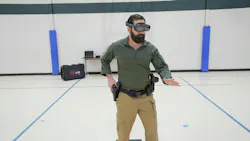
In today’s law enforcement training world, there should be very little separation between “firearms training” and training involving all other types of force, including judgmental training and de-escalation training. As training continues to evolve, we’re seeing a closing of the gap between the training that occurs on the “square range” (a fixed indoor or outdoor firearms range to practice manipulation and marksmanship) and training that occurs in the virtual world, whether it’s projected simulation or virtual reality (VR) or a combination of the two.
For the purposes of this article, as indicated in that opening paragraph, we’re going to discuss two types of training trends:
Firearms training — meaning that training that is specific only to the firearm itself; the use, maintenance, carry, deployment, storage, etc. of a given firearm. In the law enforcement world today, all officers are trained on at least a handgun with a majority of officers also trained with a rifle. That’s followed by a minority of officers who also get trained with dedicated less-lethal weapons, select fire weapons, precision rifles and shotguns.
Expanded reality training — meaning that training that is conducted via the use of a simulated projection setting or a virtual reality headset.
Let’s agree up front that almost all training can be picked apart to find strengths and weaknesses. For instance, training with a live firearm on a range limits the potential for movement, unexpected and/or unpredictable malfunctions, hostage situations, multiple officers against multiple opponents situations, and more. However, training all of those situations within a simulated reality limits using live ammunition, producing real-world (or closer to reality) function of the weapon.
Some would say that limits the value of simulated reality training when actually, if you understand what role each part of training can/should play, you understand that value of simulation training has grown exponentially in the past decade. It has evolved a long way from being a basic qualification system and offers far greater opportunity to expand scenarios, create unexpected circumstances, and involve multiple officers in a single training instance.
So, what does any of that have to do with trends in firearms training as we’re observing them today? Way back in 1999, in the precursor to OFFICER Magazine, Law Enforcement Technology printed an article about how firearms training should be structured and what topics should be included if that training was to be complete, start to finish. That training started in the classroom with basic knowledge training about selected firearms. This would include how it functions and how to field strip, clean, reassemble, and function test the firearm. It would include knowledge of basic marksmanship, the malfunction clearance process, presenting and holstering, and more. Then it would move to the square range where loading, unloading, basic marksmanship, and induced malfunction drills could be performed. Maybe some training/practice with wounded shooter drills would also be undertaken. Once the basic skills were sufficiently mastered, then competitive shooting that included moving, giving commands, reloading from cover, shooting from different positions and more could be done. But where did you go from there? Force-on-force training using Simunitions (or similar) could be done. At that level of training, judgmental shooting was incorporated. That was all firearms training.
In today’s world, however, we have simulated projection, virtual reality, and VR headsets that have “see-through” technology so the simulated world and the real world can be combined. Training weapons can be actual firearms equipped to have recoil and even simulate reloading drills. This is all a great advancement from where LE training was in 1999 when that article was published, but we’re surpassing it regularly. We have realized that firearms training is just a small piece of use of force training and that when not to shoot has to be trained at a greater level than ever before. Deescalation training, along with training on other use-of-force tools within a given scenario, has to be accomplished.
If we had to predict where firearms training was going to evolve and what “today’s trends” are, it would be an easy bet to predict that projected simulation and virtual reality will grow by leaps and bounds in the coming years. We are already seeing some relatively low-cost simulated training available for the consumer with expanded packages available to law enforcement. One such example is LaserAmmo with a basic simulated projection package costing as little as $600 with the price growing as the simulation capability, number of weapons, etc. grows. Again, though, that focuses on firearms training and doesn’t include other use-of-force tools.
The best firearms training trend we can see the value of is projected simulation/VR training that offers an officer potential use of all force tools from presence to commands to OC spray to batons, ECWs (TASER and the like), or deadly force via firearms. How fantastic would it be if you had a projected simulation scenario that started out with you in your patrol vehicle and then transitioned to the different perspective when you exited that vehicle and moved through a structure? Even better if the system could be grouped with other systems so an officer can start out solo but then have other officers join in the scenario as “they arrive on the scene.”
All of this is possible as projected simulation and VR training continue to develop. The limit is our imagination and leveraging technology to make that imagination a reality.
About the Author
 Lt. Frank Borelli (ret), Editorial Director
Lt. Frank Borelli (ret), Editorial Director
Editorial Director
Lt. Frank Borelli is the Editorial Director for the Officer Media Group. Frank brings 25+ years of writing and editing experience in addition to 40 years of law enforcement operations, administration and training experience to the team.
Frank has had numerous books published which are available on Amazon.com and other major retail outlets.
If you have any comments or questions, you can contact him via email at [email protected].