Red Dot Pistol Instructor Course
What to Know
- The course features expert instruction from law enforcement and military veterans, ensuring credibility and practical relevance.
- Participants explore the advantages of red dot sights, including increased hit probability and better incident awareness during shootings.
- Training includes both classroom lectures on optic selection and live fire drills focused on speed, accuracy, and predictive shooting techniques.
More on Officer.com
This article appeared in the September/October 2026 issue of OFFICER Magazine
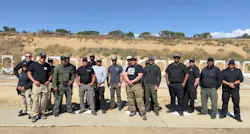
I completed the California POST Pistol Red Dot Instructor course, presented by Primal Response Training Group, a comprehensive class designed for law enforcement instructors. It turned out to be a tremendous training asset for me and worth my while. PRTG (primal-response.com) takes a practical and principle-based approach to instruction, emphasizing learning principles and training them to standard. The course had a healthy dose of live fire. It was led by PRTG’s Wayne Pugh and assisted by Steve Odom, who is CEO and Lead Instructor of his own firearms training school — Spartan Tactical Solutions (spartanshooting.com).
Instructors Wayne and Steve Odom bring serious real-world credibility to the range. Wayne is a California law enforcement officer and Special Investigations Unit detective specializing in gangs and narcotics, while Steve is a Marine veteran and retired sheriff’s sergeant with a deeply diverse resume.
There is nothing worse than a shooting school where instructors talk a big game but can’t actually demonstrate the skills they demand. That wasn’t the case here. Wayne’s demos consistently set the standard for the class.
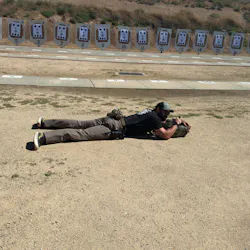
The highlight for me was working one-on-one with Steve on day two during a 10-yard lateral movement drill on steel. I offered to run the timer so he could get some reps in, and he absolutely smoked the stage. If you want to learn from instructors who can actually back up their curriculum with real-world skill, this is the course to take.
I have been a CA POST rangemaster/firearms instructor for more than a couple decades. I participate in regular training, stay updated in my instructional skills, and keep up with trends in the firearms industry. The latest POST regulations that go into effect in 2029 require that instructors update every 4 years. Since the Red Dot course met the update requirement, our program was being proactive by sending several of our instructors.
I had two purposes in attending this class. First, I needed to get an instructor update and was intrigued by the positive reputation of Primal Response Training Group. Second, I wanted to give our readers an idea of what to expect when attending this type of course. You have heard me say this before. If you are in the industry, you need to be constantly training, and you can never rely on your agency sending you through the right training courses. Sometimes you have to do it on your own.
Like most academies, much of our staff is composed of experienced law enforcement professionals, translated as advanced in age. I may have been 30 years older than the average student in this Red Dot class.
Engaging lecture
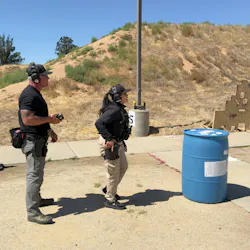
During the lecture portion, Wayne was brutally honest about some of the shortcomings of the red dot products out there. For example, there is one red dot product that isn’t very heat tolerant. There is another that comes with slide mounting plates, which Wayne told us to discard and mount directly. He provided a good resource for replacement optic screws, which never seem to be quite standardized. He had a bit of praise for several manufac‑ turing designs. For example, he described the owl ears on the top of Trijicon RMR sights — these are the distinct protrusions at the very top of the optic. The RMR Optics line has a reputation for being some of the most durable products on the market, and the owl ears are partially responsible. They divert stress away from the lens, mak‑ ing it drop‑resistant and rather unique looking.
Wayne went through the qualities and idiosyncrasies of most of the more popular optics available on the mar‑ ket. He also talked about mounting options and reputable businesses that can help with mounting. PRTG had amassed a comprehensive list of the available sites and their various qualities.
The lecture went on to talk about the various studies comparing red dot and iron sight use, like the Comparative Pistol Project done at Norwich University in 2011. This is a study with which I was familiar. It compared the performance of two different groups, one using iron sights, the other using Trijicon RMR. It demon‑ strated that there was a statistical difference in critical hits, which favored using Trijicon RMR significantly. Wayne went on to talk about several different studies on actual shootings. The lecture shifted towards some of the advantages of using RDS optics. He discussed the five‑year study of the NLEFIA (National Law Enforcement Firearms Instructors Association) review of officer‑involved shoot‑ ings. Although the sample size is rather small, it suggests that the use of a red dot sight significantly increases the hit ratio in actual shootings: 63% as opposed to the 35% average of OISs in the U.S.
We all came to our own conclusion here. The data suggests that Red Dot shooting improves accuracy, even in actual officer‑involved shootings.
What did you see?
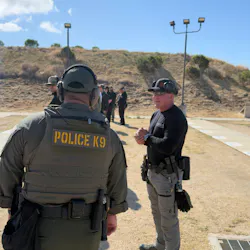
Wayne discussed another aspect of actual shootings with RDS, something I have pointed out in previous articles. Several statements from actual interviews have suggested that Red Dot users “see” more of the incident than that of those using iron sights. In some cases, the officer was able to view more of the suspect’s activity in the course of the shooting. As I have said in past articles, it is arguable that the use of RDS could be considered more defensible in court. That is, when we deliver bullets to the threat, we also have to be continually in assessment. The RDS allows for continuity of assessment simply because the focus and mechanics of the focus are on the threat, not the front sight.
This is my take on this: If we deliver lethal force to interrupt a threat, then the time between the force option and assessment is critical. Any additional measures post‑threat mitigation are unlawful. If our assessment is delayed, then objective reasonableness could also be delayed. Granted, this is an extreme, theoretical look at force application, but it does lean toward RDS employ‑ ment. Wayne articulated this concept well by going into the mechanics of shooting, from grip to vision to the actuation of the trigger. The RDS sight picture is different, Wayne explained. There is “finding the dot,” the effect of “dot movement,” and “dot tracking.” “It’s not the accuracy with RDS,” Wayne explained, “It’s the time.” He continued, “Maybe you need to speed up to get your hits.” I was thinking, “In which topsy-turvy world did I just land?” If I miss when I shoot faster, why would I speed up?
Wayne clarified that our use of RDS can flow from a reactive posture to engaging in a predictive manner. “We have to process and perform at the speed of chaos,” he explained. He was teaching us to teach students how to fire in a predictive manner — moving the eyes first, then aggressively shifting the gun. The predictive part is to be ready to engage when the dot lands on the near side of the extension of its travel. The idea was to train our bodies to drive the gun only as far as it needed to go. If the gun moved past the point of good engagement, then the shooter will overdrive and then reset, slowing down the next shot. We trained to engage when the dot entered the area of the near side of the gun’s travel across the target.
This seemed counterintuitive, but it worked incredibly well. For me, it was clumsy at first, and then I got to the point where I started to trust the gun. Wayne explained to me, “If you start with the gas pedal all the way down, everything eventually seems slow.”
Teaching style
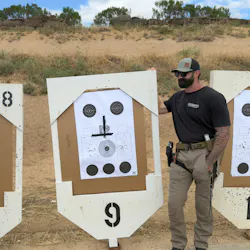
Much of the train-the-trainer technique that we saw delivered on this range was teaching by absorption. For example, while Wayne was talking about predictive and reactive shooting, he covered the concepts of parallel acts, one-hand shooting, and eye dominance in an overlapping teaching style. Much of the material that we covered was in between shooting drills. The concepts were delivered efficiently and geared towards the already advanced instructor. I was pretty impressed with the material that was being delivered, considering the fact that my round count by the end of afternoon two had already exceeded 800 rounds.
RDS specific drills
We did several painter’s tape drills, typical of RDS schools. One of them was the dot focus drill, where the front of the optic is taped. Another drill used the suppressor height sights as a backup iron sights drill. The focus was more on shooter behavior during full occlusion or RDS failure, and what to expect when successfully predicted what our round impact would look like in each one of the drills.
Feedback
As you might have guessed, I was taking rather detailed notes all the way through the class. I was also keeping a pretty good tally about our group and behaviors. The first thing that you should know is that the better shooters in the class had one common denominator: 2011-Style guns. Among them, I saw three Staccatos and two other guns that I wasn’t able to fully observe — I think one was a Springfield Prodigy. Almost everyone else was shooting a striker-fired gun. The largest showing was Glock.
The trick to RDS is not the accuracy, which is almost a given once the dot is in the right place; it is the time — finding the dot or delivering the shot. Wayne quickly dismissed the “press harder with your little finger, after drawing the holster” idea. I’ve heard other instructors present this. I’m glad that was not taught here. He also mostly dismissed the “bring the gun up to your mustache level and punch it straight out.” I like the way he addressed this. Most of us don’t draw our guns like that. We did a lot of seeing the target and then placing the red dot into that picture. It’s about trigger time and shooting at the speed of chaos is a great way to acquire this skill.
During our after-action report, several students liked the introduction to different optics, which gave us a completely different perspective. Some students liked the double trap drill, which I thoroughly enjoyed. We literally learned to deliver on our targets faster. Most of us were surprised that we were told to be almost reckless with our speed. However, some found that this approach really made us faster and more accurate shooters.
No firearms training, including the CA POST Pistol Red Dot Instructor course, should be viewed in a vacuum. Advanced instructors should take this course and file it into their quiver of instructional techniques, along with their experience at other skills development schools. I believe that this type of training increases an officer’s survivability, and PRTG made it worth my time.
About the Author
 Officer Lindsey Bertomen (ret.), Contributing Editor
Lindsey Bertomen is a retired police officer and retired military small arms trainer. He teaches criminal justice at Hartnell College in Salinas, California, where serves as a POST administrator and firearms instructor. He also teaches civilian firearms classes, enjoys fly fishing, martial arts, and mountain biking. His articles have appeared in print and online for over two decades.