Training for Power: Why Speed Matters for Police Tactical Skills
What to Know
- Speed enhances impact by combining force with velocity, making techniques more powerful and effective.
- Repetition and deliberate practice are essential for turning skills into automatic, reflexive responses.
- The progressive training system builds speed gradually, focusing first on mechanics, then on controlled velocity.
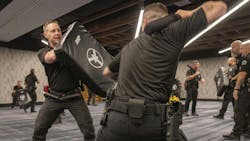
By Jim Klauba, Chicago Police Department (Ret.), ASP Trainer since 2011
When we think about training speed, we often picture sprints or “fast-feet” drills. Those have their place, but the speed that matters most in tactical performance is the kind that develops power as it relates to control. Training often focuses on strength and technique — both of which are essential — but speed should not be overlooked. As ballistic science shows, when speed increases, so does impact. In the context of defensive tactics, the faster a technique is delivered to its target, the more power it transfers. Speed isn’t optional; it’s a core element of real-world effectiveness.
Quick physics refresher
Force is defined as mass x acceleration, and power is the product of force × velocity (or force × speed). Translated for our tactical context, this basically says that the goal is to combine the physical force generated by correct body mechanics (mass and acceleration) with high velocity (speed) to achieve maximum power. When an officer applies a solid, well-trained technique with speed, more power is transferred and control improves, whether it’s a baton strike or an empty hand tactic.
Speed through repetition — making it automatic
Drilling fundamentals until mechanics become second nature is often the least glamorous part of training. Dry-fire work, drawing from the holster, or establishing a proper grip… again and again… can seem tedious. But over time, it is exactly those “reps” that lock-in consistently smooth, efficient and effective movement. I’ve watched experienced shooters—many of them civilians—move almost impossibly quickly and cleanly, and this can only come from countless deliberate repetition. In ASP training, we use a progressive system to build speed through technique reps:
- • Reps 1-2-3: Introduction of the skill, performed slowly and by the numbers
- • Reps 4-5-6: Intermediate pace, focusing on form and delivery rather than power
- • Reps 7-8-9: Integration of all elements, adding controlled speed and power
This approach reinforces technique first — then layers velocity on top of a solid foundation.
Speed put to use — the Overload Principle
In baton tactics, multiple strikes delivered to the same side of a subject’s body can disrupt or overwhelm an attack. The Overload Principle is best exemplified by the double weapon strike — a combination of two rapid weapon-side strikes. This tactic depends on quick and efficient strikes in order to disrupt the subject’s momentum.
Speed put to use, part two — Handcuffing
Smooth, fast application of restraints increases officer safety by reducing the subject’s window of opportunity to resist. Control begins at first contact, so speed and efficiency during handcuffing are critical to establishing and maintaining that control. ASP developed the “Rock and Lock” handcuff application technique to maximize speed, precision and safety in the restraint process.
Why speed matters on the street
To truly harness power, an officer must refine technique until speed becomes a trained reflex. Continuous repetition with attention to timing, control, and velocity doesn’t just build strength; it builds real-world effectiveness. When speed comes from practiced technique, it generates power, improves control and reduces the opportunity for escalation by resolving threats quickly and decisively.
Reprinted with permission of ASP Inc. Vist them at asp-usa.com