Does the New Army Combat Field Test Have Any Lessons for Law Enforcement?
What to Know
- Fitness standards for law enforcement and other "combat professions" should be tied to actual job duties rather than arbitrary measures such as push-up or sit-up totals, the author argues.
- The article examines how organizations such as the U.S. Army and NYPD have adopted more job-specific fitness tests that measure strength, endurance and task performance through activities resembling real-world duties.
- Effective fitness programs should be legally defensible, tied to job functions, include time-based performance standards, remain age- and gender-neutral, and provide remedial training for officers who fall short.
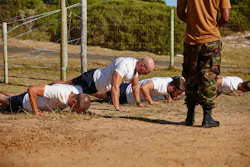
While the fitness industry has grown and people from all walks of life pay attention to it, for the purpose of this article we’re going to look specifically at fitness for what I’ll refer to as combat professions and how it should best be measured. It is no secret or surprise to anyone that being hired to work as a law enforcement professional comes with delineated fitness requirements. Just like our military services, it’s reasonable to expect that a person wearing the uniform and engaging in potentially vigorous activities during the performance of their duties should meet certain minimum standards for fitness. If they can’t meet the minimum standard, then the risk is obvious that they either won’t be able to perform the job functions or that they might be more easily injured if they try. For decades there has been debate on what the best way to measure the individual fitness level is. If you remember elementary, middle and high school, there was a general consensus assumed: the athletes were the most fit. They were the strongest and could run the fastest. What we failed to recognize then was that “most fit” didn’t necessarily mean strongest, and even when it did, it still didn’t indicate most qualified for a given profession.
Way back in 1964, Title VII of the Civil Rights Act prohibited employment discrimination and required agencies to prove that physical tests were job related as opposed to subjective assumption. For instance, can an agency prove that the ability to do 40 push-ups is job related? When was the last time any police officer or deputy had to do 40 push-ups (outside of the academy or hiring process) as part of their job? Even with the law enacted in 1964, there were court cases challenging fitness standards at least into the 1980s and quite possibly still going on today.
It is reasonable to expect anyone in a combat profession to be physically fit to include strength, endurance and flexibility. “Strength” is different from person to person, but endurance and flexibility can be more objectively measured. No matter who you are, touching your toes is touching your toes and if you can’t, then perhaps you need to work on your flexibility. Running a mile is running a mile and doing it within a given time limit indicates a certain level of endurance (think of it as cardio-vascular fitness).
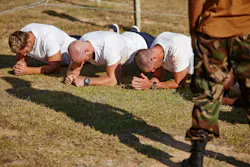
Our military (Army) has recognized that the pushup/situp/run test is insufficient and not applicable to actual job performance. That’s why they changed to the Army Fitness Test which includes deadlifts, hand-release push-ups, sprint-drag-carry, plank and 2-mile run. (A quick search online can get you all the specifics of what each exercise is, time limits, etc.) The combined results given the Army a good indication of the soldier’s base strength, core strength, performance ability and endurance. Each test can be related to some basic job function the soldier may have to perform.
Do law enforcement agencies do the same? Have we evolved from the pushup/situp/run test? (For the record, when I went to the police academy in the mid-1980s, the fitness test was exactly that: push-ups, sit-ups and a 1.5 mile run. Push-ups and sit-ups had minimum requirements and the run had a maximum allowable time. This was almost identical to the physical fitness test I took for the Army in the early 1980s except that had a 2-mile run instead of a 1.5 mile run.)
New York City Police Department, per their published guidelines (online) has a fitness test that requires each officer to perform six tasks in a continuous pattern from start to finish. The test starts with a 50-foot sprint to a six-foot fence the officer must get over, leading to a stair climb where the candidate goes up and down a flight of six stairs three times, followed by a station where the officer’s ability to physically control force in a physical restraint situation, to the pursuit run where the officer runs 600 feet through a pattern of cones, then dragging a 176#dummy 35 feet before picking up an inoperative handgun to pull the trigger 16 times with the dominant hand and 15 times with the non-dominant hand. Each of those tasks can be shown to be part of the officer’s potential day-to-day duty functions.

My local sheriff’s office, again per online published guidelines, has the following requirements as pre-employment fitness standards. The candidate must run 1.5 miles in under 18 minutes. They must complete as many pull-ups as possible with a minimum standard of one. They must complete as many sit-ups as possible within two minutes with a minimum standard of 25. They must complete as many push-ups as possible with a minimum of 15. They must perform a four-foot standing broad jump. They must climb three flights of stairs (and by default, also go down a flight in between each up a flight). They must surmount a six-foot wall. They must drag a 160# dummy 20 yards.
In both cases, it’s easy to understand the goals and why the exercises specified are there. Each candidate or officer must demonstrate the ability to perform critical job functions, and/or demonstrate sufficient strength and endurance to perform those anticipated job functions. But let me throw a wrench into the works: Where are the time limits? What are they? If you give a retired officer who is sixty years old an eight-hour day to complete these tasks, I’m pretty sure he can get them done with no issues and no heart attack. But if you give a 30-year old mildly out of shape candidate 15-minutes as the maximum allowable time to complete the NYPD test, you might get some failures and/or injuries. Both the military and some law enforcement agencies, especially in the special operations (SWAT, EST, ESU, etc.) have realized this and set their own standards – albeit with some still using push-ups, sit-ups and pull-ups as fitness measuring tools.
Take the Army’s new Combat Field Test as an example. This test requires a soldier (in certain specified jobs) to do the following all within 30 minutes: run a mile, do 30 push-ups, sprint 100 meters, lift a 40-pound sandbag onto a 65” platform 16 times, carry two 5-gallon water cans 50 meters, move 50 meters in a combination of high crawl and 3-5 second dash (mimicking combat movement under fire), run a mile. The test is gender and age neutral, pass or fail. If you assume an 8-minute mile for the mile runs, that leaves 14 minutes to do everything else: push-ups, sandbag lifts, 100-meter sprint, 5-gallon can carry and combat movement. This Combat Field Test has every task directly related to combat itself and, given that it’s gender/age neutral, it’s 100% compliant with the 1964 Civil Rights Act restrictions against tests that are prejudicial against any protected status.
In the law enforcement special operations community, I found a fitness test that is similar in that it is gender/age neutral pass/fail and has an overall time limit. This test consists of 60 push-ups, 60 sit-us, 4 pull-ups (wearing equipment vest), running three sets of bleacher stairs carrying a 40# ram and a 3-mile run. The total allowable time is 32 minutes, so again if you use an 8-minute-mile average, you have eight minutes to do the push-ups, sit-ups, pull-ups and ram stair carry. I think that’s well above the average law enforcement professionals’ physical capabilities, but I could be wrong.
At the end of the day, an agency has to perform a few functions with any fitness program. It has to ensure that the program is in compliance with the 1964 law (and honestly, 60+ years later, if it’s not you’re seriously slacking). It has to ensure that the test components represent a potential job function and aren’t arbitrary in any way. It has to test cardio-vascular fitness in the form of a time limit for given physical tasks. It should be gender and age neutral. One job, one standard, pass or fail. And the agency’s policy also has to include a remedial training system so that on-the-job officers who can’t pass the fitness test (but want to) have the guidance and tools to improve their fitness, working toward surpassing the minimum fitness standards.
Not to sound like an over-aired credit card commercial, but what’s in your program?
About the Author
 Lt. Frank Borelli (ret), Editorial Director
Lt. Frank Borelli (ret), Editorial Director
Editorial Director
Lt. Frank Borelli is the Editorial Director for the Officer Media Group. Frank brings 25+ years of writing and editing experience in addition to 40 years of law enforcement operations, administration and training experience to the team.
Frank has had numerous books published which are available on Amazon.com and other major retail outlets.
If you have any comments or questions, you can contact him via email at [email protected].