The Daily Carry Dilemma: When Does It Make Sense to Switch Guns?
What to Know
- A retired police officer and firearms instructor explains why he normally carries the same concealed handgun every day but is considering a different firearm for a multi-state road trip that includes travel through remote wilderness areas.
- After weighing the pros and cons of carrying two guns versus switching to a more powerful revolver, he opts to carry a Ruger LCRx .357 Magnum because it offers greater flexibility for threats ranging from venomous snakes to larger predators.
- The author's research led him to abandon heavy Buffalo Bore .357 Magnum loads due to concerns about severe recoil and revolver malfunctions, highlighting the importance of balancing power, practicality and reliability when selecting a carry gun.
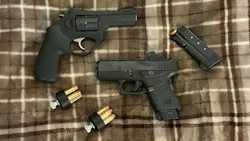
As a retired police officer, I’m one of those guys who regularly carries a concealed weapon when I leave my house. As a long time firearms instructor, I know the value of consistently carrying the same gun the same way and training/practicing to support that. I have had far too many conversations with others who talk about their “daily carry rotation.” And while I don’t see the sense or value in a “rotation” of firearms, I understand the need to carry something different every now and then. The questions become, what drives the change? How do you decide between options? What tradeoff are you making to carry a different weapon as compared to that which you carry daily?
First, let’s look at the daily carry. I like something that I consider capable but easily concealed. My choice is a Glock 43 MOS with a Shield Arms Carry Kit. Each magazine holds nine rounds of 9mm ammo, and I always carry a spare magazine (at least one). I consider the 9mm round quite capable of stopping the threats I anticipate might exist in my usual area of travel and, given that I remember the early days of my police career carrying a 5-shot revolver as my off-duty gun, 10 rounds in the gun and nine more in a spare magazine seems plenty to me. I have no problem qualifying with the G43 out to 25 yards although I don’t anticipate having to engage a target that far away. Let’s be brutally honest: I’m retired. I’m not getting involved unless there is something truly life-threatening going on in my presence and I will avoid getting involved if I can. I’ll be a great witness. If circumstances absolutely mandate that I get involved, then I’m confident I can end an encounter in 19 rounds or less. Hopefully FAR less.
Second, let’s look at the circumstances that leads me to consider a different firearm. I’m preparing for a long road trip that will take me through about 15 states and into some wilderness areas. I expect to find myself in places where I may not be the apex predator and encountering venomous snakes is a real possibility. I’m a reasonably good shot but hitting a moving snake head while I panic about getting bitten isn’t something I’m confident I can do with a short 9mm weapon. Further, if I find myself looking at a large quadruped that might consider me a tasty morsel, I’m really not confident that a 9mm is going to do anything more than piss it off.
Now, there are a few options to consider and there are pros and cons to each. The first option that comes to mind is to simply take more than one gun. I could travel with my usual G43 and spare mag(s) while taking a different handgun for those times when I’ll be out and about in some wilderness area. The upside of this plan is that my EDC really doesn’t change until my circumstances do. The downside of this plan is that I must secure the second weapon and depend on a lockbox secured in my vehicle for the whole trip. Even the most secure lockboxes have been stolen from vehicles, giving the thief plenty of time in a different location to break into the box. Vehicles are not gun safes.
Another option is to simply carry that “wilderness” handgun for the whole trip, assuming I can conceal it and use it effectively for self-defense in all situations. The upside to this is that I don’t have to worry about storage while I’m not carrying it (any more than I would my normal EDC gun). The downside is that I haven’t practiced with the weapon as much as would be prudent if it’s to be my self-defense gun consistently while I’m traveling.
In this case, the second handgun is a Ruger LCRx chambered in .357 Magnum. Several folks I’ve had conversation with comment on how “five shots may not be enough.” And while I acknowledge their outlook, for years (about a decade in fact) my off-duty gun was an S&W Chief’s Special, 5-shot .38 with a speed-strip or two for reloads (so long ago that finding speedloaders for a 5-shot revolver was a challenge). For the travel, I can carry decent self-defense loads and out in the wilds I can load the first two rounds up as snakeshot with the two follow-on rounds being something more suited for larger challenges. I have two speedloaders for the weapon and carrying different types of ammo is easier than storing a second weapon.
If I didn’t have a Shield Arms carry kit for the G43, the standard capacity would be 6+1 and I load it with Speer Gold Dot II ammo. The 147g JHP bullet leaves the barrel at roughly 1,000 feet per second (fps) with about 320+ foot pounds of energy. Comparing that to the .357 Magnum ammo… I have the Federal Premium Personal Defense 158g JHP Hydra-Shok which leaves the barrel at about 1,200fps delivering a tad over 500 foot pounds of energy. For the backwoods use I have Buffalo Bore Heavy .357 Magnum with 180g JHP pushing about 1,500fps and delivering just shy of 900 foot pounds of energy. That’s roughly equivalent to several .44 Magnum loads and my biggest concern is managing the recoil if I had to shoot it. (I had planned to learn about that on the range before I went.)
At least, that was my plan and then I did a LOT of research. In a lightweight frame .357 revolver and with the extra heavy Buffalo Bore loads being pushed at near-tolerance levels, two primary observations are mentioned in almost every source: first, the recoil is abusive beyond most shooter’s ability to manage it on repeated shots, and second, the recoil can cause “crimp jump” which means the bullets move in the case and can cause the revolver to lock up. That makes it highly inadvisable to use. So, after more research I decided to simply use the Federal Hydra-Shok rounds for the backwoods as well. That actually made my logistics easier because I only have to take two types of ammo: the normal carry load and the snakeshot for the backwoods treks.
But what are the lessons learned just from such simple planning? Planning a trip with two guns requires you to double your day-to-day logistics accounting for ammo types, storage, carry, etc. And guns that are truly suited for backwoods protection from predators aren’t equally suited for everyday carry - at least not if you plan to comfortably conceal the handgun. Sure, I could carry a full-size stainless steel .357 revolver, but with my stature and normal mode of dress, I’d have a hard time (at best) concealing that weapon. Open carry is usually a bad idea and given that I’ll be traveling through about twelve states on the trip, it’s an even worse idea without researching all those state laws first and ensuring I’m in compliance. Given that I carry under my LEOSA certification, and I don’t want to risk that, I’m better off if I take just the Ruger LCRx, depending on the one type of ammo.
Feel free to email me your thoughts: [email protected]
About the Author
 Lt. Frank Borelli (ret), Editorial Director
Lt. Frank Borelli (ret), Editorial Director
Editorial Director
Lt. Frank Borelli is the Editorial Director for the Officer Media Group. Frank brings 25+ years of writing and editing experience in addition to 40 years of law enforcement operations, administration and training experience to the team.
Frank has had numerous books published which are available on Amazon.com and other major retail outlets.
If you have any comments or questions, you can contact him via email at [email protected].