Smith & Wesson’s M&P 9 M2.0 Compact Balances Portability and Steady Shooting
What to Know
- The M&P 9 M2.0 Compact weighs 24 oz, striking an ideal balance between portability and stability for duty use.
- It features an 18-degree grip angle that enhances quick pointing and natural aim, improving shot accuracy and follow-up speed.
- The firearm is compatible with various optics thanks to the C.O.R.E. system, allowing customization for different shooting preferences.
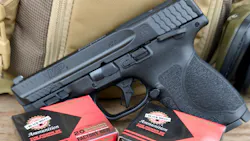
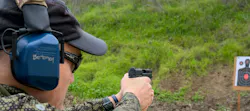
This month, I tested Smith & Wesson’s M&P 9 M2.0 Compact model. I thought this was an appropriate review for a design that celebrated its 20th anniversary in 2025.
The first polymer 40 S&W came out in December 2005. Several models followed, including carbines and handguns in various calibers. They have become exceptional duty pistols, known for accuracy and reliability. The polymer S&W models come in all sizes, including out-of-the-box race guns and pocket-sized ones.
I picked the M&P 9 M2.0 Compact because it truly bridges the gap between a full-sized duty pistol and compact gun for special assignments. One of things we look for in a duty gun is its balance between portability and a steady shooting platform. If a gun is too light, or the OAL is too short, it increases the time for follow-up shots.
Duty guns can run from 18-45 oz, but there is a sweet spot. If they are too heavy, they weigh down the belt, a condition whose evidence manifests itself at the end of the shift and towards the end of the career. If they are too light, then they affect quick engagement under pressure.
The M&P 9 M2.0 Compact weighs 24 oz and is 1.5 inches at its widest point. This is that sweet spot.
Black Hills 115 Grain Cartridges
When we first began testing the M&P 9 M2.0, we used Black Hills Ammunition 115 Gr. FMJ cartridges. These matched the performance of their 115 Gr JHP EXP duty rounds. This combination of duty/training rounds is appropriate for certain applications, and may be the best choice for your agency.
Lindsey generally carries 124 Gr 9mm cartridges because it is a good balance between terminal performance and moderate recoil. 124 grain bullets are generally driven 1050-1250 fps. 115 Gr cartridges generally shoot a bit faster. They need the velocity to match the 124 and 147 grain terminal performance.
Generally, the lighter the bullet, the lighter the recoil. There is a non-linear relationship between recoil and velocity, but within a reasonable range, light bullets mean light recoil.
Why would an agency choose a 115 grain cartridge for duty? If your agency tends towards lighter guns and needs lightweight capacity, you should test to see if 115 grain is a fit. For example, if duties include agents who is about 50/50 uniform/non-uniform and the issue gun is the M&P 9 M2.0 Compact, Black Hills 115 Gr JHP EXP is a good choice.
What’s the greatest advantage of light bullets? Follow up shots. The M&P 9 M2.0 Compact is the perfect weight and design for engaging multiple targets in a short time.
I know agencies probably don’t consider this factor, but the Black Hills 115 FMJ cartridges are what I would send with my recruits when they attend academy.
Pointability
The one thing we noticed right away is the 18 degree grip angle, which allows the M&P 9 M2.0 to point surprisingly fast.
The ability for a gun to “point” is actually a critical desirable feature in a duty gun. When I tell you this, it may draw out your understanding why some users prefer 1911 handguns and their variants. Those single action handguns from our past actually had a natural grip angle that gave it a neutral target position for most shooters. The M&P M2.0 handgun series duplicates, and actually improves, the natural point of the gun.
Let’s break this down with a simple experiment. Using your duty rig and gun, stand 7 yards away from a target on your range. If you do this in a dry fire environment, make sure you clear your gun and magazines of ammo. When dry-firing, I always check my chamber twice.
Assume a good shooting stance that aligns your hip points so they are parallel to the target. Focus on the target and draw your gun. Align the sights on the center mass of your target. Re-holster. Do this several times.
Without changing anything, close your eyes and repeat the draw sequence. Keep your eyes closed until the gun is settled into the sight picture.
If the grip angle and ergonomics are a good fit for your shooting stance and technique, you should be roughly on target, even with your eyes closed. Theoretically, good grip and stance, matched with good ergonomics, should put you more or less on target without the use of sights.
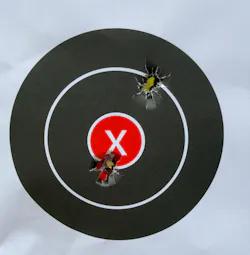
This doesn’t work for everyone, but it is a good demonstration of how shooting platform and gun fit work together. With the M&P 2.0, I can shoot a pretty good group blindfolded at 5 yards.
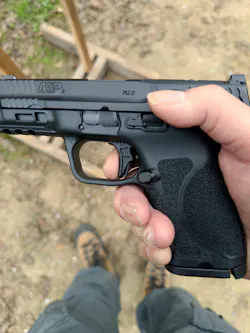
Grip angle is an important consideration in a firearm purchase. Grip size and fit is much more critical. The M&P 9 M2.0 comes with four palm swell inserts that allow a shooter to fine tune the feel of the gun. The moulded stippling gives a positive grip, even for wet or gloved hands.
If you are deciding which grip inserts will work with your hand size, you may find yourself trying to decide between two similar sizes. The one that causes you the least amount (or none at all) of movement when accessing the magazine release is the way to go.
Accessories
Besides the grip inserts, the M&P 9 M2.0 COMPACT comes standard with the C.O.R.E. System (Competition Optics Ready Equipment) mounting plates. Smith & Wesson has always kept up with the competition world, which caused their team to recognize the diverse optics products available for a handgun. The M&P 9 M2.0 comes with an optic cut and adapter plates which accommodate the most major optic products available on the market.
While I did not mount an optic on this gun, I have friends who compete with them. Being able to add one’s favorite optic to the package seamlessly is an advantage. For an agency, it is important to be able to employ an optic that agrees with the training philosophy. For example, I like large reticles that surround the center dot for fast acquisition, so I gravitate to optics like the Holosun HE508T. Others like precision dots that don’t crowd the glass. They might want an Aimpoint Acro P-2. Having multiple mounting options allow more flexibility.
The M&P 9 M2.0 came with white dot sights, which I liked using on my sunny, clear days of testing. If this was my duty gun, it would suppressor height sights and an optic.
Trigger
The M&P 9 M2.0 has a flat faced trigger with a center device that acts as a trigger safety. My competition friends prefer this style of gun because the it is one of the best carry gun triggers on the market. A quick field strip of the gun demonstrates why. The trigger engagement at the sear is a ramped catch that levers downward as the trigger is squeezed. It engages the striker cleanly, but doesn’t drag against it, or retract the striker in the process of the trigger squeeze. It simply allows the striker to release. Because of this, the M&P 9 M2.0 has two advantages: There really isn’t much of a “take up” feel in the trigger as there are in many striker-fired guns and the sear reset is very short. It is closer to a 1911 style trigger that that of other duty guns.
Many readers wouldn’t remember the difference, but there was a point in time where power steering on a car was an option. Most other duty gun triggers feel like they did not purchase the power steering option, compared to the M&P 9 M2.0.
Concealability
There is no doubt that most of us prefer a duty gun that can also be an off duty gun. The M&P 9 M2.0 has the dimensions. It is 1.5” at its fattest, and 7.25” long. The M&P 9 M2.0 has typical dimensions for a duty gun that can be carried almost anywhere.
I can easily make a 25-50 yard shot with its 4” barrel on demand. Officers can purchase it with or without a thumb safety. Every reputable company in the business makes holsters for it, both for duty and off duty.
Here’s the most important aspect: I trust this gun. I can draw and engage multiple moving targets with it. It is particularly safe to carry. It has no sharp edges which would annoy me on or off duty. Its design and internal operation is simple. Everything about it gives the user instinctive operation. Parts and armorer level care is readily available, even at fleet level.
About the Author
 Officer Lindsey Bertomen (ret.), Contributing Editor
Officer Lindsey Bertomen (ret.), Contributing Editor
Lindsey Bertomen is a retired police officer and retired military small arms trainer. He teaches criminal justice at Hartnell College in Salinas, California, where serves as a POST administrator and firearms instructor. He also teaches civilian firearms classes, enjoys fly fishing, martial arts, and mountain biking. His articles have appeared in print and online for over two decades.