The Evolution of Firearms and Accessories Never Slows Down
What to Know
- Firearms are evolving with new calibers, materials, and integrated optics to enhance performance and user experience.
- Law enforcement agencies are shifting towards 9mm and lightweight polymer frames, with ongoing innovations in sighting and mounting systems.
- Advances in metallurgy and polymer technology are driving improvements in magazine capacity, durability, and holster design.
- The integration of holographic optics and mounted lights is transforming handgun and rifle setups, though battery dependency remains a concern.
More on OFFICER.com
Download the November/December issue of OFFICER Magazine.
Click Here to subscribe to OFFICER Magazine.
As we move into the second quarter of the millennium, we have to wonder what the firearms industry holds. Given that law enforcement will forever (or at least for any imaginable future) have firearms as a daily duty tool, but the industry as a whole is understandably driven by a combination of consumer demand and engineering creativity, the situation begs the question of what innovations we’ll see in guns of all kinds: handguns, rifles, shotguns, less-lethal weapons, etc.
Now there have to be a few readers who reacted to that sentence with the thought of, “Wait a minute, less-lethal tools aren’t firearms. That’s the whole point.” Well… yes and no. A munitions launcher in 37mm or 40mm is also a firearm in that it can fire a variety of munitions, some of them lethal. A 12g shotgun is definitely a firearm but we see plenty of them dedicated for less-lethal munitions use. And now, with the proper product available, even a standard 9mm duty handgun can be made to be less-lethal.
Where duty firearms are concerned, across the span of the past five years, there has been a push away from non-military calibers. If you looked back across the past 50 years, you’d see calibers ranging from .38 Special and .357 Magnum on the revolver side and 9mm and .45ACP on the semi-automatic side, to such calibers as .357Sig and .40S&W. For a short while it seemed like we might get a caliber from each major manufacturer, although some never really took off as the designers might have hoped. Calibers like the .45GAP and the .30SC just didn’t see the widespread adoption necessary to make them “mainstream.”
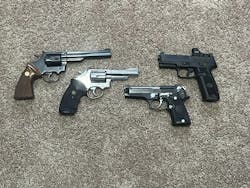
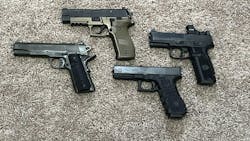
What we saw in the late 1980s was a big transition from a profession that predominantly carried revolvers to semi-automatics filling holsters nationwide. That transition occurred alongside the military switch from the Government Model 1911 .45ACP to the Beretta M9 9mm. Many of the law enforcement agencies that switched to semi-auto handguns did switch to the Beretta but a lot also switched to other guns that were submitted for military consideration; guns like the Glock 17 and the SigSauer P226.
The FBI, though, ended up going with a stainless steel 10mm handgun from Smith & Wesson, and through the vagaries of making a handgun suitably fit and function for all FBI agents, the .40S&W was born from the 10mm. As this author understands it, the .357Sig was an attempt to get .357Magnum ballistic performance out of a semi-auto handgun that had a 9mm/.40S&W frame size. The .40S&W became quite popular in law enforcement holsters but now we’re seeing more agencies trade in those .40s for guns in 9mm.
Across the years, steel frames were traded for aluminum or other lightweight metal frames and then, largely thanks to Glock, polymer frames. Eventually those frames included rails on the dust covers and optics mounted on the slide behind the ejection port. The simple law enforcement handgun is now a weapon system of sorts. The optics have shrunk, as have the lights, but the accuracy available in the optics has increased as has the light output from the mounted lights.
What could possibly come next?
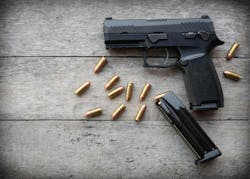
It’s inevitable that some other calibers will be invented and might be pushed for law enforcement use, and we can reasonably predict that unless a caliber is adopted by the military, making it manufactured in mass quantities, it likely won’t ever take hold as a mainstream caliber in police handguns. We have already seen some handgun designs that integrate a light under the barrel but inside the dust covers. Due to physics, and the internal working pressures accompanied by the recoil impact energies, building an internal light robust enough to last through thousands of rounds (20,000+ at a minimum) might be a challenge. The use of holographic optics (such as the common red dot sights or RDS) has already impacted the demand for any type of mounted laser light and we should expect to see that continue. As the use of mounted handgun optics grows, we might see some handgun models that don’t have fixed sights, but we can only hope that trend doesn’t evolve or take hold. Eventually batteries die and it’s inevitable that officers will need sights after the battery is dead but when the unexpected emergency arises.
Let’s not forget rifles and shotguns. The .223/5.56mm and .300 Blackout seem to perform well as patrol rifle calibers, and the ubiquitous AR-style rifle is now carried in enough patrol vehicles that few people complain about “police having military weapons.” (Let’s be clear: The AR-style rifle is not a military weapon, but the uneducated will always see it as such.)
As much as there are several high quality and highly reliable semi-auto 12g shotguns on the market and in use, the pump action 12g, which has been proven reliable for over 120 years now, doesn’t seem to be going away (and we should appreciate that).
The same RDS optics and mounted LED lights that we see on handguns are available for rifles and shotguns and the mounting/operations systems continuously evolve to make them easier to use.
In the end, the biggest evolutions we’ll see, will likely be material. The engineering world of polymers and metal alloys is something constant that we don’t see until a new development finds its way into a design improvement. It may not seem like a big impact but changes in metallurgy are why the Government Model 1911 .45ACP used to have flush-fit 7-round magazines and now there are 8- and 9-round flush fit magazines for the same weapon.
Holsters continue to evolve as well, from the long trusted leather to polymers and proprietary carbon fiber mixes, duty holsters with multiple mounting options holding guns with or without lights and with or without optics continue to grow in prevalence. Targets, dry fire systems, shooting diagnostic apps and even self-zeroing optics (with the appropriate app) will continue to develop.
What will be in the rookie officer’s holster at the beginning of a career will be fairly different from what’s in that same holster 10-15 years later. But that’s just our best guess.
About the Author
 Lt. Frank Borelli (ret), Editorial Director
Lt. Frank Borelli (ret), Editorial Director
Editorial Director
Lt. Frank Borelli is the Editorial Director for the Officer Media Group. Frank brings 25+ years of writing and editing experience in addition to 40 years of law enforcement operations, administration and training experience to the team.
Frank has had numerous books published which are available on Amazon.com and other major retail outlets.
If you have any comments or questions, you can contact him via email at [email protected].