Review: Alien Gear Rapid Force Slim Level II Holster Combines Speed, Security and Flexibility
What to Know
- The Rapid Force Level II holster offers fast presentation and reliable retention, ideal for non-uniform duty scenarios.
- Features a modular Quick Disconnect System (QDS) for quick holster swapping and multiple mounting options, including MOLLE and paddle mounts.
- Constructed from durable polymer with a reinforced sight channel, ensuring a secure fit for Glock 19 and similar models.
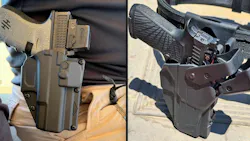
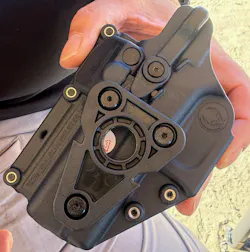
I tested the Alien Gear Rapid Force Slim Level II holster for my Glock 19. It is available for several popular duty gun models, including products equipped with lights and optics. This holster provided all of the features of a duty setup on a lightweight, off-duty platform. The Rapid Force Level II holster is a polymer OWB scabbard with a thumb release designed for non-uniform assignments. It has an extremely fast presentation and offers the perfect retention level for non-uniform assignments.
Back in the day when my office generally consisted of a steering wheel and computer in my center console, I spent a good amount of my free time in court. The uniform policy for civilian wear was “dress casual." There are a lot of different versions of this, but the biggest variation was how the “sort-of-off-duty” officers carried their guns. Some were IWB or OWB styles covered by a blazer that hopefully matched. Some officers carried an exposed gun in some version of a concealed carry holster.
Once I caught a rookie officer wearing a horizontal SOB holster walking around the court hallways. I pulled him aside and explained to him the potential for someone to disarm him before he had time to respond. It might look cool in Hollywood, but it is dangerous in real life.
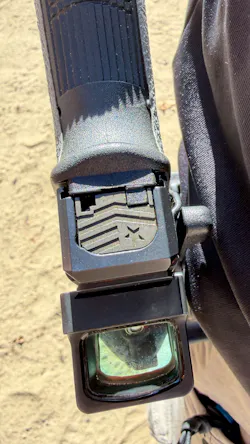
Here’s the rule: If there is even the slightest chance that your firearm could be seen in public, your holster needs some retention.
At the heart of the Rapid Force System is the Quick Disconnect System (QDS), which consists of an arrowhead-shaped male plate that clicks in and out of the similarly shaped female receiver. These two pieces connect the holster with the holster platform. The female part has two latching mechanisms near the tip of the arrow. It was designed to prevent accidental removal and shares the same level of polymer sturdiness as any other portion of the holster.
QDS adapters and options include an optional MOLLE platform, a surface mount kit, which allows a vehicle or desk mount, and a paddle mount. Some of these options allow for cant adjustment.
I tested the Glock 19 fit, which also accommodates similar configurations like the Glock 23. The model I used was for a gun without a light, but they make a similar product for light-bearing use. Alien Gear conveniently printed every fit for the holster shell on a panel on the wearer’s side of the shell. If you can find the printed American flag on this model, you can see the list of models it fits.
The inside of the Rapid Force is slicker than the slightly subdued outside. It is precision molded and includes a reinforced sight channel. The gun is held securely in place by an ejection port latch. I tried several G19 configurations in this holster, and nothing rattles when the gun is secured. The holster is set up for a straight draw, and I found that the weight of the gun is right about enough to latch it in place. There is no other action required to secure the gun.

I have always advocated for holsters that lock the gun when it is just dropped into the scabbard. This feature is common on duty holsters but, logically, is more necessary on a non-uniform holster. The off-duty officer cannot summon backup by radio, there are fewer intermediate tools like a baton and chemical agents, and bullet resistance is not part of this uniform.
I put my Rapid Force Level II Holster on my belt and started drawing. Like my contemporaries, I use a dress belt that is a bit thicker and more reinforced than a standard dress belt. There are several platforms for attaching the holster to the belt, but the locking belt slide accommodates the full range of belt widths. It adjusts by moving a hidden slider inside the hinged frame. The slider is screwed in from the back, using Allen bolts. The locking belt slide clamps over the belt in a clam-shell manner, clicking in place near the mouth of the clamshell. Once the locking belt slide is clicked together, it is locked when any QDS male plate is placed into its QDS receiver.
What’s the advantage of this system? There have been a few times when I was in court and I had to do a quick interview of someone in custody. With the Rapid Force System, instead of putting just my gun into the lock box to enter the facility, I can remove the entire holster, with the gun secured in it. This is one more added layer against a negligent discharge.
The thumb break release is a simple push to the rear, which can be pushed either by the thumb tip or the entire blade of the thumb, depending on the size of the hand. It pivots on a spring-loaded post, which is connected to the ejection port lock. It is simple and sturdy. I have only a couple hundred draws on it, but it looks like it was designed for hard wear.
If I could change anything on the thumb break, I would have either built up or reinforced the area along which this thumb release rides. This is just a personal preference thing, as the feel of the thumb break has been consistent since I’ve been using it.
It didn’t take me long to come to the most important conclusion. This holster is fast. It gives the user an unhindered presentation and a reliable re-holster.
Before I tested this holster, I had a chance to look at my friend’s Rapid Force Level III Duty Holster. It had a similar release system, plus the hooded cover. This is a great Level III duty holster. Since the Rapid Force system allows for quick changing of holsters, this is a good thing to have on the battle rig. One can train with one system and quickly switch to another.
The Alien Gear Rapid Force Slim Level II turned out to be one of the easiest and fastest holsters for Level II carry. It is lightweight, sturdy, and secure. The Rapid Force System is modular and allows for a high degree of flexibility for the officer whose duty status varies.
About the Author
 Officer Lindsey Bertomen (ret.), Contributing Editor
Officer Lindsey Bertomen (ret.), Contributing Editor
Lindsey Bertomen is a retired police officer and retired military small arms trainer. He teaches criminal justice at Hartnell College in Salinas, California, where serves as a POST administrator and firearms instructor. He also teaches civilian firearms classes, enjoys fly fishing, martial arts, and mountain biking. His articles have appeared in print and online for over two decades.