Holding the Line: Outgunned Israeli Police Faced Terrorists, Saved Lives
What to Know
- The following final part our a two-part story that looks at the Police Unity Tour's trip to Israel to the site of some of the worst fighting that took place on Oct. 7, 2023. Check out Part 1 of the series.
- Itamar Alus demonstrated extraordinary bravery during the Oct. 7, 2023, attacks, engaging terrorists and saving lives despite being outgunned and under extreme duress.
- The attacks exposed significant deficiencies in Israel’s police and military preparedness, prompting reforms in weaponry, civilian firearm policies, and security infrastructure like mandatory safe rooms.
- Many officers and civilians suffer from survivor’s remorse and PTSD, with the mental health toll of the attacks being as profound as the physical injuries sustained.
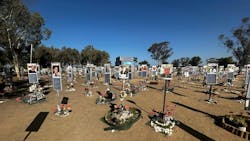
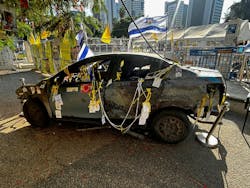
After leaving Be’eri, officers traveled east to Ofakim, approximately 12 to 15 miles from the Gaza Strip, a city that marked the farthest point reached by Hamas during the attacks. Police officers and civilians shared their experiences with the Police Unity Tour. One of those officers was Itamar Alus, a 20-year veteran with the Negev traffic police. Itamar, observing the Sabbath, woke up shortly after 6:00 a.m. that morning to pray and prepare his children for synagogue. What started as a beautiful Saturday morning and should have been a day of celebration turned into a day of tragedy.
At around 7:10 a.m., alarms sounded throughout the town. Itamar gathered his family and went to the bomb shelter. Israelis are accustomed to these alarms, and it is just another aspect of living in Israel. He figured that this would be short-lived and they would go on with their day as usual. However, inside the bomb shelter, he heard the unmistakable sound of gunfire. Unsure if this was criminal activity or a terrorist event, he left his family in the bomb shelter while he went outside. He gets outside just in time to see his neighbor, another police officer, running to his car to grab his radio. He grabbed his gun and both of them headed towards the sound of automatic gunfire near the town square.
After meeting two more police officers, they split up and went down different streets. Itamar noticed a father and daughter being chased by three terrorists who were shooting at them. He was in shock as this was not what he had imagined, and it was at that moment that he realized…this was war. Itamar, who minutes earlier was planning to attend synagogue and dressed in a white shirt and pants, now found himself hiding behind a car armed with just a handgun. In an attempt to divert the terrorist’s attention, he fired two shots and managed to strike one of them in the leg. His plan worked because the terrorists diverted their gunfire towards him, allowing some citizens to take cover. Itamar and his partner retreated into the neighborhood.
The terrorists did not follow but instead moved to a different part of the city. Itamar noticed a local rabbi lying on his stomach who was suffering from a gunshot wound. The rabbi instructed Itamar to check on those in the community bomb shelter. He found a husband suffering from a gunshot wound who was being comforted by his wife. Itamar stopped the bleeding and helped the couple get home. He returns to the rabbi and tries to move him, but he can’t move his legs. Just then, terrorists open fire on them. Bullets whistled by striking cars, houses, and the pavement, but as if through divine intervention, they missed Itamar and the rabbi. With the help of a homeowner, the rabbi is safely moved into a house, while Itamar returns outside.
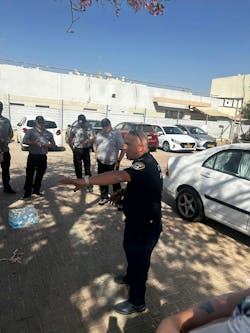
Back on the street, Itamar is engaged by another terrorist who fires at him. Fleeing and taking cover behind a car, he assumed the terrorist would follow. Instead, the terrorist threw a grenade, causing stone pellets to rain down on him. He fled and climbed over a wall into a courtyard where a terrorist was in a crouching position. Itamar fired five shots, which missed the terrorist, but as their faces locked, Itamar fired four more times, striking him in the face, killing him. With no more bullets, he borrowed another magazine from a fellow officer. He took a grenade and more magazines from the dead terrorist. He thought about taking the AK-47, but, being in civilian clothes, he was afraid that he would be mistaken for a terrorist.
Itamar continued to wonder when the IDF would arrive and just how much longer a few police officers could hold off the terrorists. Just as those thoughts crossed his mind, he encountered a person lying in a driveway. He was dead. Scanning the street for terrorists, he noticed a police officer, Michael Lizemi, who was shot dead in the middle of the street. Everywhere he looked, he saw bodies of civilians and terrorists lying dead as if they were sleeping. The memories continue to haunt him, and his only thought is if there was something more that I could have done.
Two pickup trucks unloaded sixteen terrorists who began to kill residents indiscriminately. They entered houses and shot everyone. They picked off people as they were running to the bomb shelters. Eventually, Itamar notices an IDF soldier lying on the ground. He had been shot seven times, including in the head, but he was still conscious. Itamar learned his name was Dennis and asked if the IDF was here. Dennis responded that they were not here and he had joined in the fighting on his own. Itamar did his best to stop the bleeding, but just then bullets whizzed by him. Under extreme duress and hostile fire, Itamar applied a tourniquet.
Itamar continued running through the town, and he saw another dead officer, Avi Bouzaglo. He eventually made his way to a group of police officers that had gathered because a group of terrorists had barricaded themselves inside a home. Another police officer and very close friend, Yigal Iluz, a bomb disposal expert, was found dead not far from the house. As officers from the Border Police arrived and took control of the scene, Itamar went back to check on the IDF soldier, Dennis.
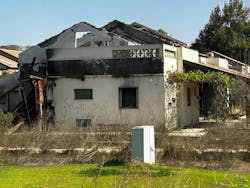
Dennis was still lying on the ground as four people stood over him. They told Itamar that there was nothing they could do for him because of his condition. Ambulances couldn’t enter the area, so Itamar decided to take Dennis to the hospital himself. Trying to find a vehicle that the terrorists didn’t disable wasn’t easy. A homeowner gave Itamar the keys to his car, and Itamar drove Dennis to Soroka Medical Center, about 15 miles away. After dropping Dennis off at the hospital, Itamar returned to Ofakim to rejoin the fighting.
Once back in Ofakim, Itamar went to check on his family. He didn’t stay long before he was back on the streets. He began to see the dead bodies of people he had just fought with earlier. He found himself in another barricaded situation as terrorists took possession of a home. A father saved his family by having them climb onto the roof through the second-story window. The father couldn’t get out in time and was killed, his body hanging out the window. The family was rescued after hiding for over two hours behind a solar water heater on the roof.
Itamar noticed that three terrorists were inside a concrete shed behind the house. Once they determined that there were no hostages, an order was given to shoot and kill without regard. They refer to this as a “pressure cooker” order. The officers began firing for nearly fifteen minutes at any places where a terrorist might be hiding—eventually, one of the terrorists surrendered. Itamar quickly realizes that he wasn’t trying to surrender; instead, he was planning to commit suicide. Without taking the chance that he might have an IED, Itamar, after getting approval, shoots the terrorist twice in the head. Upon entering the shed, more dead terrorists are found surrounded by shoulder-fired missiles and RPGs.
After a couple of hours, the fighting had stopped. Itamar retraced his steps from earlier to when it first began, thinking about his friends who died. He now lives with survivors remorse, wondering why his life was spared when so many others lost their lives. He is considered a hero, although he doesn’t view himself that way. However, at least one person would disagree. Dennis, the IDF soldier, who was all but dead, managed to survive, and it wouldn’t have been possible had it not been for the heroic actions of Itamar.
Aftermath
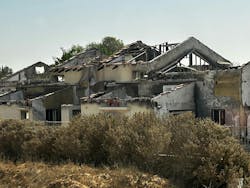
Although the police were instrumental in defending Israel, October 7 also showed glaring deficiencies within the police and the military. The event forced these agencies to reevaluate their equipment and tactics to hopefully prevent this from happening again. One issue was that the police were outgunned. Officers were fighting terrorists armed with automatic weapons with only a handgun. After October 7, officers were given more high-powered weapons and more ammunition.
But it wasn’t just the police who saw a change in firepower; civilians did as well. Before October 7, civilians were allowed to have one gun per person. That has been increased, mainly at the government's urging. Gun ownership in Israel is a privilege, not a constitutional right. After October 7, citizens are encouraged to arm themselves, and permit requirements have been loosened. According to the National Security Ministry, there have been over 260,000 requests for gun permits, with the agency approving more than 3,000 a day. That is significantly higher than the 100 recorded a day before the attacks. Citizens could have only 50 rounds of ammunition, but that has since been increased to 100. Safe rooms have also become mandatory in all new home construction as a result of the attacks.
A central issue raised by the October 7 attacks concerns the respective missions and roles of the police and the Israel Defense Forces (IDF). Police agencies are primarily responsible for internal security, while the military is tasked with defending against external threats. On that day, IDF forces were not immediately present, and by the time military units arrived, much of the fighting had already concluded. Some former police leaders have suggested that the division of responsibilities between the police and the military should be reevaluated, particularly in light of prior indications that Hamas was increasing its capabilities and reports of intelligence failures that may have affected preparedness.
Reflection
The attacks definitely left a void that can never be filled. Throughout all of my conversations with officers, there was a recurring theme. Why me? Why did I survive? Was there something more that I could do? As with Itamar, many officers expressed survivor’s remorse. They continue to see the faces of their fellow brothers and sisters in their dreams. They understand that they suffer from Post Traumatic Stress Disorder (PTSD), and it will be something that will follow them forever.
While at the police station in Tel Aviv, I spoke with a Border Police officer. Although she wasn’t there during the attacks, she talked about a few of her friends who were. They were all killed. Unlike the US, Israel is a small country where most officers know each other. She said that most officers know at least one person who was killed. As soon as she began to talk about her friends, her hand started to shake. She has PTSD from her own experiences, and couple that with losing her friends. Many officers, like her, have wounds that are not visible. The mental toll of these attacks will far outweigh the physical ones.
Through tragedy, strength and perseverance emerge. Officers of the Police Unity Tour witnessed this when they attended an Israeli wedding in Ofakim. Most of the group did not know who was getting married, except for a few people involved in organizing the trip. The bride was the daughter of Yigal Ilouz, an Israeli police officer killed on October 7. (He was mentioned in Itamar’s story.) He had visited New Jersey multiple times to ride in the Police Unity Tour during Police Week. He provided hospitality to the officers during their visit to Israel. He was murdered outside the police department while helping younger officers escape before terrorists overran it. It was a difficult time for those who knew him. Two years later, his daughter was getting married, and as a show of support, the Police Unity Tour attended her wedding. We may not have known her or anyone there for that matter, but policing is a family, and Yigal had to be smiling that we were there to celebrate with her on this special day.
Testimonials
For many in this group, it was their first time in Israel. It is hard to go on this trip without being emotionally moved. Even for those who have been to Israel before, each visit is unique. Sarah Zaveloff, an investigator with the New York City Investigation, Revenue and Enforcement Administration (IREA), visited Israel in Dec 2023 at the start of the war. She went to Nova, and at the time, there was no memorial. Looking back, she said, “The ground still bore the blood of those tortured, killed, and kidnapped. It was raw and emotional.” Two years later, Nova has been transformed into a memorial to those who were lost. Reflecting on it, she said, “It’s a touching and emotional tribute to the lives lost and affected that day.”
This trip would not be possible without the support of the Israeli police. Specifically, a handful of Israeli officers give their time to make this trip memorable. Yoni Zeitak, chief superintendent of the Israel Border Guard (Ret), has been heavily involved in the Police Unity Tour in both Israel and the US. It was during Police Week in 2023 that I first met him shortly after the Candlelight Vigil. We struck up a friendship, and he has tried to get me to come to Israel ever since. He was proud when I finally arrived. Yoni is a true friend to law enforcement and takes great pride in hosting US officers in his country.
I asked Yoni to describe what it means to be a police officer in Israel. He said, “To be an Israeli police officer is to stand at the front line of the Israeli reality. It combines human sensitivity with immense responsibility, where any moment can become a mission of saving lives, especially since October 7th. A day that reminded us all that this calling is not just a slogan, but a living, urgent reality. It is daily work carried out quietly and with dedication by a person behind the uniform who strives to protect, help, and safeguard public order, security, and the freedom of religion and belief for every individual, from every background and community.
He also had a message for all those officers serving around the globe, “All over the world, behind every badge, emblem, and patrol car stands someone who left family at home, someone who faces complex challenges, often amid turmoil, yet continues to act with deep purpose. In their honor, we stand together, we remember, we give our gratitude, and we do not forget the sacrifice or the mission.”
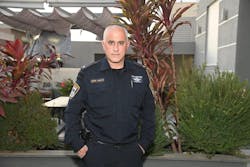
This article is dedicated to Lt. Col. Itamar Alus, the Hero of Ofakim. A few months after this article was written, Itamar passed away from a medical condition on January 3, 2026. For his bravery and based on the recommendation of his commanders, he was posthumously promoted to Senior Non-Commissioned Officer.
About the Author
 Robert Bowling
Robert Bowling
Robert Bowling is a retired police officer from Fishers (IN) and Durham (NC) police departments. In retirement, he has continued his passion to honor fallen officers. He is an Ambassador for the National Law Enforcement Memorial, as well as an historical researcher for the Officer Down Memorial Page. He also has a passion for history, focusing primarily on law enforcement history. He is a member of the Police History Society and is the author of the book Wicked Fishers. He currently teaches Criminal Justice for a local high school.