Off-Body Carry Training: Key Drills, Mistakes and Lessons Learned
What to Know
- Proper equipment setup, including holster choice and zipper management, is crucial for quick and reliable access to your firearm.
- Training should incorporate time, physical, and cognitive challenges to ensure realistic preparedness in self-defense scenarios.
- Retention mechanisms and body orientation significantly impact draw speed and safety; secure holsters and pre-orientation are recommended.

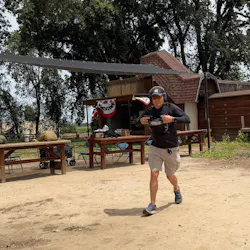
This is the second installment on Off-Body Carry. In the first installment, I admitted that I am not a fan. However, there are some advantages. Logically, if it is a viable tool, and we will likely use it, then we had better train with it.
In the last installment on Off-Body Carry, I stated the attitude of the user dictates its effectiveness. If the user does not have a realistic approach about their defensive posture, their response won’t be realistic either.
Simply put: You need to pressure test your techniques. Your pressure test should contain time pressure, physical challenge, and cognitive (decision making) pressure.
I started drilling with one.
As a reminder, the first installment of Off Body Carry started with Rule #1: Your Martial Arts should be competent.
Set it Up
The first thing I did was to optimize my Vertx Everyday Fanny Pack 2.1. The most typical fanny pack style is that of a zippered rectangular pouch that either has a hook-and-loop base, like the Vertx, or hook-and-loop combined with a holster strap like the Elite Survival Systems Hip Gunner. With either system, I recommend a fitted holster, rather than a “universal fit” one. For packs with straps, clipping in Kydex works great.
Remove all zipper pulls except the one that exposes the gun. For this zipper pull, use something that is incredibly easy to find. If you look at the photos on some of the drills, I am using my 5.11 Skyweight Utility Chest Pack, which is a chest rig that fixes against the chest using webbing across the back. I took all of the zipper pulls off my rig, and put a large carabiner on the one that accesses the gun.
The 5.11 Skyweight Utility Chest Pack is an excellent off-body carry because it keeps everything positioned on the chest. I bought it for fly fishing, and it holds my flies, tippets, and equipment for a good day on the water. The rear compartment is set up for a hook-and-loop mounted gun. Smart users can hang their bear spray canister from the bottom or even off a shoulder strap.
Unfortunately, the 5.11 Skyweight Utility Chest Pack also taught me a valuable lesson in off-body carry. If I just get out a ruler and measured it, it looks like it will hold my Ruger Alaskan or Glock 20SF, exactly my intention when I purchased it. It doesn’t. In fact, it barely holds my K6S. Lesson learned: Off-body carry payloads are smaller than what we perceive.
I use an Alien Gear Cloak Hook and Loop holster for my Hellcat. It sticks to my Everyday Fanny Pack tenaciously, and holds my Hellcat securely. It covers the trigger and trigger guard, yet allows for a full Master Grip and a clean draw.

Draw to standard
Using a pack on the waist, the draw time should be about 2.5 seconds. I set up a live fire drill for that.
My range timer confirms that placing a pull-down tab between two zippers on a pack is slower than using just one zipper to open it. No matter how hard I pulled, the draw was never clean with the pull-down tab. Disable one zipper by removing its pull.
Keep something in the front part of the pack. It will draw better. I switched to using a Streamlight Polytac 1X light because of fanny packs. It is the perfect size. It is multi fuel, fires a concentrated 500lm beam, and is lightweight.
DO NOT use the elastic loops for holding magazines mounted inside the gun compartment, a feature included in some products. When I started live firing my set up, they slowed the draw and dropped magazines. Nothing should be inside the gun compartment except your gun.
Rule #1 Your martial arts should be competent
In the first off body carry article, I talked about the inherently slow draw of this option, and how other tools could be deployed account for the time factor. When it comes to this, I have a confession. If I ever wear a fanny pack for the purpose of carrying a gun, somewhere on me is a much faster response, and its already in my hands.
If you have raised your hand to Protect and Serve, and you are not participating in some sort of training that increases your survivability besides your range time, you have not been listening. You must train hard on your own time. Pick a martial arts system and get good at it. Approach the mats or your local dojo humbly and never look back.
Rule #2: Trigger Discipline is Your Friend
I experimented with several different styles of fanny pack carry. I tried it with the strap on my non-firing shoulder, firing shoulder, centered on my waist, and offset on my waist. My fastest draw was when the pack was offset on my waist. My most comfortable carry was with the strap over my firing shoulder. I chose comfort over speed.
This training is consistent with the popular cross body purses that pull from the top. While we were at SHOT 2026, we visited with the owners of UC Leather. They had some stylish bags that were innocuous looking that drew well.
I used a simple course, which consisted of a pair of torso targets about a yard apart, and a barricade at the 10 yard line. I started at the 25 yard line about 20 yards away, with the gun holstered and the pack zipped. On the command of “Fight!” I ran toward the barricade while drawing.
I wanted time pressure and movement, and the requirement to engage from cover. I ran this dozens of times and even trained with it using a TitanX off the range.
I was determined to carry my gun with the ballistic panel over my heart. This meant over the shoulder carry. The Premier Body Armor inset gave it exactly the right stiffness.
With the strap over the non-firing shoulder, zipper pull was an easier reach, but the pack was less stable. In some of my draws, I had to steady the pack with my firing hand while unzipping, a definite no-go.
With the strap over my firing shoulder, the start of the zipper pull was a longer reach, but the pack was more stable during the draw, mostly because it was close to my shoulder. This was more consistent.
I first started running this drill with my TitanX in a CrossBreed Modular Holster. I switched to my Hellcat and an Alien Gear with a Cloak Hook and Loop holster.
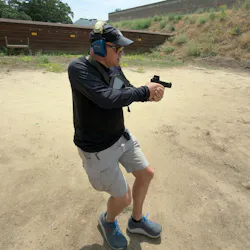
No matter how I drilled, I could not completely eliminate covering my own hand while drawing under pressure. I was drawing while running full speed from the 25-yard line and presenting within the 2.5 second standard. I could get behind the barricade within about 3 seconds, and engage under 4 seconds. However, I looked at still photos and videos of clean runs and the muzzle of my gun comes dangerously close to my left hand dozens of times.
Conclusion: Keep the finger away from the bang switch until it is time for the bang.
Rule #3: Retention is critical
DO use a reliable holster, rather than a universal fit insert to retain your gun. When I started drawing a gun in a pack under pressure, I discovered the most critical feature wasn’t a fast drawing holster. It was a set-up that allowed secure re-holstering and retention.
Some fanny packs use a retention thumb break. I tried them. These just slowed me down. The best designs “click” the gun in place. I like my Alien Gear.
The other consideration for retention is keeping the pack on the waist. The last thing I want is to have my pack unclipped from my body during a critical incident. One option is to use 550 cord to act as a “safety rope” between the two buckle ends. If the pack is unclipped, the cord only allows the buckles to separate a couple of inches.
Rule #4: Pre-orient the gun
When you carry a gun in a pack, it is parallel to the body until drawn. As a right-handed shooter, the muzzle is forward when my left foot is forward. The more I blade my body with the left side forward, the less I need to orient the drawn gun. Even when running or walking fast, the draw stroke is faster when landing on the non-firing foot.
This didn’t make any difference in draw time, but orientation burns milliseconds.
Off-body carry has its place
Off body carry should not be the first choice in carry options, but it should be an option. If you choose this option, train with it, and be brutally honest about your training.
About the Author
 Officer Lindsey Bertomen (ret.), Contributing Editor
Officer Lindsey Bertomen (ret.), Contributing Editor
Lindsey Bertomen is a retired police officer and retired military small arms trainer. He teaches criminal justice at Hartnell College in Salinas, California, where serves as a POST administrator and firearms instructor. He also teaches civilian firearms classes, enjoys fly fishing, martial arts, and mountain biking. His articles have appeared in print and online for over two decades.