Pelvic Girdle Shots: Are They Effective Ways to Stop Threats?
What to Know
- Targeting the pelvic girdle is often considered a secondary option but is generally ineffective for immediate threat incapacitation because of anatomical and physiological factors.
- Expert insights reveal that shooting the pelvis rarely causes rapid incapacitation or exsanguination, making it a poor primary target in self-defense situations.
- Training should prioritize accurate center mass shots and reliable headshots, especially when moving, to maximize the chances of stopping a threat effectively.
- Pelvic shots might cause some trauma but are unlikely to produce immediate incapacitation, emphasizing the need for proper shot placement and tactical decision-making.
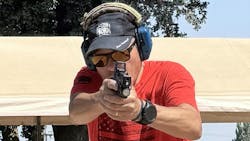
More on OFFICER.com
Download the November/December issue of OFFICER Magazine.
Click Here to subscribe to OFFICER Magazine.
I was trained to target the pelvic girdle as a secondary target. You probably were too, somewhere in your career. It makes logical sense: If the officer is under fire, and targets below the midsection are available because everything else is behind cover, the pelvic girdle shot is an option.
I was told, however, that this should be a primary option, because it immediately incapacitates the threat. In my personal experience, which is so limited it cannot be described as experience, targeting this area doesn’t make sense. It rarely incapacitates and sometimes immobilizes. It is an unlikely target that will take the threat out of the fight.
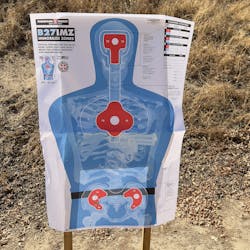
Over the years, those of us who have worked as sworn law enforcement officers get to attend a lot of training, in the same manner other professions receive professional development training. Many of my training sessions were related to firearms. I can recall several sessions where we were trained to target the pelvic girdle if center mass was unavailable. In some sessions, we shot targets that suggested the best areas to hit the pelvis with a bullet.
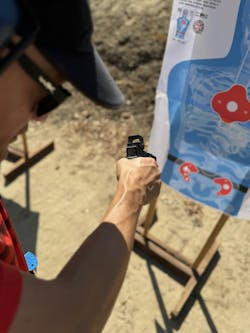
My medical training is limited to stopping the bleed under duress and keeping patients alive until people smarter than me arrive. When my training recommended using the pelvic girdle as a tertiary target, I didn’t question it. I started shooting at targets with pelvic girdle outlines.
One of the training scenarios I attended had us in uniform in a Failure Drill. The threat was wearing a concealed vest, and two shots center mass was not completely effective. Rather than deliver a headshot, we were supposed to shoot below the belt line.
I liked the drill, and brought it back to my agency. In one of the scenarios I ran, we did the same thing. The drill resembles a typical Failure Drill. The officer fires two to center mass, assesses, and fires one into the pelvis, instead of the head.
About a month later, I had to take a statement from a gang member shot by a rival gang member in the pelvic area. I believe the only thing the bullet damaged was the filter on his foul mouth when he spoke to those bandaging him and administering pain medication. His trip to the emergency room was almost an outpatient visit.
My next shooting victim was also shot in the pelvic area. This one walked into the ambulance, then walked into the ER. This should have registered with me.
The pelvic girdle area is a region covering the inguinal (groin or lower lateral) region over the ball and socket of the hip, to the top of the pelvis.
I’m not a doctor, so I had to ask a friend who is a doctor. Dr. Michael Temnyk is a recently retired orthopedic surgeon. I like training with him, especially when his medical knowledge adds insight to our shooting. He spent his residency in an inner-city hospital where gunshot injuries were common. He told me about how much exposure to trauma medicine he received working in an ER that was as large as some hospitals. Later, as an orthopedic surgeon, he performed countless surgeries in this area.
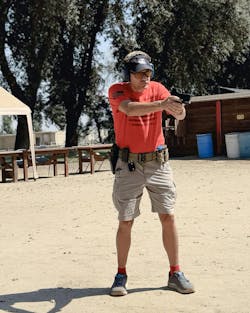
Temnyk told me that the shape and orientation of the pelvis is not obvious from looking at it externally. For example, the pelvic ring is almost oriented vertically. If one were to shoot this area, exsanguination is an unlikely outcome. Temnyk explained a gunshot could cause life-threatening issues like sepsis a week later, but there is no neurological structure that will stop the fight immediately. This is an urban myth.
In my training targets, the area where the socket and hip joint come together, I asked about shooting the hip joint.
The bottom line, according to Dr. Temnyk: If someone is running at you, shooting the bony socket of the pelvis and its head will prevent them from continuing to run at you. However, the sacrum, ileum, and pubic structures would take a “boatload of energy” to stop in an emergency. These areas are usually abbreviated by blunt force trauma, not gunshots. The pelvic ring is “like a pretzel.” If one were to saw through one edge of the ring, the pelvis is still somewhat stable. That is, it would have to be broken in two places to create an instability. It can be stopped with enough blunt force trauma, but certainly a handgun isn’t going to do that.
Temnyk continued, “If you are going to stop someone by shooting them in the pelvis, you would have to be a very, very good shot. When a person is running, the target is not static. I trained in GSW’s, penetrating knife wounds, and similar injuries.” He continued to tell me that the number of gunshot wounds that he treated in residency was astronomical. He has witnessed enough gunshot cases to recognize what a pelvic girdle shot can and cannot do. Blunt force trauma to the hip region is completely different, however.
The next question is whether a person can shoot the pelvis area into the femoral artery and cause ex-sanguination. The pelvic branches of the aorta and inferior vena cava are smaller and more elusive than we think. The truth is, the blood vessels are almost an impossible target.
If the pelvic girdle shot is not the answer, what is the answer?
If a center mass target won’t work, then go for the headshot. This most often results in immediate incapacitation.
Don’t dismiss multiple center mass shots. I have had the opportunity to talk to several people who were shot in the vest. It stopped each of them, at least for a moment. It is not uncommon to have a broken rib after taking a hit in the vest. Firing multiple shots at a person suspected of wearing body armor is a reasonable way to set up a shot with more effect.
The problem is, it’s hard enough to get recruits and in-service officers to hit a static target on a square range. If we incorporate movement, target decision-making, and more precise targets, we are asking for a miss.
Most readers know I always incorporate headshots and failure drills in my training. They are predominantly used for hostage rescue training. One thing we must bear in mind is the head is hard to hit. If there is a miss, there is potential for the bullet striking an unintended target. The headshot must be set up.
The drill
I use a shooter/coach arrangement for headshot training. From the 7-yard line, the shooter starts firing at the “threat” command, and transitions to the headshot at the “failure” command. Coaches should make this transition unpredictable, sometimes letting the shooter shoot only one shot, other times causing them to reload to continue. I add another factor to the scenario after the shooter successfully the failure drills. First, the shooter begins at the 10-yard line. On the “threat” command, he walks in a 45 degree line toward the target, beginning slightly offset from the target lane, and ending slightly offset from the target lane. Hitting the center mass while moving is hard enough.
Delivering a headshot requires the shooter create and maintain a solid platform. It requires heel-toe rocking while walking with bent knees. When doing this drill, I found I could hit the sinus cavity, but not ten out of ten times. Officers should work this drill until 100% of the center mass shots are accurate, and the headshot can reliably go into the sinus cavity.
We started out talking about the ineffectiveness of the pelvic girdle shot. It’s not the best tactical choice. The priority should be center mass first, followed by the headshot. Practice these things while moving.
About the Author
 Officer Lindsey Bertomen (ret.), Contributing Editor
Officer Lindsey Bertomen (ret.), Contributing Editor
Lindsey Bertomen is a retired police officer and retired military small arms trainer. He teaches criminal justice at Hartnell College in Salinas, California, where serves as a POST administrator and firearms instructor. He also teaches civilian firearms classes, enjoys fly fishing, martial arts, and mountain biking. His articles have appeared in print and online for over two decades.