Distance Is a Decision: Rethinking the Patrol Response to Crisis Calls
Key Highlights
- Distance gives officers time to slow crisis calls and make safer decisions.
- The PepperBall system helps create space before encounters escalate to higher-force options.
- Agencies need patrol tools suited for today’s mental health-driven calls.
- Field data suggests distance-based options may reduce harsher force use.
- Non-lethal PepperBall tools support officer safety, public confidence, and risk reduction.
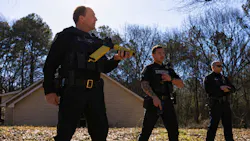

Ask a patrol sergeant what has changed about the job, and you won’t hear much about crime rates. You’ll hear about people in crisis. Calls involving mental health, substance use, and erratic behavior have been climbing in most jurisdictions, and they keep landing on the officers who already handle everything else. Sheriff Dan Starry of Washington County, Minnesota, puts the share of his agency’s calls that touch mental health somewhere between 70 and 80 percent. Most of that volume runs through patrol, not a specialized team.
These calls tend to be unpredictable and emotional without being criminal in the ordinary sense. The person might be holding a knife, ignoring commands, or simply unreachable in the moment. The officer still has to bring the situation under control, which leaves police leaders and elected officials with a fair question: are we equipping officers for the calls they actually run today, or for the ones that defined the job a generation ago?
Consider an officer’s options on one of these calls: verbal commands, OC spray, physical control, CEDs or, in the most serious cases, a firearm. Some tools require close proximity. Others may be limited by distance, timing, subject behavior or the environment. The challenge is that officers often have very little time to assess, communicate and choose the best path before the situation escalates. A non-lethal option that can be deployed from a greater distance gives officers space to evaluate, communicate and act.
This is the gap PepperBall® was built to close. The system lets an officer influence a subject’s behavior from far enough back that there’s no need to commit to a close-range decision right away. Used by more than 10,000 agencies over 25 years, it has a long track record in mobile field force and corrections, but the day-to-day value is simpler. A Washington County deputy who carries it put the contrast plainly: OC spray buys you five or ten feet, while his PepperBall launcher keeps him forty feet out and still accurate, and that’s room to think.
Distance turns into time, and time is what crisis calls are short on. With some separation, an officer can keep a conversation going, wait for a second unit, reposition, and settle on a plan instead of reacting on instinct. Sergeant Ronni Lake said that just holding the option resets how her officers approach a scene: they recognize time is on their side, time to talk it through with their partners, and put a plan together. Commander Joshua Lego of the St. Paul Police framed it the same way - give the tool room and time to work. The tactical edge is obvious; the bigger gain is to the officer’s decision-making.
The same pattern can be seen in the field. One large metropolitan department in the western United States compared its use-of-force records for the year before it adopted the PepperBall system and the year after. Total use-of-force incidents came down about seven percent. But the category results are where the real story is told. Conducted energy device use dropped roughly 20 percent. OC spray fell by more than half. The 12-gauge and 40mm munitions numbers also came down by about half. Deadly force incidents went from 18 to 6, close to a two-thirds reduction.
While a single department’s year-over-year comparison can’t establish cause and there are always variables, the direction is consistent: as officers incorporated a non-lethal option that worked at distance, their reliance on the harsher tools above appears to have been reduced The department didn’t log one more force category stacked onto the rest; it logged a shift toward lower levels of force across the board.
The detail that matters is that the higher-harm options, CEDs, OC spray, less lethal munitions, deadly force, fell together, rather than one climbing to offset the rest. That’s what you would expect when encounters resolve at a lower level, not when officers simply add another option on top of the ones they already reach for.
Public perception belongs in the same conversation. Starry made a point most command staff would recognize: over a long career you see uses of force that are clearly justified, others that are at least legal, and some lawful ones that still look awful on video. Clean paperwork doesn’t change how a community reads the outcome. Agencies need options that satisfy both operational demands and public expectations, and a call that ends without serious injury usually clears both bars.
No single tool fixes any of this, and officers in the field don’t talk like it does. One of them said what most feel - nobody takes this job hoping for the day they hurt someone, and if a situation can be settled with a cough or a bruise instead of something worse, that’s a result he’ll take every time. That’s the whole case in plain terms: gain control with the least harm the circumstances allow, and distance keeps the lower-harm path open long enough to use it.
For chiefs, that means cleaner policy, stronger training, and officers who trust they have a defensible step between verbal commands and lethal force - and with more than 200 train-the-trainer sessions a year, the capability doesn’t sit unused in a trunk. For city managers and council members approving budgets, it reframes the line item: a non-lethal capability isn’t equipment spending so much as risk reduction - fewer injuries, less litigation exposure, more public confidence kept. As calls get more complex and scrutiny keeps rising, putting time, distance, and a real alternative in an officer’s hands before a situation reaches lethal force is simply sound leadership.
Starry didn’t hedge about where he’d like this to go: he wants the capability in every squad car in his fleet. Agencies will land in different places, and budgets will decide much of it. But the calls that define a patrol officer’s hardest days come down to decisions made in a few seconds, and distance is one of the few things that can hand an officer more of those seconds. To see what that looks like for your agency, request a full non-lethal evaluation or a demonstration from the PepperBall team at pepperball.com.