Rethinking Drone as First Responder: Why DFR 3.0 Changes the Game
Key Highlights
- DFR 3.0 moves drone response from pilot programs to infrastructure-grade public safety.
- A three-phase evolution: pilot concepts, docked deployment, and now autonomous 24/7 operations.
- True 24/7 readiness replaces intermittent coverage, reshaping the economics of aerial response.
- Expanded range and resilient connectivity turn DFR into a continuously available safety layer.
- DFR 3.0 isn't incremental — it fundamentally redefines uptime, coverage, and use cases.

Drone as First Responder (DFR) programs have progressed rapidly over the past eight years. What began as pilot programs proving concept viability (DFR 1.0) matured into strategically deployed docked systems integrated into real-time crime centers (DFR 2.0).
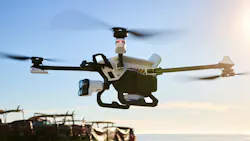
Now, a new phase is emerging. DFR 3.0 is an autonomous, adaptive, infrastructure-grade response. This shift is powered by BRINC Guardian, BRINC's new, purpose-built drone that redefines what round-the-clock, automated aerial response can be.
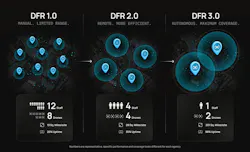
DFR 3.0 is not incremental. It fundamentally changes uptime, coverage economics, and use cases.
Here's what defines DFR 3.0.
The Key to True 24/7 Operations
The biggest operational constraint for DFR 2.0 is charging time. Legacy docked systems rely on contact charging. After a mission, the aircraft lands and sits and charges, which means you’ll be charging for as long (or longer) than the amount of time you just flew.
So a contact-charging platform such as the Skydio X10 requires 35 minutes to recharge from 15% to 95%. In contrast, Guardian’s automated battery swap takes 90 seconds, assuming a charged battery is staged in the dock.
That difference compounds quickly in high-tempo environments. In a 24-hour period with consistent calls for service, a contact-charging drone will spend over half of its operational window grounded and recharging. An auto-swapping system can realistically sustain uptime approaching 98%, because turnaround time between missions is measured in seconds, not half-hours.
This fundamentally alters deployment economics. Instead of installing multiple docks in the same location to maintain coverage while one aircraft charges, agencies can sustain round-the-clock readiness from a single dock. The capital that would have gone toward redundancy can instead expand coverage. DFR 3.0 is not just about flying more often. It is about maintaining continuous readiness as infrastructure.
Range Redefined
Of course, flight time directly impacts range. While early Beyond Visual Line of Site (BVLOS) waivers limited drone operations to 2-3 mile ranges, most agencies today operate under jurisdictional waivers. This allows them to fly anywhere within their jurisdiction, as long as the drone can safely reach the call for service.
However, many legacy DFR systems remain constrained to a 2-3 mile operational range. Guardian extends that boundary to up to 8 miles, driven by improvements in both endurance and connectivity, advancements that define DFR 3.0.
That increased range dramatically expands coverage. A single site that once covered roughly 30 square miles can now cover up to 200 square miles, nearly 7x the area of legacy systems. As a result, agencies need significantly fewer drone nests to cover a much greater area.
At the same time, agencies must consider overlap for simultaneous incidents and faster response times in higher-crime areas. With a system capable of true 24/7 operations, it is more cost-effective to deploy a smaller number of long-range systems with strategic overlap than to cluster multiple short-range systems in the same area, where costs compound quickly.
Connectivity Built for Real-World Coverage Gaps
DFR is only as reliable as its connectivity.
DFR 1.0 was manual not just because of regulatory limits, but also the sole reliance on point-to-point radios to control drones.
DFR 2.0 introduced drones with integrated cellular alongside radios, adding an additional layer of reliability. However, many jurisdictions struggle with inconsistent cellular coverage.
DFR 3.0 addresses this through intelligent multi-carrier connectivity that can hop between providers when signal quality drops.
And where no carriers are an option, integration with Starlink provides satellite-backed command and control. This enables extended-range operations in environments that previously made DFR impractical.
For instance, wildfire prone areas or parks that often incur search and rescue operations can now maintain a permanent response infrastructure. This will not only achieve better results but is also more cost effective when compared to the helicopters that have traditionally been the only option.
So when a drone like Guardian launches, it stays connected. Redundant pathways reduce mission risk and increase confidence in autonomous deployment.
Adapt & Interact
Earlier DFR generations centered solely on cameras. The aircraft arrived, streamed video and informed decision-making. That capability remains critical, but DFR 3.0 expands the mission set beyond awareness to interaction.
Guardian introduces automated payload swapping and a ten-pound payload capacity, allowing agencies to deploy mission-specific equipment without human intervention. The aircraft no longer just sees the problem. It can respond to it.
Near a nuclear facility or in high-risk cities, that may mean deploying a radiation detector. At an assisted living community, it could mean delivering an AED. In jurisdictions facing opioid overdoses, Narcan can be staged and deployed. In waterfront communities, flotation devices such as Restube can be delivered at scale. The platform molds to the agency’s operational reality.
This flexibility also extends lifecycle value. As new payloads become compatible, the aircraft’s utility increases. Agencies are not locked into a static camera platform. They gain a modular aerial responder that evolves alongside their mission requirements.
And when speaking of interaction, it's worth noting Guardian’s integrated loudspeaker. At a 131 Max dBa, here’s a loudspeaker and siren that’s 3x louder than a police car, which ensures authority, clarity, and control in any environment.
Rethinking Autonomy
As autonomous vehicles start offering taxi services, what began as a debate between different imaging technologies seems to have come to a conclusion.
Early conversations centered around the benefit of visuals cameras vs LiDAR.
With cars, visual cameras benefit from defined lanes, predictable signage, and a hard ground reference. But even with those benefits, the best systems leverage a mixture of visual cameras and radar or LiDAR.
Viral videos like “Can You Fool A Self Driving Car?” highlight how camera-dependent systems can be manipulated or confused. In aerial environments, that fragility becomes even more pronounced.
Drones, on the other hand, operate in unstructured three-dimensional space. They fly over water with minimal visual contrast, near buildings that generate multipath reflections, and around thin hazards such as power lines. Weather compounds the challenge. Rain, fog, and smoke degrade optical performance.
DFR 3.0 incorporates automotive-grade radar, similar in principle to the sensor architectures used by safety-focused manufacturers such as Volvo, to enhance obstacle detection and environmental awareness. Radar is less dependent on lighting conditions, performs more consistently in adverse weather, and detects objects that vision systems may miss.
It also requires less intensive onboard processing than vision-dominant AI stacks. That efficiency translates to preserved flight time and greater operational reliability. For public safety agencies, autonomy must be dependable in the worst conditions, not the best.
From Program to Permanent Infrastructure
DFR 1.0 proved that drones could arrive first. DFR 2.0 scaled deployment through docks and automation. DFR 3.0 transforms DFR into a permanent, resilient layer of emergency response infrastructure.
With automated battery swapping enabling near-continuous uptime, adaptive payload systems extending mission scope, resilient connectivity ensuring control in difficult coverage areas and radar-enhanced autonomy supporting all-weather operations, the role of a drone like Guardian changes. It is no longer just a flying camera. It becomes a constant aerial responder integrated into 911 workflows.
The agencies that adopt DFR 3.0 are not merely upgrading hardware. They are restructuring how aerial response fits into daily operations by expanding coverage, reducing redundancy costs and increasing reliability in the environments that matter most.
Reach out here if you’d like to learn more about BRINC’s DFR 3.0 solutions.