Meet the Va. Police Negotiator Building an AI-Powered Rock Career
What to Know
- Antwon “AJ” Stevenson, a hostage and crisis negotiator with the Norfolk Police Department, has built a large online following creating AI-assisted rock, punk and alternative music under the stage name Dark Nephilim.
- Stevenson turned to songwriting after the painful end of a longtime friendship, using AI tools to transform his lyrics into songs and music videos despite having little musical training.
- He has released three albums, over 90 singles and amassed over 45,000 TikTok followers, while using music as a creative outlet from the stresses of law enforcement work.
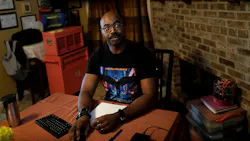
Antwon “AJ” Stevenson, a hostage and crisis negotiator for the Norfolk Police Department, is known for calming situations down, talking people off the ledge and into doing the right thing even when emotions are boiling and fear is raw.
He’s also Dark Nephilim, an AI assisted artist, who publishes his version of hard rock, punk and alternative music on YouTube and across social media.
He writes the lyrics. Computer-generated voices sing the songs. AI creates his music videos, which are best described in a single word: Metal. Swirls of often dark colors, the animated videos are replete with gothic winged creatures, fire, dripping blood and biblical imagery.
Stevenson describes his music as “human-led AI rock,” and in less than a year since the release of his debut album, “From the Ashes,” the content-creating police officer has racked up over 45,000 followers on TikTok, as the Dark Nephilim.
At 52, and with over 20 years in law enforcement, he never planned on pursuing music professionally or even as a hobby. Growing up in Norfolk, he tried his hand at guitar. He fumbled with the bass. He was a music lover coming up in the hair band era who dreamed of being a rocker but, he said, lacked a certain predisposition.
“I just could not get the instruments down. And I tried and tried,” he said. “And I just didn’t have the patience.
“So,” he explained, “I’d get pissed off, and stop.”
When he was a teenager, his family moved out of state. He graduated high school in Detroit but eventually came back to Hampton Roads and worked as a Blockbuster store manager for 12 years before enrolling in a police academy.
In the early 2000s, he was an officer for college police forces at Hampton University and Old Dominion University and started with Norfolk PD in 2008. He’d been a hostage crisis negotiator for almost 15 years before a breakup turned his life upside down.
It wasn’t a romantic relationship that ended, but instead a friendship. Last year, Stevenson and a longtime buddy with whom he’d been “thick as thieves” called it quits. And the split devastated him.
“My wife was like, ‘Why don’t you two just try to talk?’ And I was like, ‘No. I don’t want to talk,’” he recalled.
But he knew he needed something to vent the rejection and loss. And one day, he sat down at the kitchen table and spontaneously found it. On a whim, he picked up a pencil and wrote a song.
He poured his pain onto the page. And he felt better. So he wrote another one and another. For weeks he wrote lyrics every evening until he had dozens of new songs. But he didn’t know what to do with them. He didn’t play music. But then, he knew: AI did.
He uses the app Zona. He feeds it his lyrics and tells it to build a composition using the genre, and sex of the singer, he chooses. He plugs the result into another AI app, one that instantly creates a music video based on the song’s themes and his instructions. A picture of himself yields a 3D view of him singing that song in any place he wants — say, a castle.
His first album focused on the loss of his friendship. He released it last December through an online distribution service, as Big Blue Featuring AI. But though his music was now on Spotify, almost no one was listening to it.
“I guess it was just naive,” he said, adding. “I was expecting to take over the world of music.”
He’d poured his soul into those songs, he recalled thinking. Why wouldn’t other people want to listen?
“Any artist — whether you’re a painter, musician or whatever — is going to feel a similar way when you put your heart and soul into what you do. It doesn’t matter if I use AI or if I sit there with a darn guitar, that’s me. That’s me. I’m in there,” he said. “And if it doesn’t go anywhere, then what’s the point?”
Then, he said, he admitted to himself: He’d done no advertising. No marketing. No promotion.
So he spruced up his social media, made a TikTok account and decided he needed a name change.
A self-described born again Christian, he decided to lean into his interest in theology, and the Old Testament makes several references to beings it calls “Nephilim.” Stevenson holds to the interpretation that the Nephilim were the offspring of human women and fallen angels. The beings reminded him of his hybrid art form, he explained. His new artistic persona was born.
“Basically a human merging with AI technology, because it’s an ethereal being without form, to create something better.”
He’s since released three albums, with a combined 70 songs, and more than 90 singles. Some are country music or inspired by gospel. One is rap.
And while many of the tracks are driven by deep emotional tones, others such as “Head on a Swivel” and “Signal 7” are odes to his fellow law enforcement officers. His Jack Trilogy — “Jack the Mighty Hunter: Hunt for Love,” “Mighty Hunter’s Love” and “My Rockin Love for Mom” — tell the story about an affectionate cat.
“I did not know he had that many thoughts in his head,” his wife, Victoria Stevenson, said. “But it’s a way for him to release. You know, he has a high-stress job.”
_________
©2026 The Virginian-Pilot.
Visit pilotonline.com.
Distributed by Tribune Content Agency, LLC.