Ex-Mich. Police Officer with PTSD Offers Support to Trauma Victims
What to know
-
Joe Stapel, a former police officer with PTSD, has expanded his nonprofit, Help Michigan Heroes, to cover mental health counseling costs for community members affected by recent fatal shootings and crashes in Muskegon County.
-
The nonprofit, launched in 2023 to support first responders, will now pay co-pays or full out-of-pocket counseling costs for anyone impacted by traumatic incidents, regardless of insurance status.
-
The effort aims to address cumulative trauma early, reducing long-term impacts on first responders, victims, families and bystanders exposed to critical incidents.
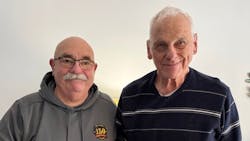
MUSKEGON COUNTY, MI — A former police officer who suffers from post-traumatic stress disorder (PTSD) is hoping to help people who may experience similar symptoms following tragedies in the community.
In 2023, Joe Stapel started Help Michigan Heroes to help pay for the cost of mental health care for first responders in Muskegon County.
But after recent tragedies, including robberies that turned into fatal shootings and violent traffic crashes resulting in death, he is opening that service to members of the community.
Stapel specifically mentioned a Dec. 10 crash on Maple Island Road, where a 51-year-old woman and a 9-year-old girl died in a collision with an oncoming semi-tanker hauling propane.
He said their family members will be affected by the incident, along with the semi-truck driver.
“All this happened right in front of him,” Stapel said. “He’s never going to forget that. And so, he may need help. Even though maybe his company would pay for it, he may not want them to know.”
He also mentioned the recovering victims of a shooting in the Jackson Hill neighborhood. The multiple shooting claimed two young adult lives and injured three others, including a 4-year-old.
“That’s all going to be in their brain,” Stapel said. “And it just doesn’t go away.”
Stapel was a full-time Norton Shores police officer for three-and-a-half years from 1974 to 1977. In that time, he saw a myriad of violent and tragic crime scenes.
Today, he’s 76 years old and still vividly remembers dozens of those events.
“It’s a life sentence,” Stapel said. “We can go out in Norton Shores and we can stop at all those places and I can tell you exactly what happened and where everybody was.”
He worked part-time for the rest of his 20-year policing career in Norton Shores, Roosevelt Park and Fruitport Township while also working full-time as the first safety specialist for Meijer.
In 2017, Stapel learned from a friend at the local Veterans Administration building that he had cumulative post-traumatic stress disorder.
“I assumed that all police officers would remember all their fatal accidents,” Stapel said.
Stapel started seeing a therapist at Services of Hope, which has now teamed up with him to offer the counseling services his nonprofit will pay for.
Through Help Michigan Heroes, Stapel offers to pay the co-pays for first responders, including police officers, firefighters, emergency medical technicians and emergency room nurses.
That now includes any community members who have been affected by trauma. He said he will even pay for the full out-of-pocket costs if they don’t have health insurance, Medicare or Medicaid.
Stapel said co-pays can run an “ungodly” $40 and $140 a visit.
First responders see crises on a “regular basis,” said Bob Grabinski, longtime firefighter in the county. He currently works for Holton Fire Department and most recently was at the Muskegon Township Fire Department.
“We see people at their emotional worst,” Grabinski said. “They’ve lost somebody, they’ve lost their house, and that does take a toll … we have a tendency to put up this brick wall.
“When I started it was: ‘Suck it up, cupcake.’ Now we’ve become more attuned to the fact that this messes with people. That they do need help. And we offer that, and we tell them, ‘Don’t bottle this in. You got to let it out, you’ve got to talk to somebody.’”
Grabinski described several of his own, and some of his coworkers’ experiences, responding to fatal calls where family members and friends are the victims.
Now, Grabinski said departments do a lot more than they used to in providing support and resources to employees.
“In fact, now in the academies, one of the first classes is we talk about the mental aspect of this and that if you have a problem you need to talk about it,” Grabinski said. “The officers in our training are being trained to watch out for signs a little better and recognize when we need to get our people help.”
Grabinski added that teams often debrief after major critical incidents.
Stapel is hoping to reach people experiencing trauma and PTSD before they look to heal their wounds with things like alcohol and drugs.
“These people just couldn’t get it out of their brain, and they chose an alternative way to deal with it,” Stapel said. “Many officers, firefighters, they choose, they try alcohol. (It) doesn’t work, and it doesn’t make it go away. It’s still there.”
Stapel was awarded a $10,000 grant from Muskegon County Men Who Care in 2023. He has also received private donations.
Donations are accepted on the Help Michigan Heroes website and checks can be mailed, specifying “first responders” or “community members” to 2363 Blodgett Street, Muskegon, MI, 49441.
Stapel is also selling aerial landscape photo prints by a late photographer friend of his, Marge Beaver, who he said asked him to sell the prints in exchange for donations.
__________________
©2025 Advance Local Media LLC.
Visit mlive.com.
Distributed by Tribune Content Agency, LLC.