Why Most Body Armor Still Doesn’t Fit Female Officers
What to Know
- Existing body armor systems are primarily designed around male body shapes, leading to safety risks and discomfort for women in defense and security roles.
- Innovations like curved armor plates and hinged trauma systems are improving fit, mobility, and protection, addressing long-standing performance gaps.
- Inclusive PPE standards, such as the UK's BS 30417, are pioneering global efforts to ensure safety, comfort, and operational effectiveness for women.
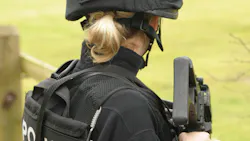
The design and provision of female‑fit body armor has become an increasingly critical issue across defense, policing, and security sectors. Extensive academic and industry research now confirms that existing armor systems — large‑ ly based on male body shapes — are failing to adequately protect women. This mismatch not only creates daily discomfort but also introduces significant safety risks and reduces operational performance for female personnel.
A 2025 PhD dissertation from Texas A&M University, “Bras, Breasts & Bulletproof Vests,” highlights numerous challenges associated with current armor used by female soldiers and police officers. Reported issues range from restricted mobility to direct physical harm. One soldier explained that her vest’s long torso design caused the armor to ride up when hitting the ground, pushing her helmet forward and obstructing her view. Similarly, a police officer described developing scars under her chin where her armor had repeatedly rubbed her skin during patrol duties. Such examples demonstrate how protective equipment intended to safeguard personnel can ironically become a source of injury.
Reduced operational effectiveness was another major theme in the research. During activities such as running, women frequently had to hold their vests in place — slowing them down — or tighten them excessively, which restricted their breathing. These improvised adjustments limit their ability to use both hands, affect reaction times, and ultimately compromise effectiveness in high‑pressure environments.
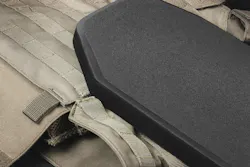
Erin Grieve, Sales Manager at NP Aerospace (NPA), explains the science behind the problem: “Current industry‑standard body armors (SAPI/ESAPI plates) are designed around male body morphology. When worn by women, these plates are uncomfortable, restrict mobility, and provide less ballistic coverage.”
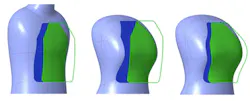
NPA conducted significant research looking at female anthropometric data and morphological differences between men and women. As shown in Figure 1 by the dark blue area of exposure, at angles of azimuth, women are 7% less covered by their body armor due to the distance between the torso and the hard armor plate, caused by the breast volume.
The consequences extend beyond immediate discomfort or protection gaps. SecurityWomen, a global INGO advocating for women in defense, policing, peacekeeping and security sectors, argues that poorly fitting PPE is both a safety issue and a barrier to professional equality. Director Juliet Colman suggests: “Security and defence employers need to wake up and drive change to enable all female personnel to be provided with proper protective clothing. Ill-fitting protective clothing and equipment impairs performance, and a happy motivated workforce leads to improved performance.”
The issue also intersects with recruitment challenges. The Australian Defence Force highlighted in 2025 that without increasing female participation, the country will struggle to meet its future staffing needs. Ensuring that women have access to protective equipment tailored to their physiology is therefore not only a matter of safety, but a national security imperative. When equipment limits performance or creates health risks, it discourages women from joining — and remaining in — the profession.
European inclusive PPE standards and developments
A major step toward addressing this has been the development of inclusive PPE standards. In September 2025, the UK launched BS 30417, the world’s first inclusive PPE standard. It has since been downloaded more than 1,700 times across 65 countries, reflecting global interest in rethinking how protective equipment is designed and deployed.
As the Founder of Workwear Solutions International, I have been a a leading advocate for inclusive PPE, chairing the committee responsible for the standard. I have emphasized that the perceived difficulty or cost of developing inclusive PPE has long been overstated. In many cases, simple design changes can have significant impact — but these improvements require a shift in mindset and organizational culture.
Over recent years, the industry conversation has evolved from focusing purely on protection levels to considering comfort, long-term wearability, and the performance implications of improper fit. Several innovative solutions are already demonstrating how inclusive design can transform operational performance.
One such innovation is the Female Body Armour System developed collaboratively by NP Aerospace and Logistik Unicorp.
Most female-specific ballistic protection products have previously been designed in isolation, with soft armour, hard plates, and textile carriers developed separately. Carriers are often simply scaled-down versions of male designs.
The system incorporates curved front hard armor to improve fit and ballistic coverage, and in its entirety, is optimised for women. This system is the 2026 Body Armor News Innovation Award winner, based on the leap forward in addressing fit and performance gaps for female soldiers.
Some of the key features of the system include:
- Curved plate geometry matching female anatomy, reducing coverage gaps, and improving ballistic protection.
- Three curvature profiles and three size cuts, providing nine configurations to fit over 95% of servicewomen. Larger breast volume does not equate to a taller or wider torso, hence the need to separate curvature from cut.
- Protection against a full range of battlefield threats, including both non-armor-piercing and armor-piercing rounds.
- Enhanced comfort and mobility, reducing cognitive and physical burden, improving overall survivability (“jump higher, run faster, less likely to be shot”).
The system can be taken further when the body armor is viewed within the context of the total uniform system, bearing in mind the additional equipment loads and environmental impactors such as being in and out of vehicles, operational mobility and taskings.
Another promising development is Hunter Apparel’s FLEXGUARD Blunt Trauma System.
Unlike conventional blunt trauma armour systems that restrict motion, FLEXGUARD has been carefully engineered in partnership with professional physiotherapists and public order experts. This collaboration has produced a system that mirrors the natural movements of the human body while delivering uncompromised protection.
FLEXGUARD features the world’s first fully hinged systems at the elbows and knees, enabling fluid, full-range motion during critical operational tasks. The gear works with the officer’s movements rather than against them, significantly reducing fatigue and supporting tactical performance in the most challenging environments.
This has seen the product win a top British award for product innovation from the British Safety Industry Federation (BSIF) as well as winning the NAUMD product innovation award in 2025.
The system incorporates an extended range of sizes and fit options to accommodate female body types and other diverse physical profiles. This ensures that every wearer is afforded the same level of comfort, protection, and performance, regardless of their build.
“The reaction from officers globally in testing has been so satisfying for the staff at Hunter as we start to commercialize this product in 2026. A notable positive is the reaction from female officers who are so relieved to get something to protect them that actually fits.” Simon Hunter Esq, MBE, CEO Hunter Apparel Solutions Limited.
FLEXGUARD will be exhibited at NAUMD’s 2026 conference in Boston.
Conclusion
As the industry progresses, it becomes clear that comfort — and the elimination of discomfort — is fundamental to effective PPE. Research consistently shows that poorly fitting equipment distracts wearers, reduces concentration, and contributes to long-term health problems. When procurement decisions fail to account for these factors, organizations incur hidden costs — ranging from injury and reduced job satisfaction to decreased performance and retention issues. Considering total lifecycle costs, including the health and operational implications of ill-fitting armor, may encourage more suppliers to invest in research and innovation.
Finally, despite advancements in product design, regulation continues to lag behind. Current standards do not adequately address female-specific considerations such as side-profile projectile testing, ricochet risks, or the unique interactions between breast volume and armor plate geometry. Addressing these gaps is essential for ensuring that women receive the same level of protection as their male counterparts.
About the Author
Natalie Wilson
Founder & Managing Director of Workwear Solutions International (WSI)
Natalie Wilson is the Founder and Managing Director of of Workwear Solutions International (WSI), a multi-award-winning company dedicated to enabling the uniform industry through innovative technical, design, and sourcing services. Natalie is the European representative on the NAUMD Board of Directors.
Natalie has become a leading voice in the development of inclusive PPE and workwear standards. Her leadership has driven advancements in making PPE accessible and effective for diverse users across industries. Drawing on extensive international expertise, Natalie shares valuable lessons from the UK and European markets on implementing inclusive practices in design and procurement. Her commitment to inclusivity and excellence continues to shape the future of workwear and PPE globally.