How to Catch a Criminal: Tipster’s Call Unravels Nev. Casino Bomb Plot
What to Know
- The bomb was a complex device with multiple triggers, timers, and safety features, designed to detonate under specific conditions, making it a formidable challenge for investigators.
- Criminals wheeled the bomb into the casino posing as delivery men, highlighting the importance of surveillance and profiling in criminal investigations.
- The FBI’s strategic use of a small explosive to disable the bomb exemplifies precision law enforcement tactics in crisis situations.
Every officer with a decent amount of time on the job knows the unexpected turns an investigation can take. Seeing a major case through to completion often involves giving up on a theory and taking your investigation in a different direction as new information becomes available. In How to Catch A Criminal, we look at the many ways not-so-perfect crimes are solved. This month, a highly elaborate scheme to score big ends with a bang, and life in prison.
It’s no secret the house always wins. Everyone knows for every coin you drop into a slot machine or chip you place on the table; there is no guaranteed return. In fact, there is only a slim chance you will do anything other than lose. The allure of putting your money on the line, of course, comes from the rare win. This might mean barely breaking even, or on the rarest occasion, a life-changing jackpot. It only takes one win to make the difference, making “one more bet” a very attractive prospect. Sometimes it is a little too attractive. The bigger the hole you dig losing money, the bigger the win you’ll need to pull yourself back out. For many gamblers, this creates a textbook example of what is known as the “sunk cost-fallacy.” This cognitive phenomenon is defined as a person’s reluctance to abandon a pursuit because of the vast amount of time, money, passion, etc. they have invested in it, even though continuing the pursuit is clearly detrimental. One Lake Tahoe High Roller in 1980 was so dead set on recovering his losses, he upped the ante from chips and cards, to dynamite and helicopters.
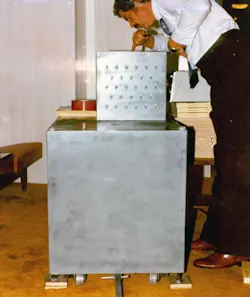
On August 26, 1980, just before sunrise at Harvey’s Resort Hotel and Casino in Stateline, Nevada, near Lake Tahoe, the nightshift supervisor noticed something odd. The door to the casino’s second-floor telephone exchange room was open. It had been closed when he passed by just a few minutes before. When he checked inside to see if anyone was around, he saw no one but found a major problem. Inside the phone room, there was now a 4-foot-long, 2-foottall, 2-foot-deep, metal box propped up on a wooden pallet in the middle of the floor. On top of the large box sat a smaller 2 feet long, 1 foot tall, 1-foot-deep box. The steel boxes were welded together, and the upper box had 28 toggle switches, each numbered, sticking out of one side. Casino security was called to inspect the contraption and determine how it got there. Already fearing the worst, security staff contacted the Douglas County Sheriff’s Office. The security supervisor and first responding Deputy noticed an envelope on the floor, tucked next to the box. A quick glance at the three-page letter inside confirmed the worst-case scenario: this huge, 2,600-pound, complex device, was a bomb, purportedly filled with a half ton of dynamite.
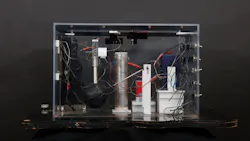
The FBI was contacted almost immediately to take over the scene as casino staff and the sherrif’s office worked to rapidly evacuate not only Harvey’s but the surrounding buildings, ferrying the droves of vacationers in town for Labor Day weekend to the local high school, out of the potential blast zone. FBI Bomb experts began examining the device, while also taking heed of the list of warnings and demands in the ransom letter. The letter explained the bomb was equipped with a toilet float which would trigger a detonator if the bomb was submerged or flooded. It also had an atmospheric pressure switch, which would detonate if chemicals were used to interfere with the electronics. Dismantling the bomb would result in detonation, because turning any of the screws holding it together would trigger the blast. Moving the bomb was also out of the question because it was equipped with a pendulum that would detonate the bomb if it was tilted or moved even slightly. There were also three different timers in play, meaning there was no time to waste. X-rays of the steel boxes showed various wiring and mechanisms, as well as the 1,000 pounds of explosive material in the larger box. The bomb was no hoax, and it was going to have to stay put and intact while FBI agents formulated a plan.
The ransom letter offered an exchange: $3 million in unmarked $100 bills, in return for instructions on which of the toggle switches to use to deactivate the motion detector pendulum, so the bomb could be moved to a safe place for controlled detonation. The letter also explained that no one, not even the bomb maker, could disarm it. It was going to have to explode, be it inside Harvey’s Casino or in the middle of the Nevada desert, as long as the extortionist comes through with the instructions. The letter outlined procedures for delivering the money. The Casino’s owner and namesake, Harvey Gross, was to have his private pilot fly his personal helicopter to a predetermined location by midnight. Once over that location, a strobe light would flash from the ground to signal where to land and drop the money. Both Harvey Gross and the FBI agreed that the extortionist would get nothing, but this was a perfect opportunity for a sting. The pilot flew the helicopter, several bags of shredded paper, padded with a small amount of cash to look legitimate, and an FBI agent to the location of the drop. A SWAT team was staged nearby ready to swarm as soon as the payoff was made, but the sting fell through. Not because the pilot failed to follow instructions, but because the strobe light was never activated.
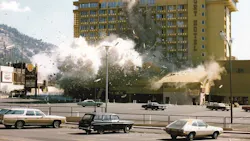
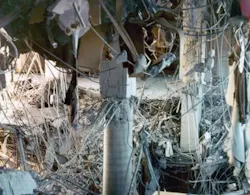
Without the opportunity to catch the bomber, there was no doubt the bomb was going to have be detonated. The best idea was to use a small explosive charge in just the right spot, to sever the electronics in the upper box from the explosives in the bottom in 0.0005 seconds, which would be fast enough to prevent an electrical signal from the various triggers from reaching the detonator. Plan A was one small, precise explosion to prevent a big one. If that didn’t do the trick, Plan B was a big explosion causing tremendous damage but effectively removing the only leverage the extortionist had. On the afternoon of August 27, Plan B worked like a charm, knocking out five floors of Harvey’s Resort Hotel and Casino. Undeterred, Harvey Gross had his staff work quickly to clean up and reopen an undamaged lounge area of the casino within two days, because Harvey’s just became the most talked about casino around. Everybody wanted to come gamble there. Afterall, the place was literally dynamite. The blast area was cordoned off with temporary walls as FBI agents worked to sift through the damage and debris for any leftover components of the bomb that might lead them to a culprit. Harvey Gross smelled opportunity again and received permission to place a window in one of the temporary walls, allowing his curious guests to peek at the destruction and watch the investigation unfold in real time.
Meanwhile, the investigation uncovered that the bomb had been wheeled in by two men posing as photocopier delivery men. They were seen unloading the bomb from a white van, covered in a sheet, and walking it into the building. Their coveralls were enough to make them appear legitimate, as they were able to load the bomb onto an elevator, with the help of a security guard who saw the men struggling with the weight of it. Once on the second floor they placed it in the telephone room with the ransom letter and left. Naturally, a nondescript white van led to hundreds of potential suspects, all of whom turned out to be good, law-abiding van owners. Harvey Gross and a few other local casino owners put together a $200,000 reward for information leading to the bomber’s arrest. As months passed, the reward continued to grow without any substantiated information coming in, until June 1981 when it reached $500,000, and one tipster decided to cash in.
A young man called the FBI and provided them with quite possibly, the most profitable bit ever pillow talk ever uttered. The caller stated he was watching news coverage of the bombing with his girlfriend one night when she mentioned she spilled some inside information about the case. Prior to breaking up, her ex-boyfriend, Jimmy Birges, and his brother Johhny, helped their father, John steal dynamite from a massive hydroelectric reservoir construction project near Fresno California. The purpose of the dynamite heist was to build a bomb and extort millions from Harvey’s Casino. Harvey’s was the target of choice because John Birges, a millionaire landscaper and restaurateur, as well as skilled craftsman, had developed a horrendous gambling problem. He was a High Roller at Harvey’s and was even on a first-name basis with Mr. Gross himself. Birges would drop thousands of dollars per hand at blackjack, and spent several weeks every month at the casino, neglecting his family in the process. After years of this degenerate behavior, Birges had blown hundreds of thousands of dollars gambling and was bouncing checks and racking up serious debt. Perpetually one big win away from turning his luck around, Birges devised another way break even. In his spare time, away from the card table, he casually constructed the most complex improvised explosive device the FBI has ever seen, to this day.
Thanks to the Lake Tahoe casinos’ reward money, the FBI hit the jackpot. In no time they tracked down Johnny Birges, his white van, and his brother Jimmy. Their alibis proved to be flimsy, and the writing was on the wall. In exchange for no jail time, the brothers agreed to testify against their father, who hadn’t been much of a father figure to them over the years, thanks to his gambling habit. They would eventually detail in court the dynamite heist, the construction of the bomb in their father’s workshop, the two landscaping employees he paid to deliver the bomb to Harvey’s, and comical failure to pick up the ransom money. As the ransom letter instructed, the helicopter delivering the money was supposed to land when signaled by a strobe light on the ground. The Birges’ were there, awaiting the delivery, but when the helicopter came near, John realized he forgot to bring the battery to power the light. The helicopter left, as did the Birges, and the whole plot was a bust. Another of John Birges’ failures came in the form of his legal defense, because he represented himself. John took credit for the bomb but claimed he only hatched the scheme because mobsters forced him to extort money from Harvey’s or he would be whacked. Zero out of twelve jurors bought his story, and John Birges couldn’t beat those odds. In 1985, John Birges received a life sentence. Exactly 16 years to the day the bomb went off at Harvey’s Resort Hotel and Casino, John Birges passed away due to complications from cancer at 74 years old. Models of the Harvey’s Casino Bomb are still used to train FBI explosives technicians.
About the Author
 Officer Brendan Rodela, Contributing Editor
Officer Brendan Rodela, Contributing Editor
Brendan Rodela is a Sergeant for the Lincoln County (NM) Sheriff's Office. He holds a degree in Criminal Justice and is a certified instructor with specialized training in Domestic Violence and Interactions with Persons with Mental Impairments.