9/11 Officer Dies of Cancer
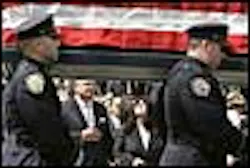

Kevin Hawkins had the townhouse in Rossville, a lovely wife and three children.
The NYPD detective with 20 years on the job had been part of Mayor Michael Bloomberg's security detail.
Starting on Sept. 11, 2001, he worked for two months at Ground Zero.
And now he's dead.
"He didn't smoke, he worked out every day, he was in perfect shape," said Vic Cipullo, vice president of the Detectives Endowment Association. "He's 41-years-old and he came down with a cancer."
Cipullo, who is convinced Hawkins died from exposure to toxic dust and debris during his time on "the pile," added, "More and more of our young cops are coming down with these illnesses."
Physicians and researchers are hesitant to draw a link between cancer and 9/11. One city official said it's too soon for cancer to be developing as a result of the potential carcinogens released by the collapse of the Twin Towers.
Researchers say there is potential for a link between cancer and the attacks, but that not enough data has been collected yet.
DEATHS REPORTED
But numerous first responders are dying from cancer - people who claim to have been completely healthy before working at Ground Zero, or with the World Trade Center recovery operations at the former Fresh Kills dump.
In January, Frederick J. Stuck III, 49, of Port Richmond, died from esophageal cancer that his family believes developed as a result of his exposure to 9/11 toxins. As a retired deputy sheriff, he responded immediately to the attacks, searching for responders at the World Trade Center PATH station. After six weeks working long hours in the rubble, he developed asthma and a pain in his chest. Eventually, doctors discovered the cancer that killed him.
"Only time will tell when we deal with these illnesses," Cipullo said. "It's not going to end. ... There will be other cancers."
As pressure increases on federal and local governments to pay for health treatment for first responders and others exposed to the post-9/11 toxic dust and debris, illnesses are emerging in increasing numbers - including numerous cancers, say police officers and firefighters.
A DIRECT LINK
Some illnesses, primarily those having to do with the lungs and throat, have been directly connected by researchers to the debris released after the attacks.
A study recently published on the Web site of the CHEST Physician journal provided what some said was the first concrete link between exposure to 9/11's toxic dust and debris and sarcoidosis - a chronic, potentially fatal disease that causes lumps of cells to grow and clump together, causing scarring and impairing the ability of a particular organ, such as a lung.
But research has, so far, been inconclusive in respect of cancer cases related to the Sept. 11 attacks.
"Catastrophic events ... can certainly increase the cancer rates," said Dr. Thomas Forlenza, chief medical officer of the Staten Island Region of the American Cancer Society, referring to events such as Hiroshima and the Sept. 11 attacks.
"On the other hand, you don't want to start pandemonium just because a young person develops kidney cancer, which can develop at any age," he said.
DOCTORS ARE CAUTIOUS
Dropping the atom bomb on Hiroshima released radiation, which is known to cause cancer. The correlation between the dust released by the Twin Towers' collapse and cancer cases isn't so direct, doctors say.
"I don't think anyone knows what was in the air after 9/11," said Dr. Frank Forte, Staten Island University Hospital's director of oncology, hematology and palliative medicine.
According to city Health Department guidelines for treating 9/11-related illnesses released in August, the dust cloud "contained heavy metals, as well as asbestos and other substances that may be carcinogenic."
Recently, Detective Hawkins applied for disability due to a line-of-duty injury. His family declined to be interviewed for this story.
Cipullo said now it's important for people to focus on getting the money to provide medical care and screenings to detect cancers and other illnesses early.
"Early detection is our only defense against getting sick," he said. "Kind of, catch it before it gets too bad."