2025 End-of-Year Preliminary Law Enforcement Officers Fatalities Report: A Closer Look
What to Know
- The total number of law enforcement officer deaths in 2025 was 111, the lowest in over 80 years, representing a 25% decrease from 2024.
- Firearm-related fatalities decreased by 15%, with 44 officers killed by gunfire in 2025, remaining the leading cause of death.
- Traffic-related deaths declined by 23%, with 34 officers killed in 2025, including a 24% reduction in struck-by incidents.

The number of law enforcement professionals nationwide who died in 2025 marked the lowest total for line-of-duty deaths in more than 80 years, according to preliminary data. The 2025 End-of-Year Preliminary Law Enforcement Officers Fatalities Report released by the National Law Enforcement Officers Memorial Fund in January shows there was a 25% decrease in overall officer deaths compared to the previous year.
The NLEOMF data shows that 111 federal, state, county, municipal, and U.S. territories officers died in the line of duty in 2025, compared to the 148 officers who died in 2024. The 111 line-of-duty deaths in 2025 represent a near-historic low. The last time annual officer fatalities were at a comparable level was in 1943, when 94 officers were killed in the line of duty. The leading cause of lineof-duty deaths continued to be gunfire, while the largest increase over 2023 was from traffic-related incidents.
OFFICER Magazine recently spoke to Bill Alexander, CEO of the National Law Enforcement Officers Memorial Fund, about what law enforcement agencies can take away from the report and what progress has been made in driving down line-of-duty deaths.
Key takeaways
Alexander stressed that while the mission of the NLEOMF remains to honor officers who have paid the ultimate sacrifice, the organization also collects data and distributes it to both the public and to law enforcement agencies in an effort to raise awareness.
“Over many years now, we have collected and continue to collect really important data that I hope gives us a window into the how, when, where and why too many men and women in uniform each year are facing these tragic and fatal outcomes.,” he says. “Every single year, we put together a package of that data and release it to the public and our law enforcement peers to equally give them a window. We push that data out in part to give the information to the law enforcement community and in part to remind the nation of the really terrible sacrifice of too many men and women who work to protect their communities and preserve and protect our democracy.”
The 25% decrease in LODDs in 2025 over 2024 can be seen as a step in the right direction, but when it comes to officer fatalities, Alexander says that it is tough to frame any death total as good news. “While I never want to use the words good news when I’m talking about even a single police officer having died in the line of duty, this report is encouraging by virtue of the fact that it’s a pretty significant drop from the prior calendar year.”
He also pointed out that the overall total is lower when looking at LODDs tied directly to events that occurred in 2025. “There’s another sort of caveat here, which is, we’re reporting 111 deaths in calendar year 2025, but 14 of those are related to men and women who’ve responded to the Twin Towers collapse in New York City following the terror attacks of September 11,” he says. “I’m not in any way minimizing those deaths, but if you take out those 14 related to September 11, we’re at 97. For decades we’ve been talking about pushing toward this goal of Below 100, and trying to get to below 100 law enforcement deaths in any calendar year. Even though our number is 111 we are sitting here gazing at the horizon and recognizing that this goal that we have been working towards for many, many years is achievable and to some degree was achieved in 2025.”
Firearms-related fatalities
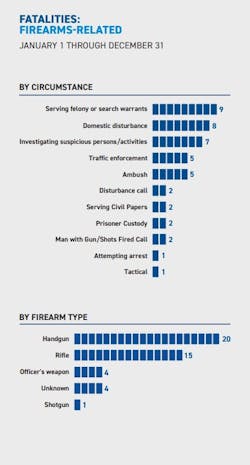
Firearms-related fatalities have claimed the lives of 44 officers in 2025, which represents a decrease of 15% from the 52 officers killed by gunfire in 2024 and was the leading cause of death.
8 were killed responding to a domestic disturbance; 7 were investigating suspicious persons/activities; 9 were serving felony or search warrants; 5 were killed during traffic enforcement; 5 were the result of an ambush attack; 2 were responding to a disturbance call; 2 were serving civil papers; 2 occurred while a prisoner was in custody; 2 involved a man with a gun/shots fired call; 1 occurred during an arrest attempt, and 1 occurred during a tactical situation.
Traffic-related fatalities
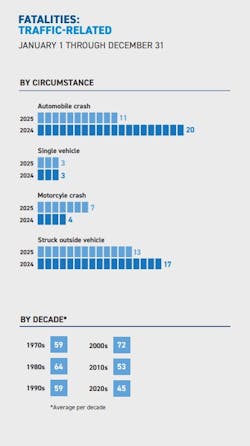
Traffic-related fatalities decreased by 23% with 34 deaths in 2025, compared to 44 deaths in 2024. The 21 fatal crashes in 2025 (automobile/ motorcycle) represents a decrease of 22% compared to the 27 fatal crashes in 2024. “Struck-by” fatalities, defined as an officer struck outside of their patrol vehicle, decreased by 24% from 17 in 2024 to 13 in 2025.
Other causes and fatalities
The ‘other’ cause category has decreased 37% from 52 in 2024 to 33 in 2025. This ‘other’ category includes long-term illnesses related to the September 11th terror attacks, acute medical events brought on by extreme and/or stressful events experienced on-duty, and a variety of rare yet significant fatal incidents.
Fatalities by state
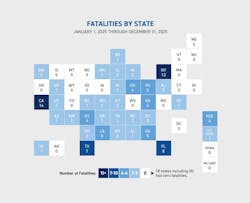
California experienced the largest number of law enforcement fatalities of all U.S. states in 2025, with 14 line of duty deaths. New York had the second highest number with 13 and Florida had the third highest with 8. There were 102 male officers killed in the line of duty, and 9 female officers. The average age of the fallen officers is 44, with an average of 14 years of service. On average, officers left behind two children.
Additional demographics
There were 102 male officers killed in the line of duty, and 9 female officers. The average age of the fallen officers is 44, with an average of 14 years of service. On average, officers left behind two children.
The statistics released in the annual report are based on preliminary data compiled by the National Law Enforcement Officers Memorial Fund and may not represent a final or complete list of individual officers who will be added to the National Law Enforcement Officers Memorial in 2026.
About the Author
 Paul Peluso
Paul Peluso
Editor
Paul Peluso is the Managing Editor of OFFICER Magazine and has been with the Officer Media Group since 2006. He began as an Associate Editor, writing and editing content for Officer.com. Previously, Paul worked as a reporter for several newspapers in the suburbs of Baltimore, MD.