Texas Police Group Defends Flock Cameras Amid Privacy Concerns
What to Know
- A Texas law enforcement association official defended Flock Safety cameras and other automated license plate reader (ALPR) systems, arguing they help solve crimes, locate suspects and improve public safety while operating under accountability measures.
- The official cited multiple cases in which Flock cameras allegedly aided investigations, including identifying suspects in a 2025 Austin shooting and tracking violent offenders, while arguing the technology could have helped prevent a 2012 murder-for-hire case.
- Critics continue to raise concerns about privacy, surveillance, AI use and potential misuse of ALPR data, but proponents point to audit trails, data-retention limits and past prosecutions of officers who improperly accessed the systems as evidence of oversight.
More on OFFICER.com
LAPD Seeks New Flock Safety Deal After Data-Sharing Concerns
- The LAPD is negotiating a new contract with Flock Safety that would give the city ownership of license plate reader data and prohibit the company from sharing it with outside entities.
As the controversy surrounding Flock Safety cameras and other automated license plate-reader technology continues to rise nationwide, the Texas Municipal Police Association reached out to the Reporter-Telegram to provide a law enforcement perspective. The Reporter-Telegram spoke with TMPA legislative liaison John Wilkerson about the issue.
"I represent over 35,000 members of law enforcement across the state, who rely on (ALPR) technology every day to help solve crimes and, of course, keep their community safe," Wilkerson said about his role, confirming he has never worked with the Flock system directly.
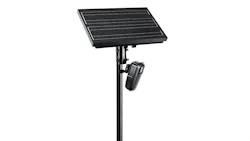
As previously reported, Flock Safety, which was founded in 2017 and is based in Atlanta, manufactures and operates cameras with license plate recognition functionality, allowing law enforcement agencies to better track down criminal suspects. Midland originally purchased the contract for the cameras during the 2022-23 fiscal year, and the City Council voted unanimously in February to renew its contract to keep the Flock cameras in Midland for an additional 24 months.
After MPD provided examples of the Flock cameras' successes during the contract renewal phase, Wilkerson highlighted some examples where their absence was apparent.
The first involved a May shooting in Austin that injured four people. Austin had not renewed its Flock camera contract when the shooting occurred, but afterward, Flock cameras caught the three suspects fleeing through Manor, Texas.
"In essence, (Austin) was without the Flock camera system," Wilkerson said. "As soon as (the suspects) got into Manor, law enforcement was alerted that these are the suspects that have been driving around and shooting up locations around Austin."
Following this, Austin said it would look into bringing Flock cameras back under new privacy guidelines.
Another involved a Harris County constable who was fatally shot in September 2024, only for the suspect to flee into Galveston County, which did not have a large Flock system. Authorities eventually apprehended the suspect.
Perhaps the most striking example came from a murder-for-hire case that happened in March 2012, when Wilkerson worked in the homicide department of the San Saba County Sheriff's Office.
"We had a missing person, (and) I had a suspect, vehicle description (and) license plate number," Wilkerson recalled. "I had attempted to get a tracker on the suspect's phone based on the information that I knew. However, the phone carrier felt that that did not rise to the level of an emergency. That permitted the suspect, who kidnapped an elderly woman, to drive over four hours to East Texas, where he subsequently killed the woman. Had we had Flock camera systems strategically placed around the state like we currently have now, I am 100% confident that we could have saved that woman's life."
Bonnie Harkey and her caretaker, Karen Johnson, had been killed by Harkey's adoptive grandson, Carl Wade Pressley, and his wife, Lillian King. Authorities said Harkey likely was alive when Pressley and King left her in a shallow grave, about 200 miles away from her home.
Flock cameras have been controversial nationwide because of accusations of mass surveillance and identity compilation, with some critics comparing it to "Big Brother" from George Orwell's novel "1984" and likening Flock Safety to a privatized police state. In recent days, opposition to Flock cameras has intensified nationwide. On social media, guides on how to disable, tamper with or destroy Flock cameras have been circulating. Some people have already taken action and cut down the cameras, particularly in Houston over roughly the last two weeks. TMPA has not released a statement on the vandalism.
"I think what (the Houston vandalization) indicates is the ignorance of the individuals that are rising to the level of violence for their political statement," Wilkerson said. "Those Flock cameras that are being destroyed around the Houston area, those don't belong to the Houston Police Department (or) the city of Houston. Those belong to the taxpayers of the city, and they're put in place to help protect their property. That's the equivalent of a criminal walking into a gas station to steal something and they smash the camera in hopes that it doesn't catch them doing something wrong; the difference is, these are put out into public places where everybody has the right to record them anyways; if you're standing on the sidewalk, you can pull out your phone and record every car that drives by there. I really hope the individuals out there, destroying the camera systems, never become a victim of a crime themselves."
In addition to guides on how to destroy the cameras circulating online, a website called DeFlock.org has been circulating, apparently showing the locations of 115,604 ALPR cameras in the country on a satellite map, 95,571 of which it identifies as owned by Flock. While MPD stated in the city's contract renewal proceedings that there are 71 Flock cameras across the city and county along with two portable ones, DeFlock suggests that this number may actually be well over 100. It should be noted, however, that DeFlock is a crowdsourced website and thus some of its details may be inaccurate; for example, two Home Depot Flock cameras are labeled as having an "Unknown" manufacturer.
Another concern for citizens is the cameras' use of artificial intelligence to perform their LPR functions and their relationships with other AI companies. In spring 2025, Flock Safety received an investment from Founders Fund, a firm run by venture capitalist Peter Thiel. While Thiel does not serve on Flock's board and thus has no direct sway in the company, speculation has risen that this investment was done with the intention of having Flock contribute its findings to Palantir, another camera surveillance company that works with facial recognition rather than license plates, that Thiel co-founded in 2003, in order to collaborate on anti-immigration efforts. Those concerns have been compounded by reports that Flock cameras have been used to support Immigration and Customs Enforcement and that Palantir has millions of dollars in contracts with ICE.
Following reports of another set of shootings involving ICE, there have been growing calls for ICE to be barred from traffic stop scanning and searches. To highlight his opinion on this in relation to Flock, Wilkerson cited Texas' former red-light camera system, which was banned by Texas in 2019 and phased out by 2021.
"I really despised the red light camera systems that we had," Wilkerson said. "And the reason I despise them is as simple as it removes that human element of the police officer from that interaction. I've made plenty of stops (over 23 years) for somebody running a red light or not coming to a complete stop, and there have been legitimate causes for somebody (to run a red light, such as) having a medical emergency or they're fleeing a violent encounter from an abusive partner. When Texas removed the abilities for cities and counties to install red light cameras, I think that's a testament to what Texas is willing to do to protect the constitutional rights of the American public."
By contrast, Wilkerson believes the use of AI in Flock cameras works because it retains a human element.
"To say that the use of AI in these programs is bad, I think is a mischaracterization of it, because that's what helps keep the integrity of the program in place," he said.
As part of the Flock renewal deal with the city of Midland, two policies to counter police overreach and abuse were reinforced: a 30-day retention policy for photographs and an audit system to track police activity when they are in Flock's system. Although he could not verify if these policies are standard across other Flock systems used in Texas, Wilkerson argues that these policies, coupled with examples of officers being caught, showcase accountability on their part and that the systems work.
"The proof is in the pudding," he said. "(Bad officers) were caught because there are good policies in place, and that appears to be occurring nationwide because you're seeing little pop-up stories all across the nation on departments throughout various states where you run into this issue (being caught). Can we stop someone from using anything at all? Clearly no, and if we could do that — if we could control human behavior and all humans, then you would not need law enforcement, you would not need the court system, you wouldn't need any of that. Anytime you inject humans into anything, you run that risk of something being misused (and) violated. What's the answer to that? You make sure that there's accountability in place and that there is empirical evidence that there is absolutely accountability in place. You're not going to show us another profession that is better at policing and prosecuting their own than what you find in law enforcement."
Perhaps the most notable Texas case involving misuse of ALPR cameras came in 2022, when an officer used more than 80,000 cameras — the vast majority of the ones in the U.S. according to DeFlock — in order to hunt down a woman who had had an abortion in order to perform vigilantism on her in the wake of Roe v. Wade's overturning. Wilkerson, who confirmed he was familiar with the case when asked by the Reporter-Telegram, noted how the officer was arrested and subsequently convicted, which he attributed to the audit systems in place and their ability to gather evidence against officers.
"TMPA has said this in various locations — nobody hates a dirty cop more than a good cop," Wilkerson said. "That's why you see (it was) one of the quickest cases that you'll see, us doing everything we can to get the evidence, (then) get that person arrested, prosecuted and as far away from being associated with those of us that are good."
In terms of continued improvement, Wilkerson cited improving anti-hack tools for the cameras, though he admitted that they, like most software and hardware, might never be fully hack-proof. He also asked people to not vilify Flock Safety in particular, given that ALPR technology existed well before its founding.
_______
© 2026 the Midland Reporter-Telegram (Midland, Texas).
Visit www.mywesttexas.com.
Distributed by Tribune Content Agency, LLC.