Driving Down On-Duty, Traffic-Related Police Officer Deaths
What to Know
- The National Law Enforcement Officers Memorial Fund reported a nearly 50% decrease in traffic-related line of duty deaths this year, the lowest since 1943.
- The forum emphasized data analysis, best practices, and innovative programs as essential tools in ongoing efforts to improve officer safety.
- The Below 100 program focuses on three key safety principles: Speed, Seat Belts, and Struck by Vehicles, aiming to reduce preventable officer fatalities.
More on OFFICER.com
Download the September/October issue of OFFICER Magazine.
Click Here to subscribe to OFFICER Magazine.
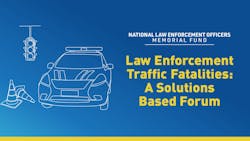
This summer, the National Law Enforcement Officers Memorial Fund, in partnership with the National Highway Traffic Safety Administration, held a forum at the National Law Enforcement Museum entitled “Law Enforcement Traffic Fatalities: A SolutionsBased Forum.” The program covered case studies, best practices and other topics focused on traffic safety.
Bill Alexander, CEO of the NLEOMF, told those in attendance the group’s Officer Safety and Wellness team works tirelessly, poring over data in order to shine a light on solutions for the nation’s law enforcement.
“Using that data and then using the expertise of experts across the field to come up with new innovative programs, best practices, and trying to make it safer for the men and women who are still out on the streets doing the job is the continuation of our mission,” he says.
Troy Anderson, Executive Director of Officer Safety and Wellness at the NLEOMF says events like the traffic forum really make the job worth it. “I take great pleasure in bringing forums like this together because we know that the work that we’re doing is really changing lives,” he says. He added that so, far this year there have been positives when it comes to LODD data collected by the NLEOMF. There was nearly a 50% reduction in trafic-related LODDs compared to the prior year, and there were no single-vehicle crash fatalities recorded. “I cannot remember a time where we made it halfway through the year and that has happened,” he says. “We are on pace to have the lowest line of duty death numbers since 1943.”
Although the numbers appear to be trending downward, Anderson stressed that it isn’t the time to stop working to prevent line of duty deaths. “We know that complacency kills. It’s not the time to take our foot off the collective accelerator,” he says. “It’s the time for us to double down in realizing that our work is actually working.”
Just a few months before the forum, the NLEOMF announced a partnership with the Below 100 program. The group has been active for more than 15 years, providing training and awareness to help prevent LODDs.
Dale Stockton, Founder and Architect of Below 100, told those at the forum that the mission of the group is to drive down line of duty deaths to fewer than 100. “People may say, ‘Well, wait a minute. Are you saying that 99 officers losing their lives is acceptable?’ And no, we’ve never said that. But you have to have something that’s realistic and achievable. In law enforcement, we’re the ultimate skeptics, right? People lie to you all the time. And when someone puts out a goal that is on its face something that just is impossible, they’re going to reject it.”
The program was created following a meeting of law enforcement trainers who sought a new way to address officer deaths. “We recognized there’s a lot of culpability on our side,” he says. “Officers were not using safety equipment; they were taking chances they didn’t have to.
“What Below 100 helps them realize is they’re putting the crosshair of risk on their family. And when they realize that, oftentimes it changes behavior in a very deep-seated way,” he says. “At Below 100 we like to keep things simple and straightforward. It comes down to the three S’s. Speed, Seat Belts and Struck by vehicles.”
In 2012, the California Highway Patrol adopted the Below 100 program to reduce preventable LODDs. “They developed a leadership component and a supervisory component based on Below 100,” says Stockton. “If you look at the last four years up until very recently when they lost an officer to what is presumed to be a duty-related heart attack, they had the longest period of time they’ve gone in the history of the CHP without a loss. Are we claiming credit for it? No. But it is a part of the solution.”
Watch the forum in its entirety at officer.com/55319012
About the Author
 Paul Peluso
Paul Peluso
Editor
Paul Peluso is the Managing Editor of OFFICER Magazine and has been with the Officer Media Group since 2006. He began as an Associate Editor, writing and editing content for Officer.com. Previously, Paul worked as a reporter for several newspapers in the suburbs of Baltimore, MD.