Ala. Bill Could Limit How Close Protesters Can Get to Police
More on OFFICER.com
Proposed Kan. Buffer Zone for Law Enforcement Faces Media Opposition
- A Kansas bill would allow local law enforcement, as well as federal agents, to enforce 25‑foot buffer zones during calls. But critics say it threatens the public’s right to document police activity in public spaces.
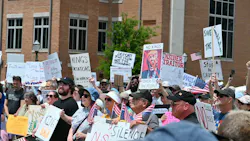
Alabama lawmakers are considering a bill that could put a big warning label on future “No Kings” protests like the ones occurring this weekend: Don’t get too close to the cops.
If the bill becomes law, it could sharply limit the public’s ability to record police activity at close range, a practice that has become central to modern accountability efforts.
Under SB293, anyone who approaches a first responder within 25 feet and is judged to “impede or interfere” with their duties could be arrested and charged with a Class A misdemeanor, a crime that carries a penalty of up to one year in jail.
While law enforcement officials including Alabama Attorney General Steve Marshall insist the bill is necessary to protect officers and the public during tense encounters, the ACLU and other critics say the measure is unconstitutional.
“Beyond the obvious First Amendment issues raised by this legislation, exactly what constitutes ‘impeding’ the efforts of law enforcement/first responders?” said Susan Hamill, a professor emerita of law at the University of Alabama School of Law. “Common sense would suggest merely recording police conduct on a cell phone without getting in their way or otherwise physically blocking them should not amount to ‘impeding’ them.”
Hamill said the language in the bill carries “chilling” implications for the First Amendment rights of ordinary citizens and could criminalize conduct that has long been considered protected.
With only six days left in the spring legislative session, SB293 faces a steep climb through both chambers. Even if it passes, the measure is almost certain to be challenged in court on First Amendment grounds, setting up a legal battle over how far the state can go in restricting the public’s ability to watch and document those who wield government power.
Police, protester safety
State officials have largely dismissed constitutional concerns, despite setbacks in other states. In Indiana, a federal judge blocked a similar law in 2024, a ruling later upheld unanimously on appeal, with the court calling it “unconstitutionally vague” and “susceptible to arbitrary enforcement.” In Louisiana, a federal judge reached the same conclusion last year.
The Alabama legislation is sponsored by Sen. April Weaver, R- Alabaster. She did not return a call requesting comment.
Law enforcement leaders say the legislation is appropriate.
Huey “Hoss” Mack, executive director of the Alabama Sheriffs Association, said the legislation “in no way restricts the public from observing or recording an action.” He said the bill “simply provides a safe buffer zone for law enforcement and first responders to perform their duties without the threat of interference.”
“This distance would provide law enforcement additional time to react and contain a situation before it may develop,” Mack said.
Baldwin County Sheriff Anthony Lowery cited the 21-foot rule, which estimates that an average attacker with a knife can cover 21 feet in approximately 1.5 seconds. It’s commonly used in law enforcement training, though critics consider it simplistic and not grounded in scientific research.
Lowery said authorities want both the public and law enforcement to remain safe during highly contentious situations.
“It’s very reasonable to keep them away from a law enforcement officer,” Lowery said. “We are supportive of anything we can do to keep that distance.”
Marshall, who is running for U.S. Senate, said he has not seen the bill. However, he said he supports the concept.
“What I can say is that it’s not only an officer safety bill, but it’s a safety to the protester bill as well,” he said. “When we see examples of individuals prohibiting law enforcement from exercising their lawful duties, that’s when we see bad things happen.”
Citizens have been killed while recording police. The most high-profile and recent example is Alex Pretti, the 37-year-old intensive care nurse who was shot and killed in Minneapolis in January by U.S. Customs and Border Protection officers while he was filming law enforcement officers with his phone.
Marshall said establishing a safe perimeter is a “valid exercise of government authority.”
“To the extent they are trying to create a perimeter, and they are not obstructing the ability to protest, and not trying to keep (protesters) from exercising their First Amendment rights, they are simply doing it in a way to ensure safety … I would support them in doing so,” Marshall said.
SB293 includes an exemption for “bona fide news organizations” that covers radio and TV broadcasting stations licensed by the Federal Communications Commission. The exemption, added at the suggestion of the Alabama Broadcasters Association, would allow journalists to continue recording at close range.
Unwinding in the courts
Grayson Clary, staff attorney with the Washington, D.C. based Reporters Committee for the Freedom of the Press, said the Alabama legislation represents a “third generation” of similar bills that, like the Indiana law, have been challenged in court.
The first generation, Clary said, was in Arizona, where a law passed in 2022 prohibited protesters from recording within 8 feet of law enforcement. The law made it a crime to do so, punishable by up to 30 days in jail.
A federal lawsuit filed in 2022 led to an injunction blocking enforcement. The case was settled the following year after the state’s attorney general agreed to make the injunction permanent, resulting in a payout of $69,000 in legal fees.
“That law said, on its face, ‘don’t get too close because we don’t want you recording what law enforcement was doing,” Clary said. “It was so unconstitutional, no one showed up to defend it when the press challenged it in the court.”
The 25-foot bills emerged as part of the second generation of legislation. Those bills, including the one in Indiana, do not specifically reference recording of police, Clary said.
“If you give officers totally unbridled discretion to decide who does or doesn’t approach them in 25 feet, there is an unacceptable risk they will use that discretion to clamp down on news gathering they don’t like or recording they don’t like,” he said. “There needs to be objective standards.”
The third wave, which includes the Alabama legislation, applies only to protesters who have the intention to “impede or interfere” with law enforcement activities, Clary said. He noted that states already have laws addressing criminal interference with a police officer and that buffer zones are unnecessary.
“The requirement that there be real interference reduces the First Amendment risks to these laws, but they are still a solution in search of a problem,” he said. “Like in the previous versions, they need these tools to crack down in the recording.”
Arrests mount
The Alabama legislation is similar to laws adopted in Florida and Oklahoma in recent years. In Florida, the law has been called the Halo Act, and arrests have already occurred. A 29-year-old was arrested on a misdemeanor violation of the Halo Law at 1 a.m. on January 1, 2025, one hour after the new law took effect.
Dozens of people have been arrested in Florida, but no major lawsuit has been filed challenging the law.
As for the Alabama legislation, Clary said the state can anticipate similar legal issues if it passes the Legislature.
“I think certainly the law raises some pretty serious First Amendment concerns that would need a hard look if it passes,” he said.
_____________
©2026 Advance Local Media LLC.
Visit al.com.
Distributed by Tribune Content Agency, LLC.