Capitol Police Officers Still Pursuing Trump in Jan. 6 Lawsuits
What to Know
- Civil lawsuits against Trump for Jan. 6 are among the last avenues to hold him accountable after criminal cases and impeachment efforts faced legal and political obstacles.
- The Supreme Court's rulings on presidential immunity significantly impact the ability to sue sitting presidents, complicating ongoing legal efforts related to Jan. 6.
- Lawmakers and law enforcement officials emphasize the importance of these cases to prevent similar events and ensure accountability for the attack on democracy.
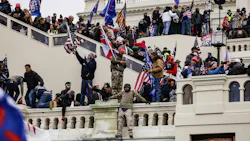
WASHINGTON — Five years after the Jan. 6 attack on the Capitol, a handful of Democratic House members and Capitol Police officers are among those still seeking to use civil lawsuits to hold President Donald Trump accountable for his role in the events.
In the years since those cases were originally filed, the legal and political landscape has changed. The Justice Department brought criminal charges against Trump over the attack, but the Supreme Court gutted the case when it ruled that presidents largely are immune from federal prosecution for official acts.
And Trump’s reelection resulted in the dismissal of the criminal case and a chance to use the power of his office to snuff out the civil lawsuits accusing him of spurring the Jan. 6, 2021, riot.
Ed Caspar, attorney for six of the Capitol Police officers involved in the lawsuits, said the ongoing civil cases “are one of the last ways to hold him to account for Jan. 6” and the effort to overturn a lawful election.
Rep. Pramila Jayapal, D- Wash., said in an interview that “it’s more important than ever we get a resolution to this,” because otherwise it could happen again. Jayapal pointed out that the impeachment effort in 2021 fell short in the Senate, and the criminal case disappeared with Trump’s reelection.
“That’s what troubles me the most, is that we’ve sort of not held him accountable yet and said you can’t interfere in an election,” Jayapal said. “We got lucky this time. And lucky is a strange word, because we all went through a lot. People died, law enforcement was attacked.”
But both the judge overseeing the cases and experts said there could be a long road ahead.
The lawsuits now face a critical test before Judge Amit Mehta of the U.S. District Court for the District of Columbia, who is set to decide just how much a president can do without anyone being allowed to sue him.
As the cases proceeded in 2023, both Mehta and the U.S. Court of Appeals for the D.C. Circuit had said that Trump could be sued for his speech ahead of the attack and other efforts he took as an “office seeker.”
The Supreme Court had already decided in the 1997 decision of Clinton v. Jones that presidents can face civil lawsuits for their activities outside of office.
But after the Supreme Court’s 2024 decision on presidential immunity in the criminal cases, the D.C. Circuit asked Mehta to weigh in on the civil lawsuits again with that high court ruling in mind.
Samuel Issacharoff, a constitutional law professor at New York University, said the combination of the precedents, as well as Trump’s actions on Jan. 6, will be difficult to untangle.
“The difficulty with Jan. 6 was that it was partially a political rally, partially him speaking at various times, acting from the White House, and partially just a matter of personal interpretation,” Issacharoff said. “So it’s hard to blend. It’s not something that we’ve seen before in the case law.”
Those issues came up repeatedly in a December hearing, where Mehta heard arguments from attorneys for Trump, the Justice Department, the lawmakers and the Capitol Police officers over whether Trump is immune from the lawsuit as well as whether the DOJ can defend him.
Former Rep. Barbara Lee, D- Calif., now the mayor of Oakland, attended the hearing. The lawmaker lawsuit still includes Lee, as well as Democratic Reps. Hank Johnson of Georgia, Jerrold Nadler of New York, Maxine Waters of California, Jayapal, Steve Cohen of Tennessee and Veronica Escobar of Texas. Several members dropped out of the lawsuit over the years, including former Rep. Karen Bass, now mayor of Los Angeles, who dropped out in December.
Trump lawsuits
Mehta, the plaintiffs and the DOJ focused during the December hearing on Trump’s speech at the Ellipse, south of the White House, before the attack.
Joseph Sellers, attorney for the lawmakers, argued that Trump’s speech and other actions that day should fall outside the Supreme Court’s definition of official presidential conduct. Sellers said Trump’s efforts that day were more the conduct of an office seeker, not acting as president.
Sellers argued that Trump made the comments at the speech “clearly with the intent of having the effect they ended up having.”
Joshua Halpern, representing Trump, said during the hearing that the Supreme Court meant to leave only a “vanishingly small” amount of presidential conduct open to lawsuits.
Trump’s attorneys have argued that Trump was speaking on the presidential “bully pulpit” on public affairs, taking care that the laws were properly executed or making recommendations to Congress about laws to pass. Any one of those justifications, they said, could sink the lawsuit.
Halpern called the issue of the speech the “linchpin” of the case. If Trump’s speech at the Ellipse is considered immune, the whole case could fall away.
The Supreme Court intended the criminal immunity decision to give a president broad powers to address the public and Congress, Halpern said, not worry about facing lawsuits for his actions.
“The entire point of immunity is to give the president clarity to speak in the moment as the commander in chief,” Halpern said.
At the pivotal rally, Trump allies spent several hours exhorting the crowd to fight and urge Congress to overturn the results of the 2020 election. Trump had in the prior two months refused to concede the election, attempted to enlist the Justice Department to sow doubt about election results and spread unfounded claims of electoral fraud.
Trump spoke for more than an hour before the electoral certification process began in Congress, urging his supporters to “fight” to overturn the election. At one point in the speech, he told his supporters that “you are allowed to go by very different rules,” and he told them, “I know that everyone here will soon be marching over to the Capitol building to peacefully and patriotically make your voices heard.”
Thousands of Trump supporters descended on the Capitol, documented in a report by the now-disbanded House select committee that investigated the attack as well as the more than 1,000 criminal cases brought by the Justice Department during the Biden administration.
During the chaos, Trump posted on social media that Vice President Mike Pence, who was evacuated from the Senate chamber, “didn’t have the courage” to reject the Electoral College votes from states Trump lost.
Hours after the attackers breached the Capitol and interrupted the peaceful transfer of power for the first time in the nation’s history, Trump posted on social media for his supporters to leave the Capitol. Then he posted asking his supporters to leave and remember the day.
“These are the things and events that happen when a sacred landslide election victory is so unceremoniously & viciously stripped away from great patriots who have been badly & unfairly treated for so long,” Trump posted.
Trump’s attorneys
Tying in with the immunity argument, the DOJ has also sought to officially defend Trump from the lawsuits, arguing that Trump had acted in his official capacity. During the December hearing, Justice Department attorney Brett Shumate said Trump’s speech at the Ellipse fell within his duties as president.
“On Jan. 6, President Trump was doing the kind of things presidents normally do,” Shumate said.
Shumate said Trump’s speech was “at least partially motivated” by the interests of the United States.
The Trump administration has also tried to delay the case procedurally, including seeking a delay in the December hearing. The administration has also refused to produce any documents from the National Archives from Trump’s first term in response to a subpoena and said at a December hearing that Trump would assert executive privilege over some documents.
Separate from getting the Justice Department on Trump’s side, Issacharoff said the courts are generally open to delays on behalf of a sitting president. After the Supreme Court’s decision allowing President Bill Clinton to face a civil lawsuit in 1997, it still took until after the end of his second term to fully resolve.
“In reality, it means that they can sue, they can go forward with putting their suit on the books, and that in all likelihood, it will be postponed until the end of President Trump’s stay in office,” Issacharoff said.
At one point during the December arguments, Mehta raised the possibility of preemptively asking the appeals court to weigh in on the issue. That maneuver could take months.
___
©2026 CQ-Roll Call, Inc., All Rights Reserved. Visit cqrollcall.com. Distributed by Tribune Content Agency, LLC.