Art as an Outlet: Museum Exhibit Highlights Officers' Creative Side
What to Know
- The 'Officers as Artists' exhibit features diverse mediums including painting, photography, sculpture, and mosaics created by law enforcement officers.
- Personal stories reveal how art has helped officers process trauma, honor colleagues, and reconnect with their passions outside of policing.
- The exhibit underscores the role of creative outlets in promoting officer mental health and resilience.
More on OFFICER.com
Download the November/December issue of OFFICER Magazine.
Click Here to subscribe to OFFICER Magazine.
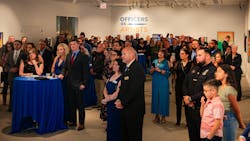
Officer Safety and Wellness has been a large part of the National Law Enforcement Officers Memorial Fund’s focus over the years, through Destination Zero, educational series and awards programs. That mission put a creative spin on raising awareness for officer mental health and wellness when the National Law Enforcement Museum staged its first-ever art exhibition.
The exhibition titled “Officers as Artists: The Creative Expression of Those Who Serve” ran from September 2024 to August 2025 and featured artwork by 50 active and retired officers across a variety of mediums, including painting, photography, sculpture and mosaic.
OFFICER Magazine spoke to four artists who had their works selected to exhibit about how they first found art and the role that it has played in their lives, before, during and after their roles as law enforcement officers.
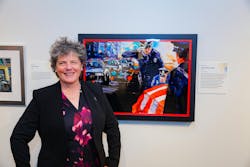
Lisa Flahive
Lisa Flahive’s college degree was in Studio Art – Painting, but she soon gave up art to follow in the footsteps of her big brother, Scott, who was a police officer in her hometown of Grand Haven, MI. She was a month away from graduating from the police academy for the Las Vegas Metropolitan Police Department when Scott was shot and killed in the line of duty on Dec. 13, 1994, while attempting to apprehend two inmates who had escaped from jail.
“It was not an easy decision, but I did choose to continue on in law enforcement. Of course, Scott’s death changed everything about my career. After spending just over seven years on patrol, I was assigned full-time to the Peer Support Team,” she says. “That was the most rewarding part of my career. Not only responding to help immediately after the critical incidents, but trying to prepare officers mentally before they became involved in a shooting or traumatic event.”
Flahive would leave that unit and spend two years as a Terminal Agency Coordinator (TAC) at the police academy. “While there, I found out my ankle needed to be fused and I wouldn’t be able to run again,” she says. “I finished out my career back in peer support, helping officers who had career-changing injuries. I retired in 2013 and moved back to my home state of Michigan.”
Unlike some of the other artists in the exhibit, she didn’t practice her art often during her law enforcement career. “I didn’t do much painting until I was nearing retirement, with the expectation that I’d go back to painting landscapes. But instead, a local jazz musician brought me onto the bandstand to paint while he played,” she says. “What followed was a whole new change of direction of focusing on humans and emotional content.”
The piece selected for the exhibit is titled “Duty Honor Courage,” which shows three officers surrounding a flag-draped coffin; in honor of her fallen brother. “There are so many people affected by a line of duty death. Here, I wanted to focus on the co-workers who, despite their best efforts, suddenly see their friend killed right in front of them. I wanted to capture the pain, disbelief and co-workers searching for meaning by honoring that sacrifice.”
While she set out to try to express and validate the emotions that officers experience, she says she is the one who ended up experiencing healing, both from traumas she had experienced firsthand and from walking alongside others who had endured their own trauma. “I hope my art helps other officers feel understood. I also hope that it inspires others to take their own creative path, whether that be drawing, woodworking or whatever so that they can have life and joy outside of this career.”
Flahive says that being a part of the National Law Enforcement Museum’s exhibit was extra special to her because her brother’s name is carved on the walls of the memorial. “When I go to the museum, I feel the weight of the sacrifice that those officers made. I feel for their families and I feel so proud of the men and women who feel led to put on that uniform and serve today. I’m ever aware that I can create my art because of the protection these officers provide,” she says. “My favorite part of this exhibit was that it opened on my brother’s birthday, and I was able to take my mom to D.C. to be there for it. I hope that Scott and I both made mom so proud.”
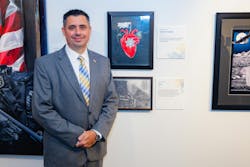
Bryan Cottrell
After spending 25 years at the Mercer County Prosecutor’s Office in New Jersey, Bryan Cottrell retired last year as deputy chief of detectives and now works for Temple University’s Department of Public Safety. While settling into his new role, he learned that his pencil sketch of a black and white photo he took in a college photography class, titled “Honor,” was selected for the exhibit.
During his career, he says that he practiced some art, but mainly focused on photography because it was more practical. “Between my job and family — I have two kids — the time involved in actually drawing and taking the time to do artwork is limited,” he says. “I used to do a lot with charcoal or pencil and I would doodle a lot and draw. but again, because of the time involved in actually doing a larger project, I transitioned more to photography.”
The sketch he submitted is based on a photograph he took in college in the late 90s. The drawing was done a little over a year ago. “They were doing a call for artists and I was getting close to my retirement and had some time off before it was due to finish up the drawing and submitted it,” he says. “I was even able to add in my retired badge.”
He heard about the submission process for the program through social media. “When I saw the ‘Call for Artists’ post I started looking into it. Not in a million years did I think I would be selected. I’ve always had some talent, but I didn’t think I was going to be one of 50, so that was very humbling, and I’m honored to have been selected for it.”
Cottrell attended the opening of the exhibit on Sept. 27, 2024, and says that it was a powerful experience. “When I go to D.C., I’ve always stopped at the memorial. I would go and reflect and pay my respects. It’s hollowed ground for law enforcement and it’s always been part of me when I go down there,” he says. “I was amazed by the talent that was represented. Some of the artwork was just unbelievable.”
He spoke about using art as an outlet to cope with the stress of law enforcement. “I had always been doing it without knowing it. It was my craft, it was my talent, it was my outlet,” he says. “I don’t think anyone that I worked with knew that I was into art. I didn’t talk about it. It wasn’t that I was embarrassed about it. It was for me. It was my outlet, and I kept it to myself,” he says. “Now looking back, that probably wasn’t such a good thing. I think I probably should have shared that with other people.”
After taking part in the exhibit, Cottrell says he can see the benefits of art for other officers, especially officers who may not think they’re that talented. “It’s a great opportunity for officers to really do something different or try something different that that kind of takes you away from the moment,” he says. “You’re not really thinking about anything else, all you’re thinking about at that time, is whatever you’re working on. My mind almost drifts away when I’m working on a sketch or a drawing.”
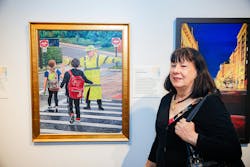
Shannon Cockett
“I wanted to be an artist, but my dad told me, ‘You’ll starve, you can’t do that,’ ” says Shannon Cockett, a graduate of Harvard who had a 26-year career with the Metropolitan Police Department in Washington, D.C.
She moved to D.C. after college to work on a U.S. Senator’s staff. She lived on Barracks Row on Capitol Hill and became a three-time victim of crime. “I had my pocketbook snatched and then my apartment was burglarized,” she says. “And then one night my roommate and I were coming back from dinner and a game of Scrabble when we were held up at gunpoint.” She says that was the event that made her decide to pursue a career in law enforcement. “I was really disappointed with the response of the police officers. They made it seem as though it was our fault that we got robbed. I just thought to myself, ‘I could do this job and I could do something.’ ”
Cockett says she had intentions of going to graduate school to earn her master’s degree. She had already been accepted, but she put that decision on hold to join the police department. “At the time I joined in December of 1981, there were people like Donald Graham, whose mother, Katherine Graham (publisher of the Washington Post at that time), had him join the police department just so he would learn the city better,” she says. “So I thought, well, this won’t hurt me and it’ll be good in terms of still going back to journalism. And then I got into it and decided that I liked it. It was very challenging.”
She says that the demands of a job in law enforcement did not leave her with any time to practice art. She also was the single mother of a disabled child. She was a homicide lieutenant in the early 90s when D.C. was the murder capital of the nation. “The reason I went to homicide is because I was a lieutenant at the Third District in Adams Morgan, and one of the last arrests I made, an officer and I encountered this man with a gun, but we were too close to him to even draw our service pistols. We ended up wrestling the gun out of his hand. I remember getting in my cruiser and thinking, ‘That is just really not very smart of me as a single parent to be taking those kind of risks.’ I thought if I go to homicide, the shooting’s all over. That’ll actually be safer.”
Cockett served as a lieutenant in the department’s Homicide Branch on the day a gunman opened fire inside D.C. police headquarters on Nov. 22, 1994, killing Special Agent Martha Dixon, Special Agent Michael John Miller and Metropolitan Police Sgt. Henry “Hank” Daly.
After retiring in 2007, Cockett began painting again. The next year she started taking classes. “I first started taking studio art classes at the Smithsonian Institution, and then I took classes all over.”
She took courses at Montgomery College and the Yellow Barn in Maryland, as well as a six-week workshop at the Florence Academy of Art in Italy. She also completed the 3-year Master Artist Program (MAP) taught by artist Glen Kessler through the Compass Atelier art school in Maryland in March of 2023. She spend much of her time now painting and attending art shows.
Her painting “Crossing to School,” which shows a female crossing guard in Takoma Park, MD, helping kids cross the street, was selected as part of the exhibit.
“I can’t make a living at it, but I certainly enjoy it,” she says. “I do between 9 to 10 shows a year.” For her, art is a welcomed distraction that has helped her cope with trama from her time as a law enforcement officer. “Everybody I know who served in a homicide unit, it’s like we walk around with a certain amount of PTSD. It’s just like veterans who’ve served in war in that I can walk or drive past a block and say, ‘Oh, I handled a triple homicide there.’ They were bad scenes where people were getting shot and you have blood splatters all over. I can’t tell you how many scenes that I saw where people had been shot in the head. This was two or three times a night.”
She says that in a way, painting helps her feel more normal. “Having that kind of appreciation of beauty and to be able to create beautiful things kind of counteracts all the bad stuff that you’ve stored in your brain. I think it counterbalances the traumatic events.”
Cockett says that her career has given her respect for how hard people work to achieve things in their lives and overcome obstacles. “I have great respect for the men and women who serve in law enforcement because they’re so underappreciated and so taken for granted. And yet, day in and day out, firefighters, paramedics and police officers deal with people who are having really bad days.”
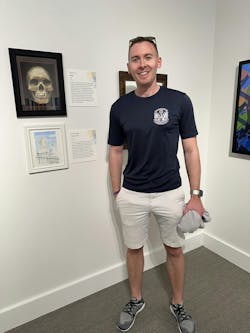
Winston Pingeon
A graduate of American University in Washington, D.C., Winston Pingeon joined the U.S. Capitol Police Department right out of college in 2016. After completing the police academy, he started painting the U.S. Capitol using watercolors. At the time of the interview, Pingeon said that he had painted the U.S. Capitol more than 30 times. “It sort of just became my muse in the sense of wanting to explore it in different ways and sort of tell my story,” he says. “It’s such a beautiful building, there’s just so much to it. It’s difficult from a technical perspective to get it accurate, but really, every time I would paint it, I would just notice something different about the building and appreciate it in a different way.”
While he has painted numerous other buildings and monuments in Washington, D.C., he says that no other building is as important or as special to him because of his time there as an officer.
As a child and teen, he had a love of the arts, but took a break while he was in college. “When I joined the U.S. Capitol Police Department, especially once I’d graduated from the academy and was in field training, I had some extra time,” he says. “I went from college where I was working in the restaurant business to waiting tables. I was doing group projects, in school full time and working. I went from working close to 70 hours a week to just 40 before I was able to work overtime because you couldn’t while in field training.”
He had extra time on his hands, especially when he was assigned to the midnight shift, which was his first assignment for the first nine months or so. “I felt like I was just called back to doing my art,” he says. “Watercolor is an affordable medium to use and doesn’t require a lot of space or equipment, like maybe oil painting or other things. I was able to just kind of go right to it with only buying a few things and my little desk.”
Pingeon says that he had always been inspired by landscapes and the ocean near where he grew up in Massachusetts, along the coastal area. Once he was an officer, the U.S. Capitol building took on more meaning for him. The first time that he painted it was in 2017.
“I was called to it long before as I was taking art classes in middle school and high school, and I had some really good teachers and mentors throughout those years who were able to kind of guide me. It just was something that I always enjoyed and it’s what I’ve continued to do,” he says.
During his time as a U.S. Capitol police officer, his last day in uniform was Oct. 7, 2021, he encountered plenty of traumatic incidents. There was the COVID-19 pandemic, civil unrest during the summer of 2020. But everything changed for him during the attack on the U.S. Capitol building on Jan. 6, 2021. “I’d already kind of started down a path of trying to show the Capitol in different lights, and lean in on using my art as a creative outlet,” he says. “That certainly changed for me after January 6, where I was violently assaulted in the line of duty, defending the Capitol with my riot squad. We just worked so much overtime after that. There were no days off, and 12- to 16-hour days. But finally, a few months after, I was able to get back to some sense of normalcy and just turned to my art, like I had in times before. But this was a different experience, obviously. It was certainly the most difficult day of my law enforcement career. Having my art there to support my attempts at just moving forward and moving through it all was very important,” he says. “Not only in a sort of therapeutic healing way for my mental health, but also a way for me to tell my story and document kind of what I experienced and how I was processing it. One thing just led to another.”
He says that for artists, many times inspiration comes from pain and suffering. “When life’s going great, there’s not so much, there isn’t as much a call to create, but kind of the opposite. It sort of aligns with my artistic viewpoint of trying to see beauty in all places, even mundane or even in really horrible, bad, violent events and places.”
The painting titled “Peace Circle,” that was selected for the incident, was painted in 2021 following the attack. “It’s crucial to have some sort of outlet from the job, from all of the difficulties that the job brings and the trauma that officers see largely on a day-to-day basis: injuries, violence, tragedies, accidents, all of that. Thankfully, a normal person will only experience maybe one or two of those events in their whole life, whereas an officer could experience multiple in a single shift,” he says. “Having an outlet like art, even if it’s just a hobby, but particularly a creative outlet where you are not only losing yourself in that creative flow where the hours fly by like minutes, but then you have something to show for it at the end.”
Buy the Officers as Artists Exhibit Catalog at officer.com/55332911
About the Author
 Paul Peluso
Paul Peluso
Editor
Paul Peluso is the Managing Editor of OFFICER Magazine and has been with the Officer Media Group since 2006. He began as an Associate Editor, writing and editing content for Officer.com. Previously, Paul worked as a reporter for several newspapers in the suburbs of Baltimore, MD.