N.H. Officer: Looking Gunman in the Eye a Victory
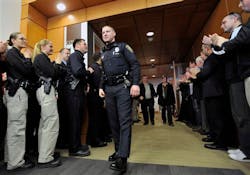
A total of fourteen rounds were fired from Myles Webster's gun.
Manchester Police Officer Daniel Doherty was falling backwards as the first round hit him in the leg.
He could feel the others whiz by him and pieces of pavement fly up as the bullets hit the street.
Myles Webster continued advancing, shooting downward as he stood above the officer.
Doherty -- while lying on his back -- was able reach his firearm and pulled the trigger, sending the gunman fleeing.
Webster continued firing more rounds blindly as he ran away, four of which went through a house next to the officer and missed an occupant's head by inches.
Doherty was shot a total of five times.
That was on March 21, 2012.
Fast-forward to just under a year later, and the 23-year-old Webster is serving 60 years to life behind bars after being convicted in December of the attempted murder of the officer and being sentenced on Jan. 14.
The Trial
From the firing of Webster's gun to the cell doors locking behind him, the justice system worked swiftly.
"It was a very quick process. It was pretty much an open and shut case," Doherty told Officer.com.
Webster was apprehended within minutes of the shooting, just one block from the scene.
"The detectives were able to build a very solid case," he said.
Doherty sat through every single minute of the trial in the front row of the courtroom, joined by members of his family and his girlfriend.
"It was an experience I don't think I would have gotten through as well without them," he said.
"It was presumably the hardest time of my life and I was able to get through it with the support and encouragement from them as well as all of the other officers sitting behind me."
Taking the stand was a challenge for the officer, but he finally found the peace he had sought.
"I was able to look him in the eye again and as soon as I did so, he looked away," he said. "I felt that was a victory for myself and for all of the other officers in this country and worldwide."
The Shooting
Doherty normally worked the midnight shift, but he had swapped shifts and was working 4 p.m. to midnight on March 21.
Around 6:30 p.m., undercover officers were working a controlled drug buy and their attention was brought to an individual who jumped out of a car in the middle of traffic in an intersection.
That individual was Webster.
It appeared that he was in some type of altercation with the occupants of the vehicle and when he exited the vehicle, the undercover officers saw what appeared to be a firearm tucked in his waistband.
They radioed for a uniformed officer to respond as they kept an eye on Webster and gave updates on his location.
Doherty was on the Eastside of the city, while the location of the individual was on Westside.
He headed over a bridge and shortly after his arrival, he spotted the young man in an alleyway.
"I tried to sneak up on him as he was walking," Doherty said. "I lost sight of him for a moment in between two yards."
He exited his cruiser and was able to make visual contact with the subject without being seen.
"Police. Show me your hands," Doherty shouted.
Webster then took off running through yards and alleyways, and the pursuit continued on foot for about a mile.
Doherty was able to make significant gains on the man and was about five feet from him as they approached a corner.
As Doherty prepared to tackle Webster, he spun around and pulled a handgun out of his waistband.
"As he was doing that, he was able to rack it and at this point there was some vehicles to my right so I tried to put the brakes on to stop myself to get behind these cars," he said. "But based on my momentum and speed, my feet slid out from beneath me."
After the exchange of gunfire occurred and Webster had left the scene, Doherty laid there for about one to two minutes until the undercover officers were able to find him.
They applied a tourniquet to his leg and located the other bullet wounds -- five in total -- on his body.
Doctors later said that if the officers didn't render aid and apply the tourniquet when they did, Doherty wouldn't have made the ride to the hospital -- which was only two blocks away.
The Recovery
For the first three days, Doherty was in a medically induced coma.
When he first woke up, he was on a breathing machine and wasn't sure if he still had his leg or not, wasn't sure what the extent of the injuries were and couldn't stay awake long enough to hear what had happened.
As the days went on, he started to stay awake longer and heard the details of the incident.
"The recovery was an extremely hard task," he said.
Doherty was in the hospital for just under a month undergoing extensive rehab, which is still ongoing today.
His tibia bone was replaced by a titanium rod and learning how to walk again took some time.
"It's a very uplifting experience to go from not being able to walk to walking on my own power, barely with a limp," he said.
He just started to run, something he calls a "very big feat."
When asked when he hopes to return to duty, there was little hesitation:
"The sooner the better. Hopefully in the next 30 to 60 days I'll be back out there."
The Importance of Training
Doherty credits his survival to the instincts ingrained in him through training.
"I don't even remember going for my gun. It was just in my hand," he said. "Muscle memory is a real thing because I didn't have to think about it. It just happened."
A lot of his superior officers have said that if Doherty didn't fire back as Webster was advancing on him, the gunman would have eventually had the kill shot.
"Me shooting back scared him off," he said. "One of those 14 rounds was meant for my head."
It was later discovered that one of Webster's bullets hit the barrel of Doherty's gun.
"That bullet was meant for my face."
When reliving what occurred that day, he invoked the phrase "fight or flight."
"I could have very easily laid there and not fought back because of the pain. But because of the training I was able to," he said.
"Training is a very essential part to this job and sometimes we all look at each other and ask 'I don't understand this piece of training or I don't believe this is important,' but I have a new outlook on it.
"Train as though it's real."
About the Author
Paul Peluso
Editor
Paul Peluso is the Managing Editor of OFFICER Magazine and has been with the Officer Media Group since 2006. He began as an Associate Editor, writing and editing content for Officer.com. Previously, Paul worked as a reporter for several newspapers in the suburbs of Baltimore, MD.