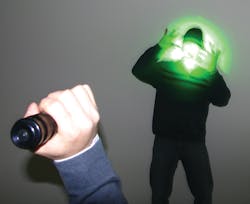
The use of lasers is very common; they serve as valuable tools in many aspects of our lives. Lasers come in a variety of forms and are used by doctors to correct our vision, to scan bar codes on the things we purchase, or to create brilliant light shows at amusement parks. Instructors use them to teach astronomy or highlight their presentations; construction workers use them to cast a perfectly straight line, police use them to pinpoint vehicles with radar, and we enjoy teasing our cats and dogs as they playfully chase that elusive red dot.
Most of us are accustomed to the small novelty key chain laser sold for a few dollars. This common laser emits an insignificant 5mW power beam. Very few of us know that in recent years handheld lasers have become much more powerful, smaller, and are substantially more affordable. The popular lasers are now sold with red, green, and blue colored beams with red touted as the hottest and green as the brightest. Numerous companies in China are selling the most powerful handheld lasers in the world. These lasers can be ordered through Internet sites with a powerful 1,000mW (one watt) power beam. One watt may not sound like much, but lasers over 500mW are Class 4, meaning they are hazards to eyes and skin. These lasers can light matches, pop balloons, and cast a beam that can efficiently paint an object from many miles away. While these lasers are fun and aesthetically cool, in the wrong hands they can also be extremely dangerous.
Such powerful lasers were not a problem in the past because they were manufactured in the form of a bulky electronic box and relied on a fixed power outlet to operate. They were also unaffordable, costing thousands of dollars, and their marketing to would-be customers was primarily directed toward commercial or scientific customers. The lasers being manufactured today are sleek, handheld, and the most popular lasers are designed with features similar to the famous Star Wars light saber. The lasers powered by rechargeable lithium batteries and are now being sold for under $300.00; they are in great demand and some manufacturers are finding it difficult to keep up with the onslaught of orders.
Safety issues for law enforcement
It is currently lawful to possess a handheld 1,000mW laser. Although the Food and Drug Administration regulates lasers, there are no current restrictions for purchase or possession, and there are no age limitations. The two primary safety issues with lasers stem from their power and their seemingly unlimited range. Because of this and the increasing market saturation, attacks on commercial aircraft and police helicopters have increased exponentially in recent years.
Directing a powerful laser into the cockpit of any type of aircraft can temporarily blind the pilot even from many miles away. This exposure is similar to having a camera flash go off directly in your eyes. Such exposure also adversely affects vision for a minimum of several minutes after the exposure has ended. In laser-speak, this is referred to as, “afterimages”. A laser attack on aircrafts is a Federal felony and can carry a maximum prison sentence of twenty years and a $250,000.00 fine. The FAA created a formal reporting system in 2005. Reported “laserings” increased from nearly 300 in 2005 to 1,527 in 2009 and 2,836 in 2010. Despite such a harsh penalty, laser attacks on aircraft are ever increasing.
Lt. Mike Higashi (Ret.) serves as a police helicopter observer for a southern California agency. On three separate occasions, Mike and his pilot were “blasted” by a bright green laser while flying on patrol. He said it’s like being in a dark room and having a Streamlight flashed in your eyes. Such attacks force pilots to look away and it takes time for the pilot’s eyes to readjust to the dark, which is extremely hazardous. Mike adds that even worse is when the laser hits the Plexiglas of the helicopter, it refracts in all directions flooding the cockpit with potentially blinding light.
As more and more powerful lasers are sold, it may be only a matter of time before the use of these lasers becomes a serious problem in everyday policing. With a 1,000mW laser, an arsonist could pull over to the side of the road and use the laser to ignite dry brush, causing a fire and there would be no evidence—propellant or matches—indicating how the ignition started. Drivers on the freeway could easily be blinded from a suspect sitting atop a hill a mile away. Hitting the target is not difficult either. A 200mW laser at five feet casts a dot about the size of a pencil eraser. At just 400 feet, the laser dot is the size of a pizza. While testing a 500mW laser, the beam covered the entire front hood and cab of a police car from more than half a mile away (3,168 feet) and continued on through the back window for several blocks until a row of trees stopped it.
A suspect entering a business to conduct a robbery could have a partner render the surveillance camera useless by simply aiming the laser into the lens, thus producing a video recording depicting only a splash of bright light. Perhaps the most serious example might involve police confronting a high-risk car stop or armed encounter. If a suspect or layoff accomplice leveled the beam of a powerful laser into the officer’s eyes, the officer’s sight would be immediately compromised and the suspect would have a distinct and potentially lethal advantage. Just brief, but direct contact with a powerful laser may cause serious and lasting retinal damage. During a vehicle pursuit, a suspect’s passenger could easily force the pursing officer to back off or terminate the pursuit to avoid being blinded. High output lasers can also be commercially mounted to rifles, providing them with pinpoint accuracy at greater distances.
Tactics
The best defense an officer can deploy against powerful lasers is by knowing that they exist in the first place and not to be caught completely off-guard if confronted with one. There is no doubt officers would react immediately if a laser dot was seen on their person, as low power lasers are common attachments for firearms. Defense against high-watt lasers is simple and calls for the immediate protection or blocking of the officer’s eyes, the effective use of cover and concealment, and using multiple officers to locate and confront the suspect.
One huge advantage for police is that high-watt lasers beams are visible from the laser to the point of contact, especially at night when lasers are most often used. This allows officers to know exactly where the suspect is while the laser is in use. Those who have attacked aircraft with lasers and have been arrested were caught because of their continued or repeated operation of the laser allowed ground units to follow the beam to the source.
Possible benefits to law enforcement
With a little calculated speculation, it is easy to forecast how potentially dangerous these high-powered lasers might be if intentionally used against officers or others. Examining the obvious potential threats and abundant criminal uses is the first step to preplanning and ensuring a successful outcome.
Despite the negative aspects, big lasers may have benefits for law enforcement and also serve as a tactical part of our standard equipment. Using the same speculation to determine possible dangers, a number of possible uses and benefits should be considered. Throughout the country, many jurisdictions field officers in vast rural patrol areas where backup may be many miles away. If an officer was hurt and without radio contact, or found himself or herself in an area that had no roads, a high-powered laser may allow searching officers or airships to easily locate him. Some of the high-end lasers are equipped with a strobe and Morris code that flashes the distress signal, “SOS”. Aggressive dogs commonly confront officers serving arrest or search warrants. Even the most vicious dogs might be driven back, even at great distance, when brilliant flashes of light confuse and minimize the dog’s ability to see its target.
When police helicopters are assisting officers with foot pursuits or suspects who are hiding within a perimeter, the airship utilizes a powerful spot light and Forward-looking Infrared (FLIR) also known as thermal imaging. Commonly, officers are verbally led by the airship to the suspect via the radio, as the helicopter crew maintains the suspect’s image on the FLIR system. When suspects are in rural areas or in the middle of track housing, the airship must rely on landmarks to direct officers, “Go to the rear yard of the two-story house”…“Turn left”… “He jumped over the south fence”. As officers are following directions, they are also following the airship’s powerful light. When the officers get close to where the suspect is hiding, the airship’s light often also illuminates the officers as they close in.
With the use of even a lower watt laser (100mW to 300mW), the airship could turn their spotlight off, monitor the suspect on FLIR, and place the laser spot right on the suspect while officers simply follow the beam directly to the suspect’s hiding place and all without illuminating the officers or relying on radio traffic that suspects might overhear.
Lasers are also used very effectively to trace bullet trajectories and are used by the military and tactical units to detect trip wires. They are also used to guide rescue Medevac helicopters and can be deployed to maintain a very sophisticated security perimeter.
There is already a commercially manufactured laser designed specifically for law enforcement called the Dazer Laser manufactured by Laser Energetics This is a powerful and highly effective laser designed in the form of a firearm (The Defender) or a small flashlight (The Guardian). The Defender model boasts a 500mW-powered laser with an effective range of 2,400 meters, which is well over one mile, and a maximum range of 4,000 meters for hailing and warning. The Dazer Laser is uniquely designed not to damage or injure the eyes of a violator and is effective both day and night. The effects of the Dazer Laser instantly eliminate the violator’s ability to see the officers forcing him/her to close or shield their eyes or turn away giving the officer a substantial tactical advantage. Attempting to ignore the effects of the laser causes the violator to become “dazed” or experience a sense of imbalance or disorientation.
The most powerful handheld lasers
“May I quote its website? Don't let the Arctic name fool you, this laser possesses the most burning capabilities of any portable laser in existence. That's why it's also the most dangerous laser ever created.”
Chris Matyszczyk, CNET News, June 18, 2010
In 2007, the Guinness Book of World Records recognized a laser that was shown to be the most powerful handheld laser in the world. A China-based company called Wicked Lasers manufactures a sophisticated and powerful 1,000mW laser called the Arctic Series Laser (mentioned in the quote above). While the Arctic laser is more cool than practical, the company is finding it difficult to keep up with the huge demand for their product. The laser is impeccably engineered and has a long list of functions and high-tech safety features.
Since then, the company has upgraded to the Krypton Series, publicizing it as the brightest handheld laser in the world. According to the company, this laser has the power to reach a target over eighty-five miles away. Keep in mind; the Earth’s atmosphere ends at about sixty-two miles and the company warns that the laser could be potentially hazardous to satellites. Wicked Laser reports the Krypton’s brightness measures in at about 86 million lux. Direct sunlight cast between 32,000 and 130,000 lux. This means that even on the brightest of days (130,000 lux), looking at the dot of the Krypton Laser would appear to be about 661 times brighter than staring directly at the sun.
Why the lasers are made so powerful and why they are not strictly regulated will undoubtedly become growing concerns in the near future. As they become increasingly more popular and incidents, injuries, and crimes occur, this will certainly be an important law enforcement issue. Like firearms; however, the deciding factor of whether a laser is good or bad depends on who is holding it. These powerful lasers are the ultimate gadget, but can also be the ultimate weapon and the law enforcement community must pay close attention to their increasing existence.
About the Author
Andrew Borrello
Andy Borrello is a Lieutenant and 23-year veteran with the San Gabriel (CA) Police Department. He welcomes comments and can be reached at [email protected].