Stay Cool in the Heat of the Chase
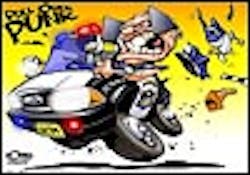
Quick--answer this question in 25 words or less. How dangerous is pursuit?
Chasing and catching bad guys is what we do. It's what we've always done. Marshall Dillon and Roy Rogers and Wyatt Earp and Hopalong Cassidy and Deputy Dawg all did it on horseback. Reed and Malloy, Lieutenant Dan Matthews, Ponch and John, and Toody and Muldoon all did it in cars. Heck, Sky King even did it in an airplane. Both mythically and in reality, police pursuit has long been a part of law enforcement.
In our lighter moments, or amongst ourselves over backyard barbeque, or at choir practice, we sometimes whimsically cast the idea of chasing and catching bad guys as part of the fun of police work. Viewed from its most positive perspective, locking up people that hurt other people is gratifying, and the fact that we get to drive fast in doing it is an added bonus.
However, the reality of police pursuit is a much more serious matter, as any officer will tell you once they get done kidding around. When viewed as a "pursuit" rather than a "chase," going after suspects and criminals takes on a whole different aura. It can be dangerous, since we don't know why the bad guy is fleeing. Driving at high speed can, in fact, be exhilarating. It's also more dangerous for the officers involved, and potentially hazardous for other motorists that share the highway.
Over the last 20 years, there has been a trend developing in law enforcement that places more and more limitations on police pursuit. The rising costs of litigation, accompanied by fear of lawsuits and the attendant bad publicity, have caused many agencies to enact policies geared toward severely curtailing or eliminating pursuit, except in cases involving the most serious crimes. Along with this concern for civil liability that seems to permeate everything we do nowadays, there is a growing awareness that pursuit, and motor vehicles in general, present safety hazards for officers. In fact, as many or more officers are killed in vehicular incidents each year as are killed in felonious assaults. Common sense tells us that a far greater number are injured.
Exactly how many? Nobody knows for sure. Based on your knowledge of the job, you know it has to be a lot.
The Human Factor
Because of this growing concern for liability, as well as concern for officer safety, there is clearly a need for more training in the area of emergency vehicle operations. No matter how much training we have had in this area (and some of us have had precious little) it's never enough.
What training we get tends to center on a classroom recap of the law and policy, and perhaps a discussion of vehicle dynamics. Then we move to the driving range, if we're lucky, for a little defensive driving. We practice threshold braking and evasive steering, cornering and skid control, and maybe some backing and close quarters maneuvering.
All of this is good training, and we need it. What often gets left out, however, is the most critical element of all--how to deal with the emotional aspect of a pursuit.
Every one of us has experienced a phenomenon commonly known as body alarm response. You probably think of this as your "fight or flight" response. This is your normal reaction to a perceived threat, that moment when your situational awareness begins to shift into hyper-drive, and you start to go into survival mode.
We've all been there. Body alarm response manifests itself in many ways, differently for each of us, and often differently based upon the situation. Common reactions are tension, sweating, shallow rapid breathing, quickened pulse, perceptual narrowing, a feeling of anxiety, and the list goes on. There are many physiological and psychological elements to this normal, natural reaction to danger.
Most of us have learned to manage this effect to some degree, some more successfully than others. Every officer knows someone that is remarkably cool under pressure, and someone that just can't seem to hold themselves together. Generally we admire the former, and pity the latter. The fact is that we all have elements of each type--some of us just react differently.
Pursuit Fixation
When body alarm response kicks in during a vehicle pursuit, we fall into a condition known as "pursuit fixation." We suffer all the typical responses to body alarm stress, within the context of an intense, focused mission. We are after the fleeing bad guy and our mission in life becomes his apprehension. We are focused on our goal--to catch him!
There are a couple of common by-products of this situation. First, it's not uncommon for officers in these circumstances to get angry. There are lots of theories as to why this happens, and my friends in the police psychology field probably have medical terminology for classifying it, but ,in the most simple terms, I think a lot of officers just get p***ed off that the guy is running. Whether the officer sees it as a challenge to authority, or is unhappy at having to put himself or herself at risk by driving fast, or maybe just doesn't want to get their freshly washed cruiser muddy, they get angry. Anger colors judgment, and in a police pursuit, we cannot afford to have our judgment impaired by any extraneous emotion.
The second by-product is single-mindedness. That, in and of itself, is not necessarily bad. The problem occurs when that single-mindedness is focused solely on apprehension of the violator. When this occurs, sometimes officers lose sight of their primary mission, which is to preserve public safety. After all, the very reason the officer is trying to stop this suspect is because the bad guy has broken the law. Whether it's a traffic offense or something more serious, the law was most likely put in place to preserve public safety in some regard. The bad guy breaks it, thereby endangering public safety, and the officer tries to apprehend him in order to allow the justice system to control the deviant behavior. The bad guy flees from this effort at control, and the officer gives chase in order to re-assert control.
The very nature of police pursuit is to enhance public safety. In order to pursue, we--by definition--put public safety at risk. It is the job of the officer to balance the need for the apprehension (and therefore the enhanced public safety that will result from apprehension) against the risk to public safety caused by the pursuit itself. Under the stress of the pursuit, in that moment when body alarm response is challenging the officer's ability to rationally and analytically analyze options and select courses of action, he or she cannot afford the luxury of anger.
What can you do about it?
You cannot avoid body alarm response. It's natural and normal. All beings experience it. In fact, you don't want to avoid it--it's what makes you sharp and aware, it provides your sixth sense, your "survival awareness," and your enhanced ability to hit harder, run faster, and scream louder. Body alarm response is a good thing. It's the outward manifestations of body alarm response, and the way that they can interfere with your other abilities, that create the problem. These manifestations can usually be managed, and the more you can learn to control them, the calmer you will be under stress, and the greater will be your ability to think clearly, and to survive.
First of all, and probably the most important thing, is to be aware of the natural nature of body alarm response. Read about it, study it, learn all you can. Such books as An Intimate History of Killing, and Fear: A Cultural History, both by Joanna Bourke; The Gift of Fear, by Gavin De Becker; and Emotional Intelligence by Daniel Goleman, are good places to start.
Talk about it with your trainers and your fellow coppers. This is just a fancier version of the "What If...?" game.
Seek out formal study in fear and anger management. Learn calming techniques. Practice a martial art. Consider taking any of the excellent classes offered by Brian Willis of Winning Mind Training, or others geared toward developing your ability to enhance your mind's control over your physical reactions.
Is there a sure fire way to avoid getting caught up in pursuit fixation, or body alarm response? Not really. But there are steps you can take to enhance your ability to control this perfectly natural reaction to the tension of a high stress encounter. Then, the next time some so-and-so decides to take off on you, you'll be in better shape to safely and effectively run him to ground, and hook him up.
Stay safe, and wear your vest! (and Buckle Up!)