Hot On The Trail of Old, Cold Cases
In the mid-1990s, the Fairfax County (VA) Police Department observed what Detective Sgt. (ret.) David Rivers of the Metro Dade County (FL) Police Department was doing with homicide cases, and discovered he was instrumental in developing a cold case squad to focus on unsolved murders. As the supervisor of the squad, Rivers' unit was responsible for the investigations received on more than 1800 open homicide cases that dated back to 1951. When Fairfax County Police noted Rivers' accomplishments, the department implemented their own cold case squad in 1995.
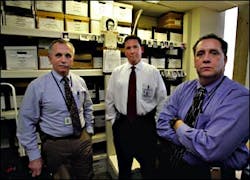
For the first year, the Fairfax County Police Department had to locate and centralize their case files. Initially, the department could not find people who wanted to work in the squad and consequently, it became a training ground for young recruits and inexperienced officers. However, in the year 2000, Detective Robert J. Murphy and Detective Steven Milefsky, two experienced veterans of the department, approached their boss and told him they were both challenged by murder cases and wanted to work on those types of cases. They were granted their wish. These two detectives now comprise the cold case squad, where they have remained for the past 7 years.
Detectives Murphy and Milefsky understand the value of focusing on cold cases and acknowledge their work embraces a sense of law and order, crime victims, and the community. With the advent of a DNA database in Virginia, their ability to effectively work these cases grew exponentially.
Both Murphy and Milefsky recognize the impact their work has on surviving family members. Historically, families said they were not treated well and, in some instances, the family members of victims made valid points. Families assumed they were forgotten. Consequently, survivors had a tendency to harbor hostility and resentment towards the police and, oftentimes, detectives were the objects of their venting process.
With the advent of the cold case squad, Detective Murphy acknowledges," It's pretty rewarding when we go out and meet the families. Nine times out of ten, when we contact the families, we see gratitude." However, Murphy also acknowledges that when he and Detective Milefsky enter the lives of the victims' families, they also reopen emotional wounds. He adds that families desire accountability and need to know the facts of the case to help them process their grief. The detectives are able to apprise the families of the case status of their loved one, keep them updated on any new developments and, in the case of a successful investigative outcome, they can be informed of who committed the crime.
In 1992, a woman in the Fort Hunt area of Fairfax County was murdered. The victim, Marilyn Bandera, was a shop owner and married with two children. Her husband discovered her when he came home for lunch. She had been stabbed 169 times, and there was evidence the victim had fought her attacker. The perpetrator of the crime had apparently cut himself on a knife found at the scene of the crime. The detectives obtained a hit on the DNA, and he was later apprehended.
Detective Murphy worked the case for a long time. He stated, "It was one of those cases that haunted you. The victim was a good person, a good citizen, a mother." The defendant was charged with and pled guilty to capital murder. The victim's husband was not in favor of the death penalty. Respectful of the husband's wishes, the prosecutor agreed to a sentence of life plus 30 years. Summing up his long, involved efforts to solve this crime, Detective Murphy said, "That was a very rewarding case."
Detective Murphy acknowledges one of the biggest cases of his career is one that is ready to go to trial; it involves a young couple, Rachael Raver and Warren Fulton, who were college students at the time of their murder. They went to a bar on a Saturday night and never returned home. Both were shot and killed, and Rachel Raver was raped. A DNA hit pointed to a serial murderer, Alfredo Prieto, who has been on death row in California since 1990.
Detectives Murphy and Milefsky work well together. Though they are different in some ways, they each think about one angle of a case versus another and can ultimately come to the same conclusion. Murphy reveals that for one to be successful in working cold cases, a detective needs "a ton of experience and a slow, methodical, tenacious approach," which is not only valuable for the investigation and resolution of cases but also aids in effectively dealing with the victims' families. Murphy states, "The bottom line is you have to be passionate about what you do and self-motivated. You have to want to do your job for the right reason." He admits the most rewarding aspect of their work is "when we catch the bad guy and put him in jail."
Despite the fact that Detectives Murphy and Milefsky have successfully solved a number of their cold cases, Murphy states, "You have to realize you'll never solve all of them." Though they may be working on four or five cases at the same time, they also recognize that simply because cases are old does not diminish their urgency in attempting to solve them. Moreover, the families of victims are often demanding and frequently contact the detectives to inquire about the status of their cases.
For survivors, the diligent work of these dedicated detectives in the cold case squad offers hope that the victims are not forgotten and the possibility exists for justice to prevail. Families are grateful for their efforts and remember them during the holiday season. Their contributions to public service are being acknowledged on June 28, 2007, when they both will receive the 2007 Public Service Award from the Northern Virginia Chapter of the American Society of Public Administration. The significant impact they have made in their investigation and closure of cold cases coupled with their critical understanding that each victim made a difference in someone's life has not gone unnoticed. Detectives Murphy and Milefsky are making a notable mark in the cold case squad of the Fairfax County Police Department, and they serve as exemplary professional role models worthy of emulation.